Porsche Brake Repair in Dubai
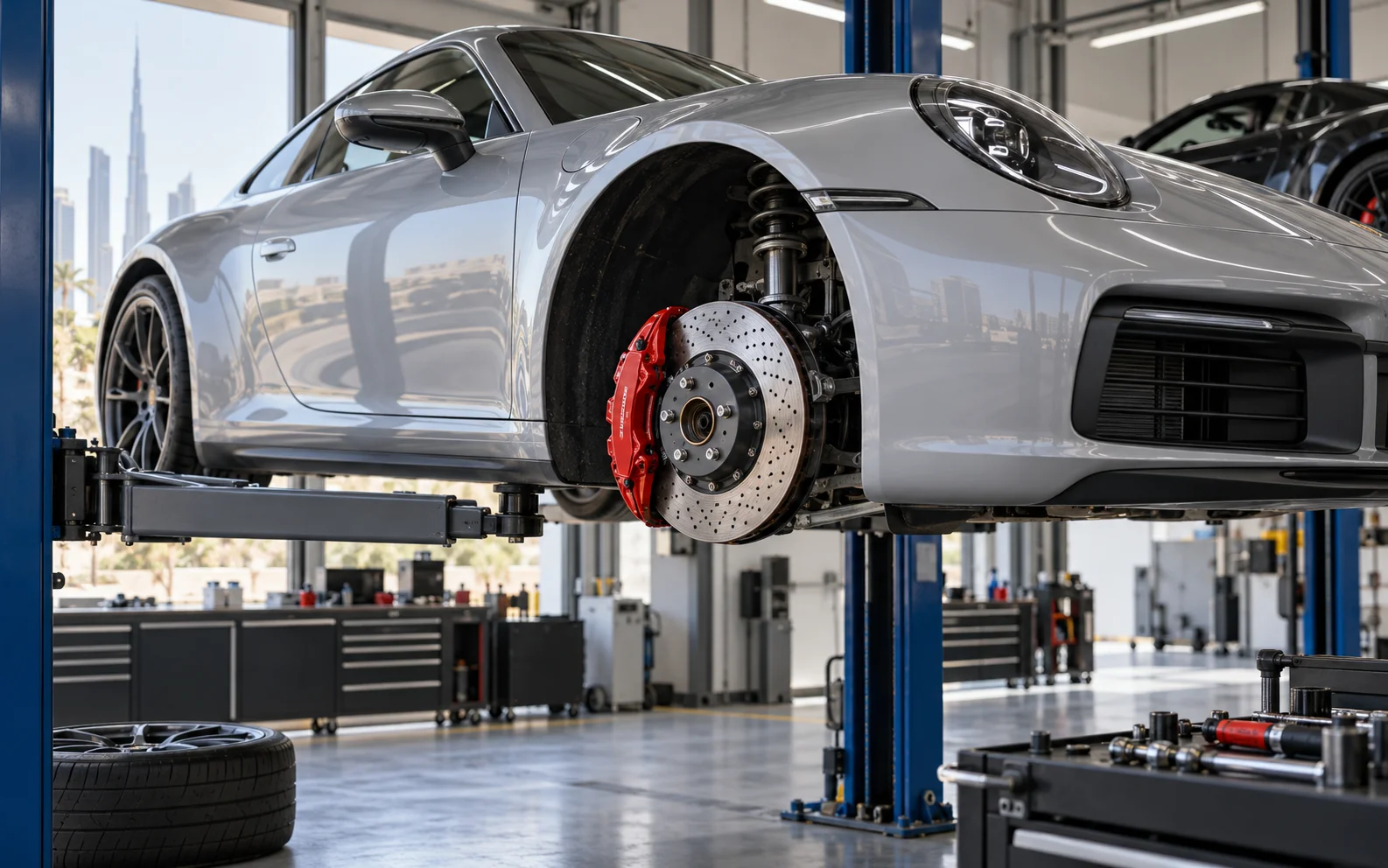
Steel, surface coated and ceramic Porsche brakes wear in different ways and cost very different amounts. We identify your brake system first, measure pads and discs, and quote per axle in writing before any part is changed.
Porsche brake repair price estimates
For suitable standard iron-disc brakes, these planning allowances include a pad set for one axle, normal fitting and 5% VAT. Front and rear are quoted separately after model, year and fitted brake equipment are confirmed.
Three brake job quotation examples
These illustrative budgets explain different scopes. They are not completed customer jobs or fixed offers. Each assumes a suitable standard iron-disc application with serviceable discs. Model year, parts availability and inspection findings can change the price.
Macan rear pads only
Compatible supplier-brand rear pad set with normal fitting. Proceed only if both rear discs and the associated hardware pass assessment.
Planning total for one rear axle. Sensors, extra hardware, discs and diagnosis excluded. Confirm the rear parking-brake procedure and parts before booking.
Cayenne front pads only
Compatible supplier-brand front pad set with normal fitting. A warning or uneven wear requires assessment before the pad-only scope is accepted.
Planning total for one front axle. Sensors, extra hardware, discs and diagnosis excluded. Any additional work needs a revised quotation.
Porsche Genuine pad option
Illustrative Cayenne front-axle quotation using a Porsche Genuine pad set with normal fitting on a confirmed standard iron-disc system.
Planning total for one front axle. Sensors, extra hardware, discs and diagnosis excluded. This is not a PSCB or PCCB package.
Ask for a revised quote naming the pair of discs, matching pads, fittings, labour and VAT. A pad-only example cannot estimate ceramic-disc replacement. Completion time and stock are confirmed for the actual parts.
Identify your Porsche brake system
Porsche brake equipment includes conventional cast-iron discs, often called steel brakes, Porsche Surface Coated Brake or PSCB, and Porsche Ceramic Composite Brake or PCCB. Caliper colour is a strong clue, but painted calipers exist, so we confirm the system from the chassis number and the discs themselves before ordering parts.
| What to check | Steel discs | PSCB coated | PCCB ceramic |
|---|---|---|---|
| Caliper colour | Black, red, silver or other colours by model | White | Yellow |
| Disc material | Cast iron | Cast iron with a tungsten carbide surface coating | Carbon fibre reinforced ceramic |
| Disc look | Grey metal surface | Bright, mirror like surface | Dark, matt surface |
| How wear is judged | Thickness against the minimum marked on the disc | Coating condition and the Porsche limit for the disc | Generation-specific wear assessment and surface condition using the applicable Porsche procedure |
| Pads | Matched to steel discs | Specific pads for the coated disc | Specific pads for ceramic discs |
| Price basis | Planning estimates above for standard iron-disc applications | Quoted for your car | Quoted for your car |
Coated and ceramic discs need their own pads. Fitting pads made for steel discs, or changing one axle to a different system, can upset brake balance. The parts follow what your car was built with, unless a full conversion is planned and quoted. Converting a car to ceramic brakes is a major job with its own parts list, and it is never done as a simple pad change.
Brake notes by Porsche range
Each range has its own pad shapes, disc sizes and options. These are the points we confirm for each one before quoting. Older and classic models are just as welcome, and parts for them are checked for availability before the car is booked in.
- Model and year
- Chassis number
- Caliper colour
- Front, rear or both
Cayenne brake equipment varies by generation and specification. Confirm iron, PSCB or PCCB discs and assess front and rear wear separately before selecting parts.
Popular in Dubai traffic, where stop start driving wears pads quickly. Front and rear pads usually wear at different rates, so we quote each axle separately.
Many cars carry PCCB as an option. Steel disc cars often show a raised lip at the disc edge, which we measure rather than judge by eye.
Large discs and heavy weight make disc condition important. Vibration under braking is checked against disc runout and thickness variation.
Regenerative braking reduces friction-brake use, but does not remove the need for inspection. Check the fitted disc surfaces, hydraulic system and model-specific maintenance requirements, even when pad wear is low.
See the reading and the reason for repair
A useful report records each wheel, the applicable limit and the action recommended. There is no universal pad or disc thickness for every Porsche. The fields below show what to request, not results from a customer vehicle.
Inner and outer pads
- Record in millimetresFront left, front right, rear left and rear right, with inner and outer friction-material readings.
- Compare conditionNote uneven wear, taper, contamination and sensor condition.
- State the decisionRecord the applicable limit, repair recommendation or next inspection plan.
Iron-disc measurements
- Lowest measured thicknessRecord the value in mm alongside the minimum for the fitted disc.
- Runout and variationWhen indicated, record these separately with the test method and limits.
- Retention or replacementConsider both disc faces, damage and the applicable fitting procedure, not thickness alone.
PSCB and PCCB assessment
- Confirm the exact systemIdentify the disc version and matching pads from the actual vehicle equipment.
- Use its own procedureRecord the required coating or ceramic wear assessment and any specialist equipment used.
- Record any limitationA visual check or iron-disc thickness reading alone does not establish PCCB serviceability.
Ask for the measurement record before approving replacement. See the inspection checklist and blank report template. For ceramic and coated discs, our PCCB and steel brakes guide explains what each wear check can prove.
When the discs must change too
Disc replacement follows measured condition and the applicable service procedure. When required, quote a matched pair on the affected axle with the correct pads and fittings.
Below minimum thickness
The minimum is marked on steel discs. Once reached, the disc has to go.
Cracks
Assess crack location, extent and the applicable disc inspection criteria. Damage outside the permitted limits requires replacement.
Vibration and measured faults
Measure disc runout and thickness variation separately. Check hub mounting and other relevant causes before deciding whether discs need replacement.
Deep scoring
Grooves from worn pads or trapped grit stop new pads seating properly.
Heat damage
Assess heat-related surface changes with braking symptoms and the manufacturer criteria. Colour alone is not a complete diagnosis.
Coating or surface worn
On PSCB and PCCB discs, wear is judged against the Porsche limit for that disc.
Which brake service do you need?
Not every brake complaint needs new discs. This comparison shows what each job covers, so you can match it to what the inspection finds.
- New pads on one axle
- Caliper hardware checked as fitted
- Discs measured and kept
- Discs not included
- New pads on one axle
- New discs as a pair
- Hubs cleaned before fitting
- Bedding in advice
- Sensor replaced
- Warning cleared and checked
- Pads not included
- Discs not included
- Fluid replaced and bled
- Specified fluid type
- Pedal feel checked
- Pads and discs not included
Genuine, supplier brand or track pads
On steel disc cars there is a real choice of pad. Each option is shown on your quote with its price, so you decide with the facts in front of you.
- Matched to the car as built
- Expected noise and dust levels
- Check any applicable warranty terms
- Often a higher parts cost
- Made by established brake suppliers
- Lower price per axle
- Good for daily driving
- Feel and dust can differ slightly
- Higher heat tolerance
- Suits regular circuit days
- Noisier and dustier on the road
- Can wear discs faster
The word OEM on a box does not on its own mean the part is identical to the Porsche branded one. We tell you exactly which brand and part we are fitting.
Other brake parts we check
Every brake inspection looks at the full system, because a worn pad is sometimes the result of another fault.
What you notice, and what it usually means
Brake symptoms often point to a cause before the wheel comes off. Use this list to describe what you feel when you call, and we will know what to check first. Any loss of braking power, a pedal that sinks, or a brake fluid warning means the car should not be driven until it is checked.
Inspect, quote, fit, bed in
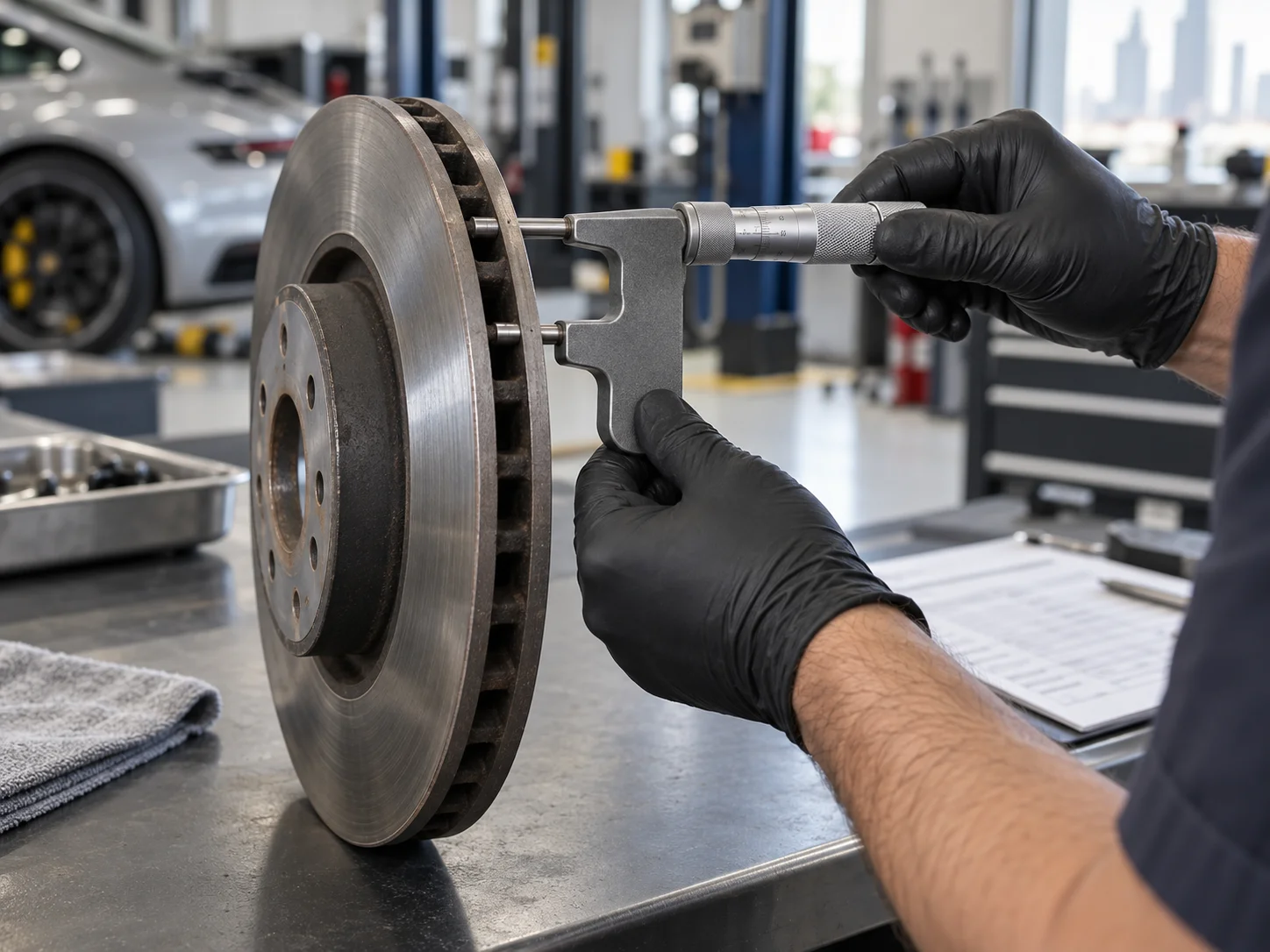
The same six stages apply to every car, from a Macan on its first pad change to a 911 with ceramic brakes. You see the measurements before you approve anything.
- IdentifySystem confirmed from the chassis number and the discs.
- MeasureInner and outer pad readings, disc assessment and relevant diagnostic findings recorded with their limits.
- Quote per axlePads only or pads and discs, with sensors and fluid listed.
- FitHubs and applicable caliper hardware serviced, with the correct fasteners and tightening procedure.
- TestFault cause addressed, pedal and warnings checked, with a controlled road test only when safe.
- Bedding in adviceWritten bedding-in advice matched to the vehicle and fitted parts.
The first drives after new brakes
Follow the bedding-in instructions for your vehicle and the exact pads and discs fitted. Road and track compounds can have different requirements. Bedding in must not be used to explain away an abnormal pedal or reduced braking.
How Dubai driving affects brake checks
Traffic, load, storage and driving style help determine inspection needs. Follow the schedule for your exact vehicle and arrange earlier checks for symptoms or demanding use. There is no single Dubai mileage interval.
Agree the evidence, charges and aftercare
A useful quotation lets you see what was found, what is included and what remains uncertain. Request the following details in writing before parts are ordered.
Inspection and approval
Confirm the inspection or diagnostic fee, whether wheels are removed, what the report includes and whether any fee is credited against approved repairs. Agree any further dismantling or recovery charge separately.
Parts and completion
Record the axle, brake system, manufacturer and part numbers. Ask for current availability and an estimated completion time. The inspection findings should support any added discs, sensors or caliper work.
Warranty and follow-up
Request the written parts and workmanship terms, their duration, exclusions and claim process for your selected parts. Do not assume coverage for normal wear, track use or unrelated faults. Keep the approved quote and final invoice.
What makes the recommendation traceable
Ask for dated photographs of your own brake surfaces, recorded readings with their limits and the name of the person who assessed the vehicle. General page photographs do not replace evidence from your inspection.
Technical references include Porsche’s explanation of PSCB and Brembo’s minimum disc thickness guidance. Use the applicable Porsche procedure for the fitted vehicle and brake equipment.
Page information updated 27 October 2026. Final repair recommendations depend on the vehicle inspection.
Read more before you book
Porsche brake questions
01How much does a Porsche brake pad change cost in Dubai?
For a suitable standard iron-disc application, allow approximately AED 1,900 to 3,200 per axle for compatible supplier-brand pads or AED 2,600 to 4,800 for Porsche Genuine pads, including normal fitting and 5% VAT. These are planning estimates, not a fixed tariff. Sensors, extra hardware, discs and specialist systems are separate.
02Do I always need new discs with new pads?
No. Retaining discs depends on their measurements, condition and the applicable service procedure. Request the readings and limits supporting the decision. A disc being above minimum thickness is only part of the assessment.
03How do I know if my Porsche has ceramic brakes?
Yellow calipers usually mean PCCB ceramic brakes, and the discs look dark and matt. Because calipers can be repainted, we confirm the system from the chassis number before quoting.
04What are white calipers on a Porsche?
White calipers usually mean PSCB, the Porsche Surface Coated Brake. The cast iron discs have a hard tungsten carbide coating that reduces brake dust. They need their own matching pads.
05Should the wear sensor be replaced with the pads?
Sensor replacement depends on its condition and the applicable fitting procedure. A worn-through, damaged or procedure-mandated sensor must be replaced. The quote should show the required quantity and cost rather than assume reuse.
06How often should Porsche brake fluid be changed?
Many Porsche maintenance schedules specify brake-fluid renewal every two years. Confirm the interval and fluid specification for your model year and market. Inspection and fluid renewal are separate jobs, and a fluid change alone does not diagnose an abnormal pedal.
07Can I fit cheaper pads to PCCB or PSCB discs?
Only pads approved for the actual disc and vehicle application should be used. A pad marketed as ceramic is not automatically compatible with PCCB ceramic discs. Confirm the part number and system before fitting.
08Why do my new brakes feel less sharp?
New friction parts need the specified bedding-in procedure, but reduced braking or an unusually soft or sinking pedal must not be dismissed as bedding in. Stop safely and arrange assessment for those symptoms.
09How long does a brake job take?
Pads or pads and discs on one axle are usually same visit work when parts are in stock. PSCB and PCCB parts may need ordering, and we confirm availability before you come.
10Is brake dust on my wheels a problem?
Some dust is normal on steel disc cars. A sudden change, dust on one wheel only, or a burning smell can point to a sticking caliper and should be checked.
11Can surface rust on the discs be ignored?
Light surface rust after rain or washing clears after a few stops. Rust that stays, or pitting on cars that sit for weeks, can cause noise and vibration and is checked at inspection.
12Do you work on brakes for all Porsche models?
We work on Porsche brakes across the range, using genuine parts specified for your car or a suitable supplier brand where you prefer. Send your model and chassis number for a quote.
13Why do rear pads need special steps on some models?
Parking-brake arrangements differ by model. Where an electronic service mode or other preparatory procedure is specified, it must be followed. Do not assume every Porsche uses caliper-mounted parking-brake motors.
14Can brakes be checked during a normal service?
Yes. Pad and disc condition is checked at every service visit and written on the inspection sheet, so you can plan brake work before it becomes urgent.
15Is it safe to keep driving with the pad warning on?
A pad warning does not establish a safe remaining distance. Follow the exact vehicle manual and arrange prompt inspection. With persistent grinding, reduced braking, a sinking pedal, suspected fluid leakage or a stop instruction, stop safely and arrange assistance.
Stop with confidence again
Tell us your model and caliper colour. We will confirm your brake system, explain pads only or pads and discs, and give you a per axle quote before work starts.
An enquiry is not a booking. The appointment is confirmed with you directly. Porsche Repair Dubai is an independent workshop and is not part of the Porsche Centre dealer network.