Porsche Computer Diagnostics in Dubai
A fault code tells us where a control unit noticed a problem. It does not tell us which part failed. We scan accessible, supported control units, agree targeted tests and explain the findings and any remaining uncertainty before you approve repair work.
Is this the right page for you?
This page is about finding the cause of a fault on a car you already own. Two other needs have their own pages, so you get the right test and the right report. To understand the difference between a code scan and a diagnosis first, read our guide on what a Porsche diagnostic scan can and cannot tell you.
A warning light or fault
Engine light, limp mode, a no start, a gearbox warning, electrical faults or several warnings at once. Agree fault-finding checks and review the evidence before a repair quote.
Checking a car before you buy
A condition report on a car you do not own yet, covering body, history and mechanical health.
A confirmed ECU fault
When the tests point to the engine control unit itself, the repair and programming route is explained separately.
When to stop and arrange assistance
Follow any dashboard instruction to stop or switch off. Severe shaking, a flashing engine warning, smoke, a burning smell, overheating or impaired braking or steering require a safe stop and appropriate assistance. Do not keep driving to reproduce the fault. Road tests are considered only when safe for the vehicle and occupants.
Porsche diagnostic estimates in Dubai
These are indicative planning estimates, not fixed workshop tariffs. The written quote must confirm the tests, time allowance and final total including VAT before work starts. A free code read is not offered or implied by these figures.
Initial diagnostic assessment
AED 200 to 500Complaint review, an accessible-module scan, saved fault records and agreed live-data checks. The quote specifies the test or time allowance. Parts, programming, dismantling and extended tracing are excluded unless itemised.
Extended electrical investigation
AED 450 to 900A separately approved stage for a named wiring, supply or communication concern. This allowance is additional to the initial assessment unless the quote explicitly combines or credits it. Agree the maximum spend and next approval point.
Repair and specialist tests
Quoted after assessmentSmoke, pressure or compression tests, dismantling, reassembly, parts, software work and external specialist services are separately scoped when needed. Further visits or logging sessions require an agreed fee.
The diagnostic charge pays for authorised testing and documented findings, even when the cause is not yet confirmed or you choose to repair elsewhere. Confirm this condition before approval. Any credit against repairs must be written into the quote. Do not assume that all stages or repeat visits are included.
The code is only the tip of the problem
A scan lists the fault codes stored in the control units. The time and cost depend on vehicle access and the agreed scope. A diagnosis is the testing that follows, measuring the sensor, wiring, supply and component to distinguish possible causes.
Many owners have paid for parts based on a code alone, only to see the same warning return. The difference between a scan and a diagnosis is the difference between a guess and a finding.
- Fault code and description
- Which control unit stored it
- Whether it is active or stored
- Available freeze-frame or environmental data
- Live sensor values compared with expected ranges
- Supply voltage and ground at the component
- Wiring continuity, resistance and shorts
- Applicable component or circuit tests
- Post-repair verification with relevant tests and a road test where safe
One code, many possible causes
Take a common example. A misfire code for one cylinder tells us the engine control unit saw that cylinder misbehave. Any of these can cause it, and each needs a different repair.
One stored code
Replacing the first part on the list without testing is how a small fault becomes an expensive one. A coil swap test or a smoke test takes far less time than fitting three parts in a row. The test result decides the repair, not the code.
Diagnostic myths that cost Porsche owners money
These ideas come up often at the counter. Each one sounds reasonable, and each one can lead to paying for parts the car did not need.
A code names the circuit or condition the unit saw. The failed part can be a sensor, its wiring, its supply or something the sensor was measuring correctly.
Many faults store a code without lighting the warning lamp, and some mechanical problems never store a code at all. A supported scan and appropriate physical tests can reveal information that the dashboard does not display.
Clearing does not repair the cause and may erase useful context. Save available records first and clear only as part of an appropriate diagnostic or repair procedure.
Generic readers focus on emissions related engine codes. Gearbox, chassis, safety and body units need equipment that supports the brand.
Supply, ground and wiring faults can resemble a failed control unit. Replacing the unit without checking those circuits may leave the original symptom unresolved.
Connecting the tester is only the start. The value is in the testing that follows, and that is where the time and skill go.
What a generic scanner sees and what it misses
Generic OBD2 code readers were designed around emissions related faults. A Porsche has dozens of control units, and many of them only talk to equipment that supports the brand. This is why a parking lot scan often shows no codes while the car still has a fault.
| Area | Generic code reader | Equipment with relevant Porsche coverage |
|---|---|---|
| Emissions related engine codes | Usually | Confirm exact application |
| Manufacturer specific engine codes | Limited | Confirm exact application |
| PDK or Tiptronic gearbox unit | Often no | Confirm exact application |
| ABS, stability and airbag units | Often no | Confirm exact application |
| Air suspension, PASM and PDCC | Usually outside basic OBD scope | Confirm exact application |
| Body, comfort and infotainment units | Usually outside basic OBD scope | Confirm exact application |
| Live data from supported units | Engine only | Confirm exact application |
| Actuator tests and basic settings | Usually outside basic OBD scope | Supported units |
This is a comparison of equipment categories, not a verified inventory of this workshop. Confirm the diagnostic platform, software coverage and functions for your VIN before booking. PIWIS may be required for particular procedures. Tool ownership alone does not establish authorised online access. Coding, adaptation and programming have separate eligibility and approval requirements.
From the complaint to documented findings
Each stage narrows the list of possible causes. Some investigations confirm a cause, while others identify further testing or monitoring that needs separate approval. You approve the work before each paid stage begins.
- 1
Interview and symptom record
When it happens, hot or cold, at what speed, and what changed recently.
- 2
Scan accessible and supported units
Save available fault records and operating data before clearing. Note units that cannot communicate or are outside coverage.
- 3
Live data and freeze frame
Sensor values and the conditions when the fault was set.
- 4
Pinpoint tests
Voltage, ground, wiring and the component itself, measured at the plug.
- 5
Finding and next step
Document the evidence and uncertainty, then quote any proposed repair or further test for approval.
What your diagnostic report looks like
You receive a written finding, not just a list of codes. It is written so you can understand it, and so another workshop could follow it if you choose to repair elsewhere. The example shows how evidence and uncertainty should be recorded. Its numbers are fictional teaching values, not a customer job or Porsche test limits.
- Codes saved firstAvailable fault records, plus inaccessible or unsupported units, before any clearing.
- Readings that matterMeasured values next to what they should be.
- Finding and confidenceA confirmed cause, a supported suspicion or a fault not reproduced, with the next step explained.
- Next step and approvalThe repair quote waits for your reply.
Engine warning light and rough idle. Record cold-start behaviour separately from the warm test below.
An intake leak is a supported finding in this hypothetical case. Its contribution to the misfire needs verification. Use the exact model procedure for test pressure and interpretation. These sample trim values are not universal pass or fail thresholds.
Nothing extra happens without your yes
Agree a fee and spending limit for each diagnostic stage. Additional tests, dismantling or specialist work need a revised scope and approval. This is how each type of work is handled.
Included in the agreed stage
- Scan of accessible, supported units
- Saving codes before clearing
- Live data on the named system
- A written summary of findings
Asked before it starts
- Extended wiring tracing
- Smoke, pressure or compression tests
- Removing panels or trim to reach a part
- Any outside specialist work
Never done without approval
- Replacing any part
- Software updates or coding
- Clearing codes before they are saved
- Repairs outside the reported fault
What diagnostics cannot always do
Good fault finding is honest about its limits. These are the situations where a diagnosis takes longer or needs more steps. When one of them applies, we explain it before asking for more time, so the decision stays with you.
- Faults that are not presentAn intermittent fault that does not appear during testing may need a road test, a data log or a second visit.
- Codes already clearedClearing may erase useful fault context. Retained records, physical checks and live data can still help, but intermittent symptoms may need monitoring or another visit.
- Mechanical noisesMany noises and vibrations store no code at all and need a road test and physical inspection.
- Hidden wiringSome looms run behind trim, under carpets or inside the engine bay and need dismantling to reach.
- Online only functionsCertain programming and protection steps depend on access to Porsche systems.
- Several faults at onceLow voltage or a network fault can trigger many unrelated codes that must be sorted first.
Faults we trace on Porsche cars
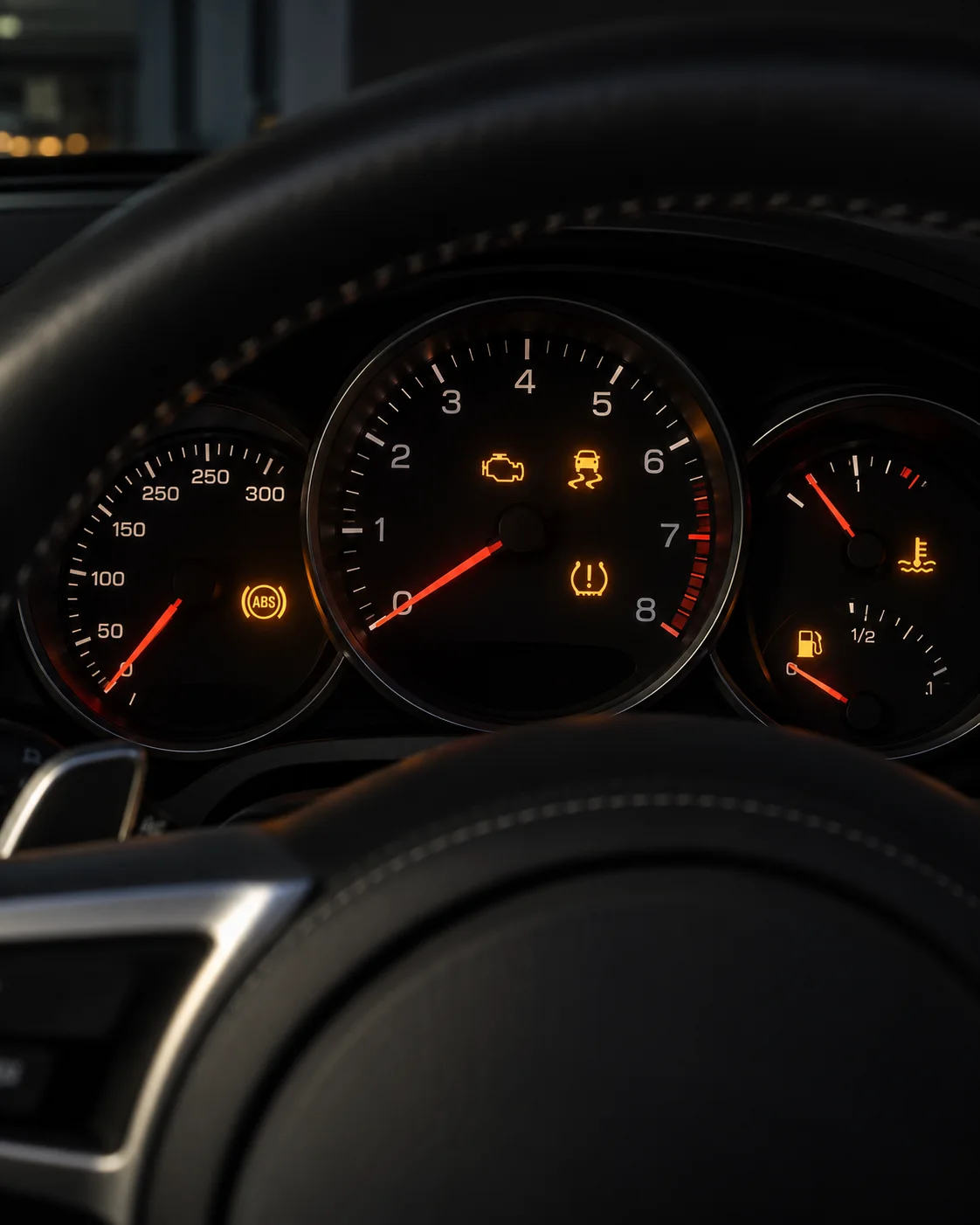
The diagnostic plan starts with the complaint and a scan of accessible, supported units. A fault in one system can create warnings in another. A weak battery, for example, can light warnings in the gearbox, chassis and comfort systems on the same drive. The categories below describe possible diagnostic enquiries. Coverage is confirmed by model, year, powertrain and the required operation before booking.
Engine and fuel
Gearbox and drive
Chassis and safety
Electrical and comfort
Match the diagnosis to the powertrain
Combustion-engine vehicles
Misfire, fuel trim and ignition examples apply to appropriate combustion engines. Engine, transmission and fitted options determine the test plan. PDK, Tiptronic and manual vehicles have different requirements.
Hybrid and electric vehicles
Taycan and electric Macan do not use the petrol ignition and fuel-trim tests shown here. Identify the low-voltage, charging or drive-system complaint first. High-voltage testing requires appropriate competence and equipment and is outside a routine scan unless explicitly accepted and scoped.
Documented outcomes
The report should state a confirmed cause, several contributing faults, a supported suspicion requiring another test, or a fault not reproduced. Include inaccessible modules and tests not completed. A clear result can be an agreed next step rather than a replacement instruction.
Porsche provides technical information for independent workshops. Availability of that resource does not establish this workshop’s subscription or equipment access. Confirm the required procedure and capability for your vehicle.
Notes that help us find a fault faster
If a fault comes and goes, a few details can help us reproduce it. Share what you have when you contact us.
When it happens
Cold starts, a long drive or waiting in traffic. Note whether the engine is hot or cold.
Conditions at the time
The outside temperature and whether the AC was on can help narrow down a recurring fault.
What you noticed
A dashboard photo or a short video of a noise or judder can help. Only record when safely parked.
Recent changes
Mention any recent repair, battery replacement or jump start, even if it seems unrelated.
Avoid clearing codes or disconnecting the battery before the diagnostic check, as this can erase useful information.
Related Porsche help
Porsche computer diagnostic questions
What is a Porsche computer diagnostic?
It combines a scan of accessible, supported modules with agreed tests on the relevant system. The result may be a confirmed cause, several contributing faults, or a documented next test when the fault cannot yet be established.
How much does a Porsche computer diagnostic cost in Dubai?
Indicative planning estimates are AED 200 to 500 for an initial assessment and AED 450 to 900 for a separately approved extended electrical investigation. These are not fixed tariffs. Confirm the scope, VAT-inclusive total and any diagnostic credit in writing.
Is a free code read the same as a diagnosis?
No. A code read shows where a unit saw a problem. A diagnosis tests the circuit and component behind that code. Many repeat faults come from replacing parts based on a code alone.
Why did a cheap scanner show no codes?
Generic readers mainly see emissions related engine codes. Gearbox, ABS, airbag, suspension and body units often need equipment that supports Porsche.
How long does a diagnostic take?
An initial assessment may take around an hour, depending on access and the complaint. Agree the actual test allowance before booking. Intermittent faults can need longer observation or a return visit.
Will you clear my warning light?
Available fault records are saved first. Controlled clearing may form part of an authorised diagnostic procedure or post-repair check. Clearing alone does not fix the cause or establish that the vehicle is safe.
Can you diagnose a fault that comes and goes?
Often, yes. Freeze frame data, road tests and data logging help catch faults that are not present at the workshop. Your notes on when it happens speed this up.
Is this the same as a pre purchase inspection?
No. A diagnostic finds the cause of a fault on your own car. A pre purchase inspection checks the overall condition of a car before you buy it.
Do I pay the diagnostic fee if I repair elsewhere?
The diagnostic fee covers the testing and findings. You receive the written finding and can decide where to repair.
Can you diagnose a car that will not start?
Yes. Battery, supply, immobiliser and control unit communication are checked first, because these are common causes of a no start.
Do newer Porsche models need special equipment?
Newer models have more networked units and some functions need an online connection to Porsche systems. We confirm before quoting what your fault needs.
Can low battery voltage cause fault codes?
Yes. A weak battery can make several units log faults at once. Battery and charging tests come early in the process for this reason.
What should I bring?
Bring the vehicle key, relevant history and symptom notes. Additional keys are needed only for applicable procedures. Avoid clearing codes or disconnecting the battery to reset a warning. Immediate safety instructions take priority.
Can a diagnostic find the cause of a noise?
Noises and vibrations often store no code, so they are traced by road test and physical inspection rather than by scan. The diagnostic plan for a noise is agreed with you first.
What happens after the finding?
You receive the written finding and a repair quote with parts, labour and any programming listed. Nothing is repaired until you approve the quote.
Will I see the readings?
Yes. The report lists the key readings and what they should be, so you can see why the finding points to that cause.
Book a diagnostic assessment
Send the model, year and the warning you see, with a photo of the dashboard if you can. We confirm the first stage and its fee before your car is connected.
- Supported units assessed
- Codes saved before clearing
- Written finding
- Fee agreed per stage
An enquiry is not a booking. The appointment is confirmed with you directly. Porsche Repair Dubai is an independent workshop and is not part of the Porsche Centre dealer network.