Toe
Whether the front edges of a pair of wheels point in or out when seen from above. Incorrect toe can accelerate tread wear. Steering behavior also depends on other geometry, tires and suspension condition.
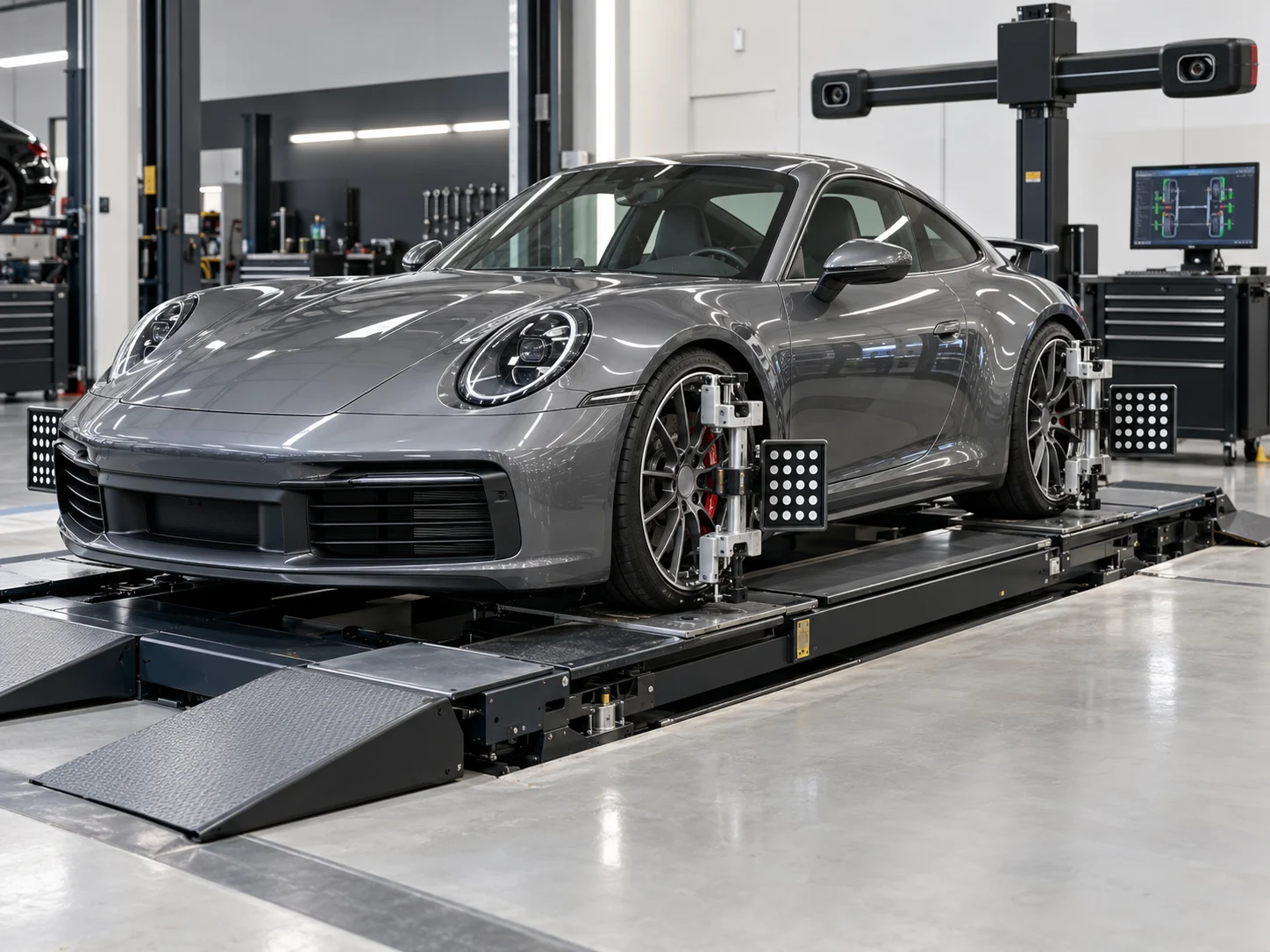
A pull to one side, an off centre steering wheel, a vibration at speed or tyres wearing on one edge. We work out whether the car needs alignment, balancing or something else, measure all four wheels, and give you the before and after readings in writing.
ToeFront and rear, each wheel
CamberTilt of each wheel
ThrustRear axle direction
Use these planning estimates to compare the work your Porsche may need. They are not a fixed workshop price list. The written quote confirms the total before work starts.
| Service | Estimated AED | Included in the estimate |
|---|---|---|
| Four-wheel measurement | 150–250 per car | Tyre and pressure checks, geometry measurement and readings. No adjustment. |
| Four-wheel alignment | 250–450 per car | Measurement, accessible factory adjustments, steering centering and before/after report. |
| Dynamic balancing | 40–75 per wheel | Wheel removal/refitting, machine balancing and standard correction weights. |
| Four-wheel balancing | 160–300 per set | The same balancing work on four wheels. Tyre removal from rims is excluded. |
| Alignment and balancing | 400–650 per car | Four-wheel alignment plus dynamic balancing of all four wheels. |
All estimates above include labor, the listed checks and a 5% VAT allowance. Calibration, seized adjusters, replacement parts, tire supply, tire fitting and wheel repairs are extra. Unusual wheel fitments or additional diagnosis may change the price. A check-only fee is not automatically added to an alignment package. Ask for one combined total.
Steering-angle resets, rear-steering setup and camera or radar calibration are quoted separately when the applicable Porsche procedure requires them. They are not included in the ranges above.
The scope below is how the work is normally split. Your quote confirms exactly what is included for your car, including any calibration step.
Useful after a kerb strike or before buying tyres, to see if adjustment is needed at all.
The usual choice after suspension or steering work, or for uneven tyre wear.
For new tyres, or a car that both pulls and vibrates.
Choose this for a suspected balance problem or after tire fitting when geometry adjustment is not indicated. The quote specifies the number of wheels, standard weights and any further runout or tire diagnosis. Balancing does not adjust toe, camber or caster.
Wheel damage assessment, tire supply and fitting, wheel bearings and suspension parts are separate jobs. A damaged wheel is not automatically suitable for straightening or welding. If we find one of them during an alignment, we show you and quote it before going further.
These are illustrative quotations, not completed customer jobs. Each total includes labor and a 5% VAT allowance. They show how the service choices differ. Final prices depend on inspection and the written quote.
Example alignment cost
AED 350
Four-wheel measurement, accessible standard geometry adjustments and before/after readings. Assumes sound suspension and free adjusters. No parts or calibration included.
Example balancing cost
AED 240
Dynamic balancing of four wheels with standard correction weights and wheel removal/refitting. No tire supply, tire removal from rims, road-force testing or damaged-wheel repair.
Example combined cost
AED 550
Four-wheel alignment and dynamic balancing of four wheels with readings and weights. Assumes no damaged parts or seized adjustments. Ride-height faults and any required calibration are separately quoted.
Alignment sets the angles of the wheels against each other and against the car. Balancing corrects mass imbalance in each wheel and tire assembly using measured correction weights. A car can need one, both or neither, and a vibration is not always solved by either.
We decide which one your car needs from the symptom, a safety inspection and, when safe, a road test, and we tell you before any work is booked.
A four wheel alignment measures every wheel and sets the adjustable angles to the values for your model. Rear readings are included even when the complaint feels like a front-wheel problem. Adjustment follows the provisions for the fitted suspension.
Whether the front edges of a pair of wheels point in or out when seen from above. Incorrect toe can accelerate tread wear. Steering behavior also depends on other geometry, tires and suspension condition.
The inward or outward tilt of a wheel seen from the front. Too much tilt wears one shoulder of the tyre and changes grip in corners.
The angle of the steering axis seen from the side. It helps the steering return to centre. On many cars it is measured and checked rather than adjusted.
The direction the rear axle points compared with the centre line of the car. If it is off, the steering wheel sits crooked even when the car drives straight.
Accurate readings depend on the car being prepared for its exact model and suspension specification. A model badge alone does not identify the correct targets. The workshop checks the year, fitted chassis equipment, wheel sizes and any modifications against the applicable procedure.
Pressures, approved sizes, tread condition, matching fitment and wheel damage are checked first. A bulge, exposed cord or significant pressure loss needs attention before a road test.
Fuel or loading conditions follow the model-specific instructions. A full fuel tank is not a universal rule, and it does not apply to a Taycan. Air suspension must be at the prescribed setting and settled before measurements.
Play in bearings, tie rods or bushes, damaged arms and abnormal ride height can prevent reliable adjustment. The car needs a suitable level rack and correct measurement setup.
For a 911, 718, Macan, Cayenne or Panamera, generation and equipment matter more than the badge. Taycan alignment concerns chassis geometry, not high-voltage battery servicing. Rear-axle steering, air suspension, PASM or PDCC may change preparation or follow-up steps where fitted. Lowered cars need agreed targets and an explanation if factory adjustment cannot achieve them.
Calibration is not automatically required for every system after every alignment. The correct decision depends on the vehicle, equipment, work performed and applicable Porsche repair instructions.
A reset or calibration may be required after geometry or steering work. The required procedure and diagnostic checks should be recorded rather than assumed from a centered steering wheel.
Driver-assistance calibration is separate from setting wheel angles. The fitted equipment and repair procedure determine whether it is required and which static or dynamic method applies.
Rear-axle steering or ride-height systems may require a specified setup or calibration. The quote should identify any additional operation, equipment availability and cost before approval.
A Porsche campaign for specific 2014 Panamera vehicles is an example of why instructions must be matched to the affected vehicle. It is not a universal alignment procedure for all Porsches. If specialist calibration is needed, arrangements and the separate charge should be confirmed before the alignment proceeds.
See what was measured, what changed and what still needs attention. Your readings should be compared with the correct specification for your Porsche.
Model, year, chassis equipment and wheel fitment, with the required load and ride-height conditions.
Left and right toe, total toe, camber and measured caster. Before and after values where applicable.
Left and right toe and camber, rear total toe and thrust angle. All four wheels belong on the report.
Minimum and maximum values alongside the measurements, using clearly identified units.
The angle that could not be corrected, the reason and the recommended next step.
Required calibration and its results, plus any warning or symptom that remains after final checks.
Not every angle is adjustable. An out-of-range result should be explained, not hidden. This checklist explains the report fields and is not a completed customer report.
Alignment is not a fixed service item. It is needed when something has changed the angles, or when the car or the tyres show that the angles are already wrong.
New struts, springs, arms or bushes change the geometry. See our suspension repair page.
Tie rods and racks set the front toe directly. See our steering repair page.
A hard strike can bend an arm or a rim even when nothing looks broken.
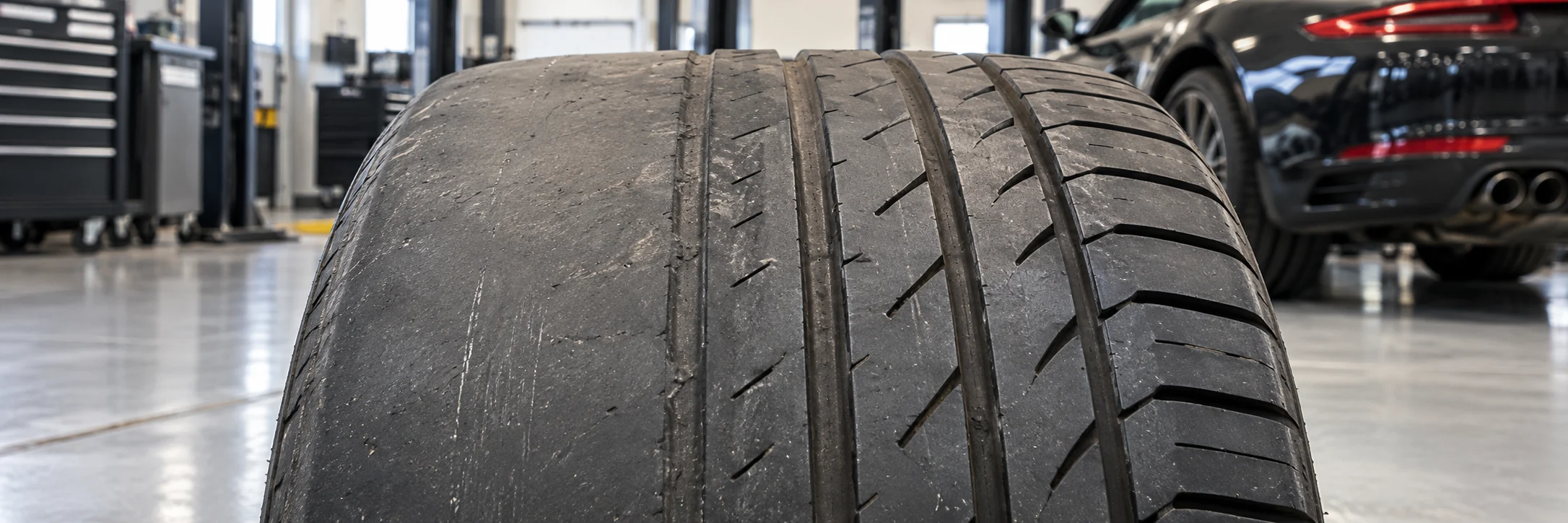
Edge wear or feathering calls for a tire and geometry check. The pattern alone does not prove an alignment fault.
Pulling can involve tires, road camber, brake drag, suspension geometry or damage. It needs diagnosis before adjustment. See why a Porsche pulls to one side.
An off centre steering wheel while driving straight usually means toe or thrust angle.
Visible wear can guide inspection, but cannot confirm the cause. Do not touch exposed cords or reach beneath an unsupported car. Tire condition and pressure should be checked alongside geometry.
May involve camber, toe, worn components or altered ride height. Measure before deciding the cause.
Geometry check
May involve geometry, loading, tire pressure or cornering. Wear alone does not establish toe direction.
Geometry check
Typical of running with low tyre pressure for a long time.
Pressure
Typical of pressures set higher than needed.
Pressure
Tread blocks sharp on one side and smooth on the other, a classic sign of incorrect toe.
Geometry check
Scalloped dips around the tyre, often worn dampers or imbalance rather than alignment alone.
Balance and dampers
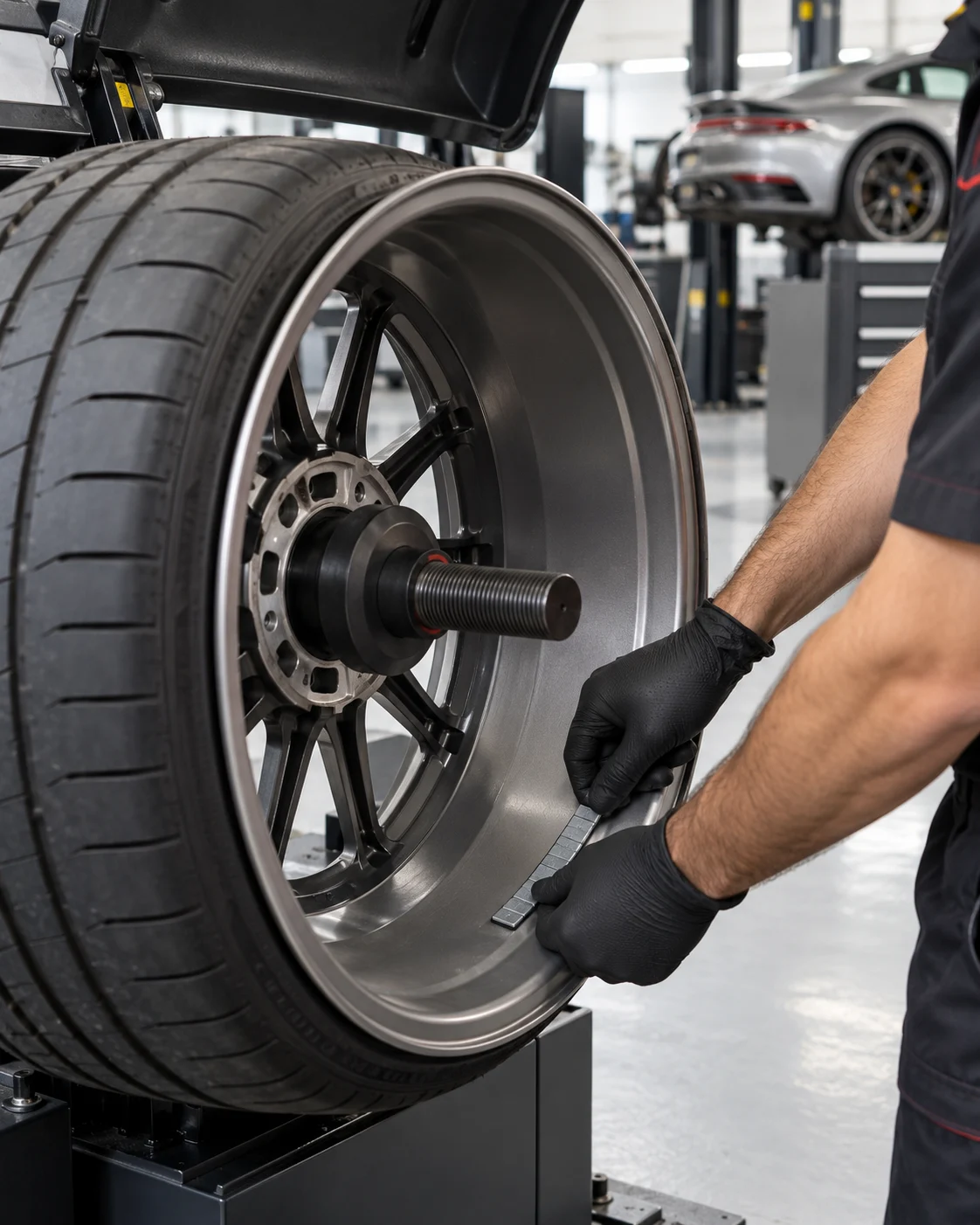
A balancing machine measures mass imbalance in the wheel and tire assembly. Correction weights are placed at the indicated positions. Dynamic balancing uses two correction planes, so the process is more precise than adding one weight opposite a visible heavy spot.
Corrects weight that makes the wheel hop up and down. One plane, usually felt as a bounce.
Corrects weight on the inner and outer side of the rim that makes the wheel wobble side to side. Two planes, usually felt in the steering wheel.
Persistent vibration may need checks for centering, radial and lateral runout or tire force variation. Hunter explains road-force measurement as a separate test of loaded tire behavior. This does not mean road-force testing is included or that a particular machine is installed here.
Balancing is normally done when new tyres are fitted, when a tyre is removed from its rim, or when a weight has fallen off. It does not change any alignment angle.
A vibration that appears at motorway speed is the most common reason people ask for balancing. Balancing fixes many of them, but not all. If the vibration stays after a correct balance, one of these is the next suspect.
Smooth at low speed, shake in the steering wheel or seat as speed rises.
A wheel can balance by mass yet still vibrate because of radial or lateral runout. Damage needs inspection against the wheel manufacturer’s limits.
Temporary flat spotting can follow parking. A bulge or suspected belt separation is a different safety concern and needs inspection before driving.
A hum that changes with speed or in corners, or play in the wheel when rocked.
A vibration under power that changes when you lift off, rather than with road speed alone.
Pulling, vibration or uneven tire wear? Tell us what you notice. We will help you choose the next step.
The model name is enough to begin.
Describe the pull, vibration or tire wear in your own words.
We will confirm the appointment and expected duration directly.
Photos and recent repair details can help later. You do not need a diagnosis or chassis number to contact us.
Your written quote confirms the work and price. Ask about any follow-up check and workmanship terms. Repairs or calibration may extend the visit.
A pull, a crooked steering wheel or wear on one tyre edge points to alignment. A vibration that builds with speed points to balancing. If you have both, or you are not sure, we inspect the tires and, only when safe, road test the car before recommending either.
Plan for AED 250–450 for four-wheel alignment, AED 160–300 for balancing four wheels, or AED 400–650 for both. These are estimates including labor and a 5% VAT allowance, not fixed workshop offers. Calibration, repairs and tire supply are separate. Your written quote confirms the total.
All four wheels should be measured so front geometry can be considered against the rear axle and thrust angle. Only the adjustments provided and permitted for the fitted suspension are made. Any angle that cannot be corrected is recorded.
Not as a universal rule. Fuel, loading and ride-height conditions must match the procedure for your exact model. Electric models have no fuel tank. We identify the preparation required rather than asking every owner to follow the same instruction.
Yes. You receive the before and after readings for each wheel, with any angle that could not be set to its value noted and explained.
Alignment is not a general cure for vibration. Tire damage, imbalance, runout, poor wheel centering, bearings, brakes or drivetrain faults can be responsible. Persistent vibration after balancing may need runout or road-force testing. A road-force test measures loaded tire behavior and is different from ordinary dynamic balancing. Availability and cost must be confirmed.
No. Steering-angle, rear-steering and driver-assistance requirements depend on the exact vehicle and work performed. Any required calibration should be identified and priced separately before you approve the job.
Usually, but factory values may not be reachable on a lowered car, and you may need to choose between tyre wear and handling. We show you the readings and discuss the target before adjusting.
It depends on the model, whether bolts are seized and whether a calibration is needed. We give you an expected time when you book and tell you straight away if a worn part changes the plan.
Yes. Every new tyre fitted to a rim should be balanced. It is also a good moment for an alignment check, so the new tyres start life on correct angles.
Yes. A hard hit can move an adjuster, bend an arm or damage a rim. If steering changes after an impact, stop safely and seek advice before continuing. Damage may extend beyond alignment.
No. Alignment and balancing estimates exclude tires, wheel repair and replacement parts. Damaged wheels need a separate assessment against manufacturer limits. Cosmetic refurbishment does not make a structurally damaged wheel safe.
We stop, show you the play or damage, and quote the part. Aligning a car with worn joints wastes the alignment, because the angles move again as the car is driven.
The symptom alone cannot establish that the car is safe. Stop in a safe place and arrange assistance for strong or sudden pulling, severe vibration, impact damage, a tire bulge, pressure loss or difficulty controlling the vehicle. Even a mild persistent change needs inspection. Do not perform a high-speed test to diagnose it.
Tell us what the car is doing. We check whether it needs alignment, balancing or another repair, measure all four wheels and hand you the before and after report.
An enquiry is not a booking. The appointment is confirmed with you directly. Porsche Repair Dubai is an independent workshop and is not part of the Porsche Centre dealer network.