
Is Your Porsche Battery Discharged or Failing
A discharged battery has too little charge available. A failing battery has lost the ability to store or deliver enough energy for its intended job. Your Porsche can have both conditions at once, so dim lights, slow cranking or a successful jump-start cannot reliably tell them apart.
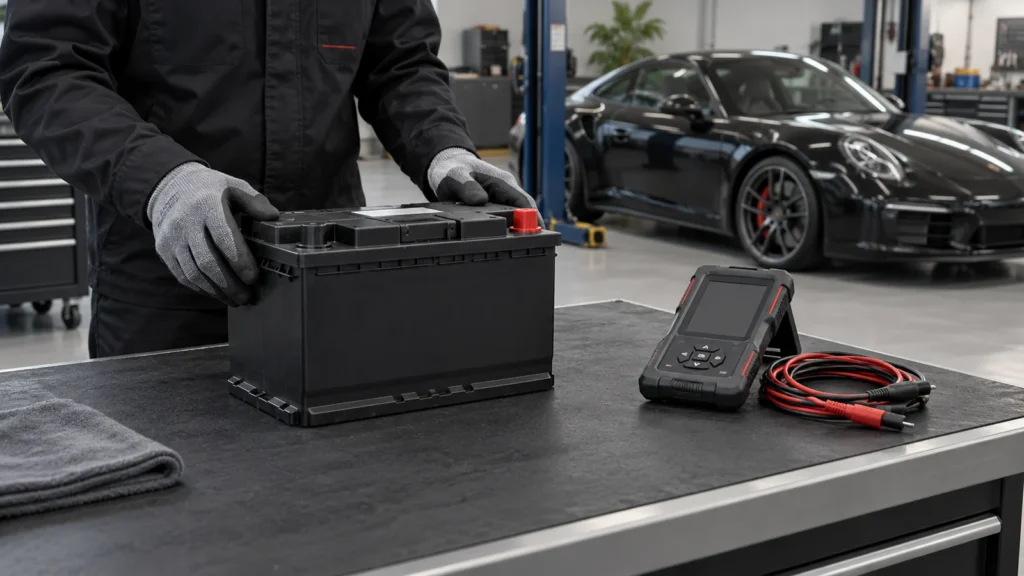
The useful question is whether the correct battery can be charged safely and then pass the appropriate tests. If it can, investigate why the charge became low. If it cannot meet the required performance after a valid assessment, replacement may be necessary. A loose connection or a fault elsewhere can also imitate battery failure.
If your Porsche will not start now
Stop repeated start attempts. Record the warning message and whether the engine turns or the vehicle reaches its ready state. If the battery is damaged, leaking, unusually hot or its type is unknown, arrange assistance. Use external power only when the exact vehicle manual permits it and identifies the correct connection points.
Tell the workshop the model year, whether it is petrol, diesel, hybrid or electric, how long it was parked and whether assistance has already been attempted.
Discharge and battery deterioration are different findings
State of charge describes how much charge is available at that moment. State of health concerns the battery’s ability to perform compared with the requirements of its application. A low reading after a long parking period does not automatically establish permanent failure.
Conversely, a battery can show an apparently satisfactory resting voltage and still struggle under demand. A starting-power test and an energy-capacity assessment answer different questions. A handheld conductance tester can provide a useful estimate of starting performance, but its result is not a direct measurement of every aspect of usable capacity.
A deteriorated battery may also discharge repeatedly because its remaining usable capacity is low. Recharging can restore charge without restoring lost performance. That is why “charge and retest” is a diagnostic step rather than a promise that every battery can be recovered.
Identify the battery before selecting a test or charger
Porsche vehicles do not all use the same low-voltage battery. The model, year, options and previous replacement matter. Check the fitted battery label and the correct vehicle information rather than assuming that every Cayenne, Macan, 911 or Panamera uses the same chemistry or rating.
- Lead-acid batteries include conventional designs and AGM batteries. The tester and charger settings must suit the actual construction.
- Lithium low-voltage batteries need compatible equipment and the vehicle-specific procedure. A lead-acid recovery or desulphation mode must not be assumed suitable.
- Battery management can affect the readings and permitted recovery procedure. A protective disconnect is not an invitation to bypass the battery’s protection.
For a concrete example of why identification matters, Porsche describes the 911 Carrera GTS T-Hybrid’s low-voltage battery as a lithium iron phosphate unit in its T-Hybrid technical information. That does not establish the battery type in every other 911.
Temperature and recent use also affect interpretation. Record whether the battery is hot, cold, recently charged, recently jump-started or has just supported an attempted start. Follow the battery, vehicle and test-equipment requirements for stabilisation before comparing results.
Low-voltage supply is separate from the traction battery
This guide concerns the low-voltage electrical supply. On a conventional combustion model it supports the starter and vehicle electronics. On a hybrid or electric Porsche, the low-voltage supply also supports the control systems needed to bring the vehicle into operation. The exact architecture depends on the model.
The high-voltage traction battery is a different system. A full traction-battery display does not prove that the low-voltage supply is healthy, and a low-voltage no-start or no-ready condition does not by itself prove traction-battery failure.
Charging-system diagnosis must match that architecture. A conventional alternator test is not the right universal description for every Porsche. Electrified models may use a DC/DC converter to supply the low-voltage network. Porsche explains this arrangement for the electric Macan in its battery and charging information.
Do not connect ordinary battery equipment to orange high-voltage cables or attempt to open a traction-battery enclosure. High-voltage warnings, impact damage or a charging-system fault require the appropriate specialist assessment.
What the symptoms can and cannot tell you
Slow cranking, clicking, dim lights and multiple warnings can be consistent with a low-voltage problem. They can also involve poor connections, a starter circuit fault or another cause. Working lights do not establish that enough power is available for starting, and a dark dashboard does not establish that the battery is permanently beyond recovery.
Record the exact warning message and what happens when you try to start or make the vehicle ready. Note whether the engine turns, whether the display resets and whether the car has been parked or recently repaired. Avoid repeated attempts if the vehicle is not responding normally.
Low voltage can cause several systems to record faults, but do not assume that every warning is a false alarm. Restore a stable supply through the correct procedure, preserve relevant diagnostic information and reassess any remaining faults.

When not to attempt charging or a jump-start
Do not attempt assistance on a battery that is visibly damaged, leaking, swollen, smoking or unusually hot. A strong abnormal smell, hissing or signs of impact also need professional advice. Keep ignition sources away and avoid touching leaked material. If there is smoke or fire, move away and contact the appropriate emergency assistance.
If the battery type, equipment compatibility or permitted connection points cannot be established, stop and arrange assistance. Do not force-charge a battery that the charger cannot recognise or override a protection state with improvised wiring.
Tell the assistance provider if the car is a hybrid or electric model, has had flood or impact damage, or is displaying a high-voltage warning. Recovery arrangements should follow the vehicle’s instructions.
A charge-then-retest workflow with defined conditions
Start with battery identification and a safe visual assessment. Record the battery type, capacity and starting-current rating where applicable, together with the rating standard printed on its label. A tester entered with the wrong chemistry or standard can produce a misleading decision.
Check the relevant connections and the initial charge condition using the specified method. A battery-health test may require a different connection location from the vehicle’s external starting-aid points. Cable resistance can influence some measurements. The technician should follow both the test-equipment instructions and the vehicle’s access and safety requirements.
When the result calls for charging and the battery is safe to charge, use an approved compatible mode and the correct connection arrangement. After charging, follow the required rest or surface-charge procedure and repeat the relevant test. Do not apply the same voltage or cranking cut-off to every battery chemistry and temperature.
VARTA’s handheld-tester guidance explains the importance of correct battery data and measurement connections. Midtronics’ explanation of test errors also distinguishes an inconclusive test condition from a replacement decision. Use the procedure for the actual equipment and battery rather than treating a generic display message as a complete diagnosis.
| Finding | Conditions to establish | Appropriate next step |
|---|---|---|
| Low initial charge or an inconclusive result | Battery identified, safe physical condition and correct test setup. | Charge through the permitted method if appropriate, then reassess. |
| Acceptable performance after charging | Required stabilisation completed and the correct battery-specific test criteria met. | Investigate the reason for discharge and monitor the original complaint. |
| Performance still below specification | Valid charge, correct rating data, sound test connections and repeatable findings. | Assess replacement and any contributing vehicle fault. |
| Acceptable battery result but poor starting | Supply assessed under the relevant operating demand. | Investigate voltage drop, connections and the applicable starting or control system. |
| Battery becomes low again while parked | Battery condition and charging supply assessed first. | Measure and record parked behaviour using the specified sleep conditions. |
| Lithium protection or incompatible-test warning | Exact battery and equipment compatibility confirmed. | Follow the manufacturer’s recovery or referral procedure. Do not bypass protection. |
These are diagnostic decision routes, not customer test results. Ask for the actual readings, test conditions and conclusion for your car. If symptoms persist despite an acceptable screening result, further testing may be needed rather than declaring the entire electrical system healthy.
What to keep from your battery assessment
| Record | Details to request |
|---|---|
| Battery identity | Model year, powertrain, battery part number, chemistry, capacity and starting-current rating with its standard where applicable. |
| Before charging | Temperature, recent driving or assistance, initial readings, tester mode and physical condition. |
| After charging | Charger mode, completed charging process, required stabilisation and repeat test result. |
| Vehicle investigation | Connection checks, applicable charging-system findings and a timed sleep-state trace if parked drain is suspected. |
| Agreed next step | Recharge and monitor, investigate another fault, or replace with the identified specification and applicable registration procedure. |
Reading a charge and retest result
Worked example, not a customer test. An identified AGM battery first returns a charge-and-retest result. After compatible charging and the required stabilisation, it meets the tester’s applicable criteria. This supports investigating the cause of discharge before approving replacement. It does not prove full energy capacity or rule out a parked-current fault.
If the result remains inconclusive, confirm the setup and follow the equipment’s next test. Do not convert an incomplete assessment into a failed-battery verdict.
Why a parked-current test needs a sleep-state record
Some electrical use while parked is normal. Alarm, security and control functions can remain active, and modules may wake periodically. The relevant limit depends on the model, equipment, state and measurement period. There is no single current value that proves every Porsche is healthy or faulty.
- A useful drain investigation documents the parking and locking conditions, time allowed for the required sleep state and any wake events.
- Nearby keys, opening the car, diagnostic equipment, remote activity or accessories can affect the measurement.
- Where appropriate, logging over time is more informative than one reading shortly after switching off.
Disconnecting a cable or removing fuses can alter the behaviour being investigated. This is workshop diagnostic work, not a reason to insert an ordinary multimeter into the starting circuit. Explain recent accessory installations, dashcam use, storage periods and the time taken for the symptom to return.
A new battery may also become discharged if a charging fault or excessive parked load remains unresolved. Conversely, a deteriorated battery may struggle through an otherwise normal parking period. The battery result and vehicle behaviour need to be considered together.
Jump-start and charger connections must follow your manual
Use the procedure for the exact model and year. Porsche’s owner’s manual guidance explains how to find the correct information by vehicle identification or model year. Check whether external assistance is permitted, the required equipment and the locations identified for that operation.
- Where the manual specifies external starting-aid or charging terminals, use the designated positive connection and the specified negative or ground point.
- Do not choose an arbitrary metal engine component.
- Do not assume that a terminal used to release a bonnet during a power failure is also a jump-start or charging terminal.
The connection order, operating states, equipment limits and disconnection procedure must come from that model’s instructions. Do not use this general guide as a substitute for them. If the labelled points cannot be identified confidently, ask an assistance provider to handle the operation.
A successful assisted start is not a full recharge or a battery-health certificate. Nor does a fixed period of idling or a short drive guarantee that charge has been restored. Arrange the appropriate charging and assessment rather than relying on repeated jumps to keep the car usable.
Replacement, registration and adaptation
Replace a battery because the assessment supports it, not simply because the dashboard was dark. Confirm the correct chemistry, capacity, starting rating where applicable, dimensions, terminal arrangement and any ventilation requirements. A battery that physically fits is not automatically the right replacement.
Some energy-management systems require replacement data to be registered, coded or adapted. The requirement depends on the vehicle and the battery specification. Ask which procedure applies and whether the quoted work includes it, rather than accepting a promise that every Porsche needs the same reset.
For a confirmed replacement, use the Porsche battery replacement service and request a quotation identifying the battery, installation, applicable setup and warranty. If the battery passes but the engine still will not turn normally, the separate Porsche clicking and no-start guide covers the broader symptom.
At handover, keep the battery specification, before-and-after results and any remaining investigation recommendations. Confirm that the original concern was rechecked and that any required settings or adaptations were completed.
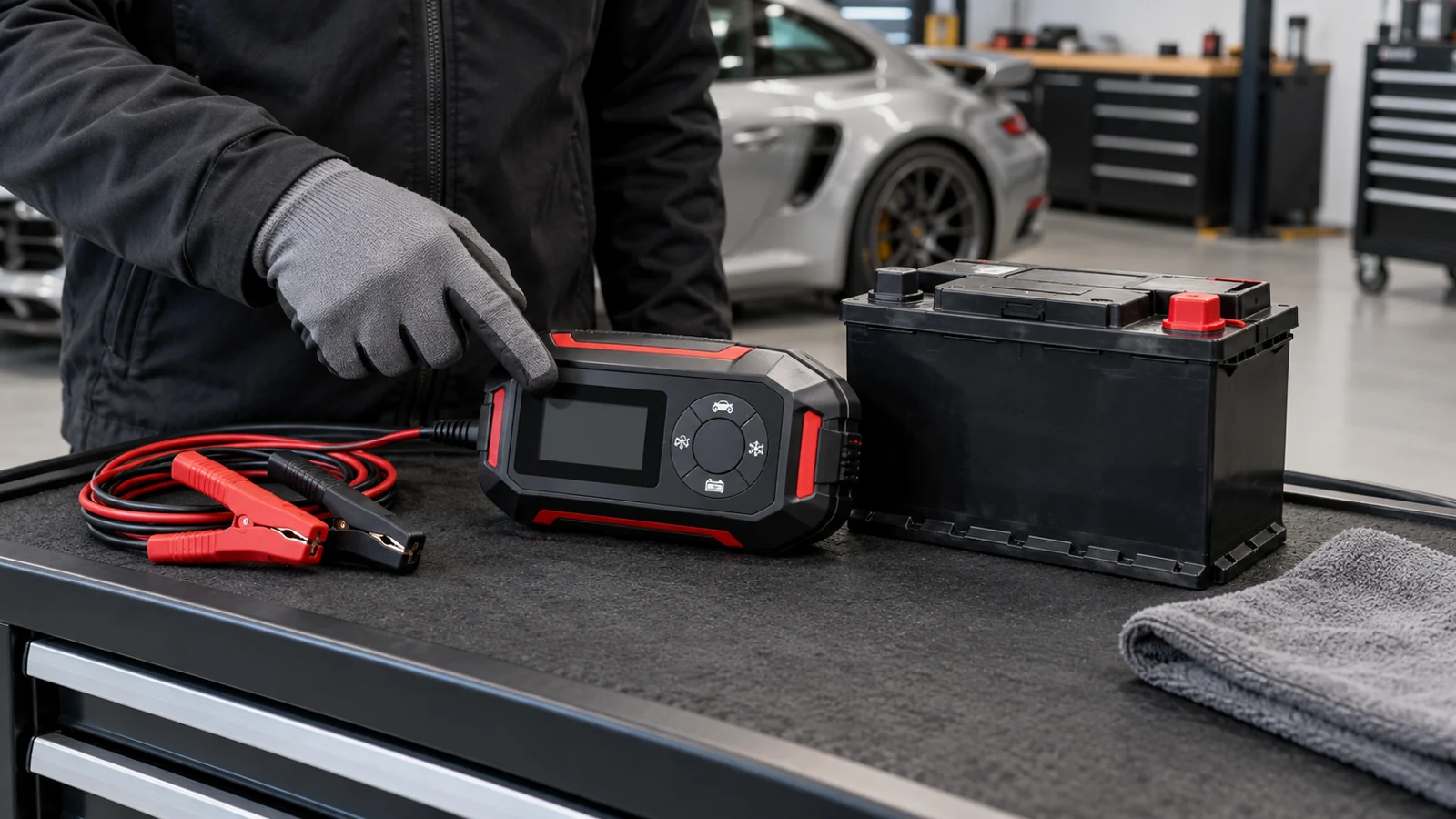
Reducing repeat discharge during storage or short-trip use
If the vehicle is used infrequently, check the manufacturer’s storage and charging recommendations. Select a compatible maintainer and the permitted connection method for that battery and model. Do not assume that every accessory socket supports charging or that any charger can be left connected in any mode.
Review accessories that operate while parked and have repeated low-charge warnings assessed. Keep a record of how long the car was unused and any changes in use or equipment. Regular driving may help the energy balance, but it cannot repair a failing battery or guarantee recovery from a deep discharge.
Battery age and Dubai temperatures provide context for an assessment, not a fixed replacement deadline or a diagnosis. Base the decision on the battery’s condition and performance under the appropriate test conditions.
Porsche discharged battery questions
Does starting after a jump mean the battery is healthy?
No. External support may allow a discharged or deteriorated battery to start the vehicle. It can also mask a connection problem. The battery still needs the appropriate charge and health assessment, followed by investigation of why it became low.
Can I diagnose the battery from its voltage alone?
No. A voltage reading needs context, including battery chemistry, temperature, recent charging or load and whether the vehicle is awake. It does not directly measure usable capacity or prove that a battery can deliver the required starting power.
Where should jump leads or a charger be connected?
Use only the connection points and procedure identified in the manual for your exact model and year, with compatible equipment. Where designated external starting-aid or charging points are provided, follow their markings and specified ground point. Do not substitute an arbitrary engine-block bolt or a terminal used only for emergency bonnet access.
Does every Porsche replacement battery need coding?
No single rule covers every Porsche. Registration, battery-data entry, coding or adaptation may apply depending on the fitted energy-management system and the replacement specification. The workshop should identify the procedure required for your model and document what was completed.
How much parked current is normal?
The acceptable value depends on the model, equipment, vehicle state and measurement period. Modules can remain awake or wake periodically. A valid drain assessment uses the prescribed sleep conditions and limits rather than applying one current threshold to every Porsche.
Can a Taycan have a charged traction battery but a low-voltage problem?
Yes. The high-voltage traction system and the low-voltage electrical supply have different functions. A charged traction battery does not rule out a low-voltage battery, connection or DC/DC charging fault. Follow the vehicle’s warning and recovery guidance rather than attempting work on high-voltage components.