Porsche Brake Inspection Checklist and Timing
Have your Porsche's brakes inspected at the interval in the maintenance schedule for its exact model year, market and brake equipment. Arrange an earlier check if braking changes, a warning appears, or the car has been used heavily or on a circuit. Brake inspection, brake-fluid renewal and replacement of worn parts are separate jobs.

There is no single mileage interval that fits every 911, 718, Cayenne, Macan, Panamera and Taycan. A useful inspection records what was checked, actual wear measurements, the applicable limits and the next action. It should help you understand whether the brakes can remain in service, need monitoring or require repair.
When should Porsche brakes be inspected?
Use the vehicle's scheduled maintenance as the baseline and symptoms or demanding use as reasons to check sooner. The maintenance display does not replace an assessment of an unusual pedal, new grinding noise or loss of braking performance.
Scheduled inspection
Match the service record and maintenance document to the VIN, model year and market. Check that the brake work listed for that visit was actually completed and recorded.
Earlier condition check
Arrange a check for persistent noise, vibration, pulling, uneven wear or a warning message. Do not wait for a mileage target when the braking behaviour has changed.
Track or demanding use
Discuss the car's use before the event and inspect again when required afterwards. Circuit work, repeated heavy braking and relevant towing use can justify a different inspection plan.
A documented example with a defined model and market
Porsche Cars North America's inspection sheet for the 911 Carrera and Carrera S 992, as of model year 2020, edition July 2019, lists inspection at 20,000-mile or 30,000-km steps, with a maximum of two years if the mileage is not reached. It includes brake wear checks and separately lists brake-fluid renewal every two years.
This is a reference for the models and market identified in that document. For a Dubai vehicle, confirm the current schedule applicable to its VIN, including any market-specific requirements or later instructions. A used imported car also needs its market and service history checked. Do not transfer that example to every Porsche or treat it as permission to ignore symptoms between services.
At a routine workshop visit, ask whether the scope is a visual check through the wheels or a wheel-off assessment with measurements. Both can have a role, but the report should identify access limitations. A brief visible check cannot establish the condition of every concealed pad surface or disc face.
Use the previous findings to plan the next check
A follow-up should account for the thinnest pad, disc condition, the last fluid-change date and how the car is used. If wear is approaching a limit, request a specific review plan rather than a promise of a fixed number of kilometres remaining. Wear is not always even or linear.
Dubai traffic, long descents, vehicle load and driving style help explain the use history. They do not justify inventing a universal “Dubai interval”. Keep the manufacturer's requirements and any workshop recommendation clearly identified in the record.
Which symptoms mean you should stop driving?
Stop safely and arrange assistance
A sudden loss of braking, a pedal that sinks or becomes unusually long, a suspected hydraulic leak, smoke from a wheel, or a stop instruction on the dashboard needs immediate attention. Follow the exact warning in the owner's manual. Do not drive to the workshop if the car cannot brake normally.
If braking becomes noticeably worse while driving, move to a safe stopping place as conditions allow and seek assistance. Do not conduct your own high-speed brake test. A low fluid warning should be investigated rather than repeatedly topped up to hide the symptom.
| What you notice | What needs checking | Useful evidence |
|---|---|---|
| Persistent squeal or grinding | Pad and disc condition, debris, contact and hardware | Inner and outer pad readings, surface photographs and when the noise occurs |
| Vibration during braking | Disc thickness variation or runout, hub condition and other wheel or chassis causes | Measured results against the applicable limits |
| Pulling under braking | Tyres, brake balance, caliper operation and relevant suspension condition | Side-to-side findings and a controlled test only if safe |
| ABS or PSM warning | The displayed message and stored faults in the relevant control systems | Full code, status and supporting test results |
Noise alone does not establish that the pads are worn out, and vibration does not prove the discs are warped. Equally, a warning light is not a diagnosis of a particular sensor. Describe when the problem happens, whether the car is cold or warm, and any recent tyre, brake or suspension work.
What a useful Porsche brake inspection checks
Confirm the brake package before assessing wear. Cast-iron discs, Porsche Surface Coated Brakes and Porsche Ceramic Composite Brakes need the correct procedures for their fitted parts. Caliper colour alone is not sufficient identification, particularly on a modified car.
- Vehicle details and reported concern. Record the model, year, mileage, brake equipment, service history and exact warning or symptom. Note whether the concern is present on every stop, only when warm or after storage.
- Pads at all four wheels. Inspect inner and outer pads and record remaining friction-material thickness in millimetres. Note taper, uneven wear, contamination, damage and wear-sensor condition. Do not estimate the hidden inner pad from the visible outer pad.
- Discs and their braking surfaces. Check both faces where accessible, including scoring, corrosion, cracking and abnormal contact. For the fitted iron-disc system, record the lowest measured thickness and compare it with the correct minimum specification. Assess runout or thickness variation when the symptom and procedure call for it.
- Calipers and associated hardware. Check for leakage, damaged boots, uneven operation and signs of drag. Assess pins, guides or retaining hardware as applicable to the actual caliper design. Fixed and sliding calipers do not have identical service arrangements.
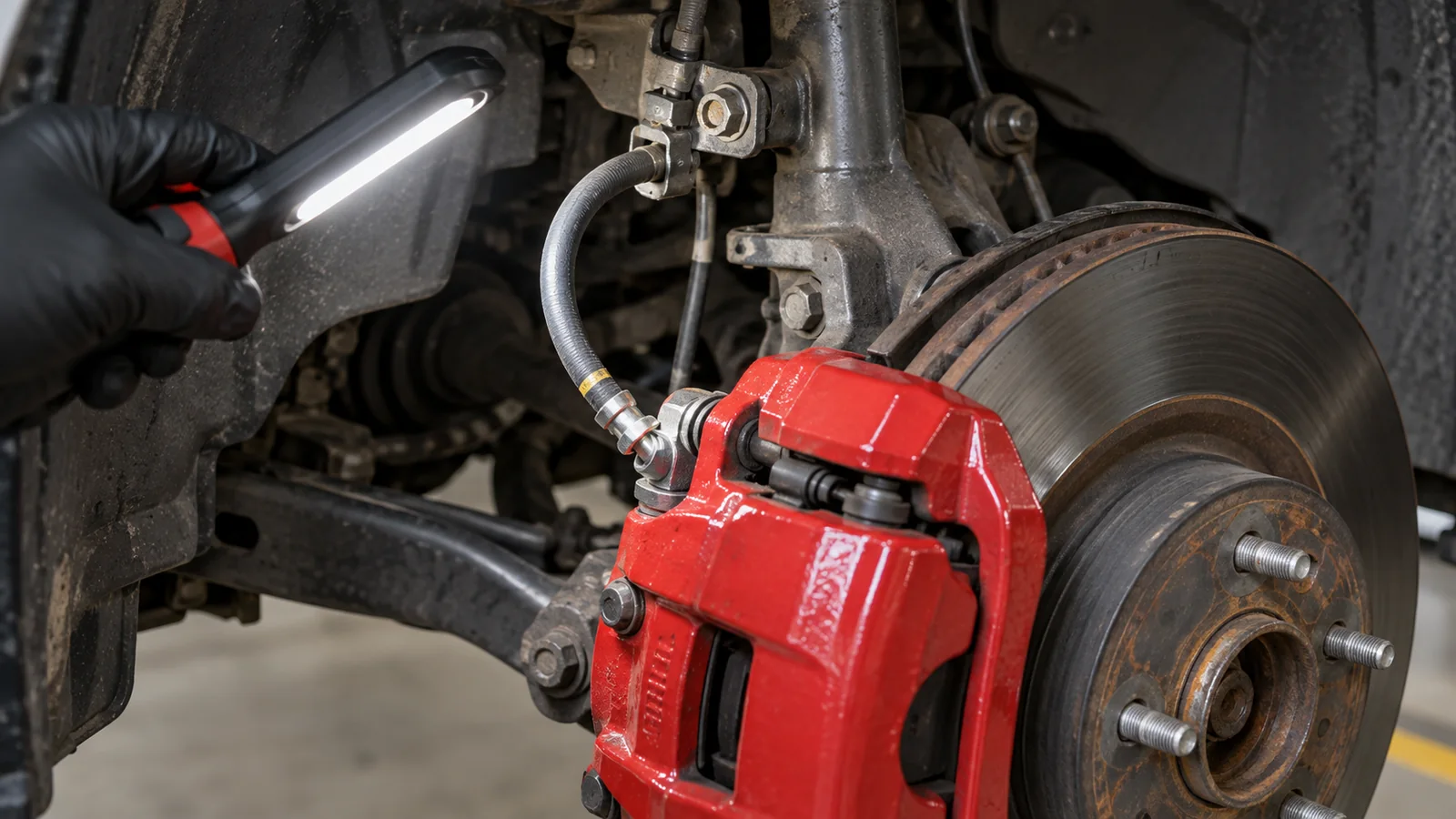
- Hoses, pipes and connections. Inspect for leakage, abrasion, damage, corrosion and incorrect routing. Include flexible hoses and accessible connections. Record any areas that could not be inspected.
- Fluid, pedal and brake assistance. Check fluid level, documented renewal date, signs of leakage and pedal behaviour. Any fluid-condition test should state the method and result. Investigate an abnormal pedal or assistance concern rather than assuming a fluid change alone will resolve it.
- Warning systems and parking brake. Record the warning text and relevant ABS, PSM or parking-brake faults. Check wear-sensor wiring and parking-brake operation as appropriate. Preserve diagnostic information before clearing faults.
- Controlled operation check and report. A road test is appropriate only when the vehicle is safe to test. Record whether the reported symptom was reproduced, the findings, limitations and agreed next action.
Measurements need the right limits beside them
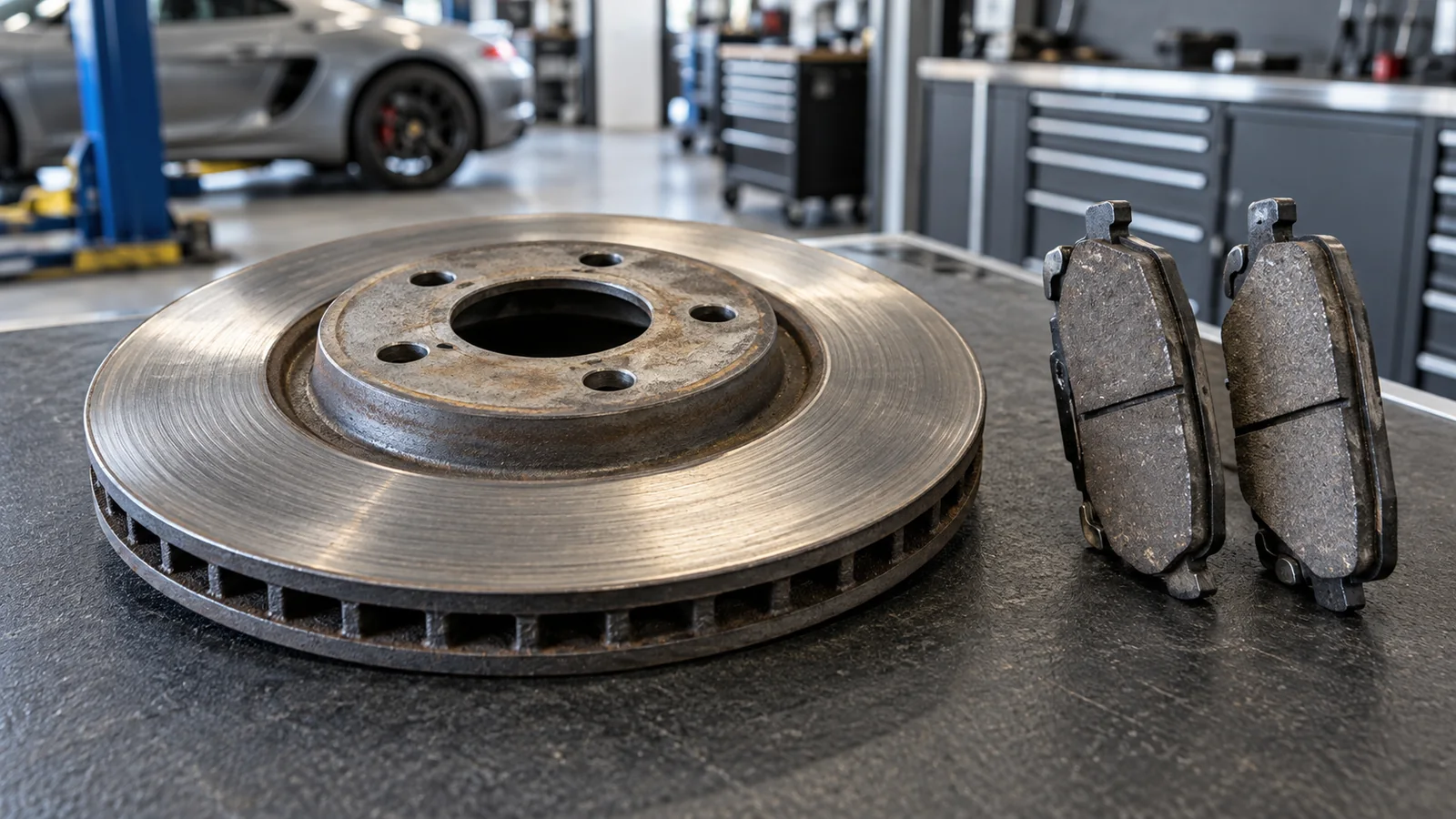
A disc reading means little without the correct specification for that fitted part. Brembo's minimum-thickness guidance explains measuring at multiple points and comparing the lowest value with the disc's minimum-thickness marking. Follow the applicable Porsche procedure and equipment requirements for the actual brake system.
For replacement symptoms and per-axle cost scope, see our Porsche brake pad guide.
There is no universal disc thickness or pad replacement value that this guide can safely apply to every model and brake option. Ask the workshop to identify the source of the limit on its report. A visible disc lip, a photograph or one measurement across the unworn edge is not a complete wear assessment.
PCCB and coated brakes need their own assessment
PCCB wear assessment can require specialist equipment and a procedure specific to the disc generation. Do not apply a cast-iron disc checklist as the sole test or assume a ceramic disc is sound because its surface looks clean. Record which procedure was used and whether further assessment is needed.
The 992 maintenance sheet linked above explicitly calls for a special-tool PCCB wear check at every service and when pads are replaced for the vehicles covered. Confirm the correct instructions for a different model or disc version before drawing a conclusion.
Taycan and hybrid brakes still need inspection
Regenerative braking changes how often the friction brakes work. It does not remove the pads, discs, hydraulics or parking brake from the maintenance plan. Porsche's Taycan technical explanation describes friction braking alongside recuperation and distinguishes coated and ceramic systems on the versions discussed.
Low pad wear does not, on its own, confirm the condition of the whole system. Check the fitted brake surfaces, operation and any time-dependent maintenance requirements for the exact model year. Do not use deliberate aggressive braking on public roads as a substitute for an inspection.
Inspection, fluid renewal and repairs should have separate scope
An inspection assesses condition and records findings. Brake-fluid renewal replaces fluid using the correct specification and bleeding procedure. Pad, disc, caliper or hose replacement is repair work. These jobs may be booked together, but the quotation should identify each one.
| Work | What it establishes or changes | What to agree before work |
|---|---|---|
| Visual inspection | Visible wear, damage and accessible system condition | Whether wheels are removed and which areas can be assessed |
| Measured inspection | Documented wear readings and comparison with applicable limits | Measurements included, diagnostic scope and report format |
| Fluid renewal | Replacement of the specified hydraulic fluid | Fluid specification, due date, bleeding scope and separate charge |
| Diagnosis or repair | Investigation or correction of an identified fault | Further tests, parts, labour and approval before replacement |
Many Porsche maintenance documents list fluid renewal separately as a time-based item. The cited 992 schedule uses two years for the versions it covers. Use the current vehicle-specific schedule to establish the due date, including when mileage is low. Fluid appearance alone cannot confirm its condition, and a favourable spot-test result does not automatically extend a scheduled renewal interval.
If the fluid history is missing, record that uncertainty and agree an appropriate next step. A low reservoir may relate to pad wear or a leak and needs assessment. A fluid change does not fix a leaking component, a dragging caliper or a worn disc.
Ask for an itemised AED quotation stating the inspection access, measurements, diagnostic work, VAT treatment and exclusions. Do not assume a package described as “comprehensive” includes new fluid, parts or repair labour. Any additional work should follow the findings and your approval.
What the brake measurement report should show
Ask for a record you can compare with the next inspection. It should identify the vehicle and brake equipment, the inspection date, mileage, access method, readings, applicable limits and the person who assessed the findings. Customer contact details and a complete VIN can remain in the workshop's private copy.
Sample measurement-report template
This blank report template shows the fields to request. Keep customer names, registration details and the full VIN in the workshop’s private copy. Enter actual readings and the correct limits only after inspecting the vehicle.
Vehicle and brake package — record exact model, model year and fitted equipment
Date and odometer — record date and kilometres
Scope — visual or wheel-off, measurements, diagnostic checks and access limitations
| Wheel position | Inner / outer pad material | Disc reading or wear assessment | Applicable limit and finding |
|---|---|---|---|
| Front left | ___ / ___ mm | ___ mm minimum measured, or system-specific result | Enter limit, source and decision |
| Front right | ___ / ___ mm | ___ mm minimum measured, or system-specific result | Enter limit, source and decision |
| Rear left | ___ / ___ mm | ___ mm minimum measured, or system-specific result | Enter limit, source and decision |
| Rear right | ___ / ___ mm | ___ mm minimum measured, or system-specific result | Enter limit, source and decision |
- Hydraulics and fluid — level, leakage findings, last renewal date, test method and result if tested.
- Calipers, hoses and parking brake — condition, operation, defects and inaccessible areas.
- Diagnostics — complete codes and status, supporting checks and whether the concern was reproduced.
- Conclusion — serviceable within the checked scope, monitor with a review plan, repair required, or not assessed. Record any instruction not to drive.
How to read an inspection finding
Worked example, not a customer record. One inner pad is below the replacement criterion for the fitted brake package while its outer pad has more material remaining. That finding supports replacement across the affected axle and investigation of the uneven wear. It does not establish that the opposite axle needs new pads.
If the discs meet their applicable service criteria, new discs are not automatically required. If a concealed area could not be assessed, the report should record it as not inspected. Ask for the actual readings, specification source and photographs with your quotation.
“Brakes OK” without scope or readings gives you little to compare later. A useful report explains why a repair is recommended and distinguishes an observed defect from an area that still needs diagnosis. If a check could not be completed, the report should say so rather than show a pass.
Plan additional checks around track and heavy use
Before a circuit event, confirm the car's readiness, the brake equipment fitted and the manufacturer's additional-use requirements. Discuss pad and disc condition, fluid history, cooling hardware and any existing symptoms. Road-service timing alone does not establish track readiness.
After demanding use, report fade, changed pedal travel, persistent vibration, unusual noise or visible damage. Have the relevant inspection completed before returning to demanding driving. A brake that feels better after cooling may still need investigation into why performance changed.
For road use, tell the workshop about repeated mountain descents, towing where permitted and substantial changes in load or driving pattern. These details support a sensible inspection plan. They do not mean every driver needs replacement pads or a fluid change at every visit.

Questions about Porsche brake inspections
How often should I have my Porsche brakes inspected?
Follow the maintenance schedule for the exact model year, market and brake equipment. Arrange an earlier assessment for symptoms, warnings or demanding use. There is no single mileage interval for every Porsche.
Does an inspection include replacing the brake fluid?
Only when fluid renewal is explicitly included in the agreed work. Inspection and renewal are separate tasks. Check the vehicle-specific due date and the written quotation.
Can a quick look through the wheels confirm the brakes are fine?
It can identify some visible concerns but may not reveal inner-pad wear, the condition of the inner disc face or other concealed areas. Ask what was accessible and whether a measured wheel-off assessment is needed.
Does vibration mean I need new discs?
Vibration needs diagnosis. Disc condition, runout, thickness variation, hub condition and other wheel or chassis faults may be relevant. Replacement should follow measurements and findings.
Do PCCB brakes use the same inspection method as iron discs?
No. Use the procedure for the fitted PCCB disc and generation, including specialist wear assessment where required. A general iron-disc thickness check alone is not a complete PCCB assessment.
Does a Taycan need checks if the pads hardly wear?
Yes. Recuperation does not remove the friction brakes and hydraulics from the maintenance schedule. Check operation, condition and the model's time-dependent requirements as well as pad thickness.
References checked 29 October 2026
Manufacturer documents are linked beside the relevant guidance. Porsche Repair Dubai is an independent workshop. The applicable vehicle maintenance schedule, fitted brake equipment and measured condition determine the final recommendation.