Porsche Cayenne Common Problems by Generation
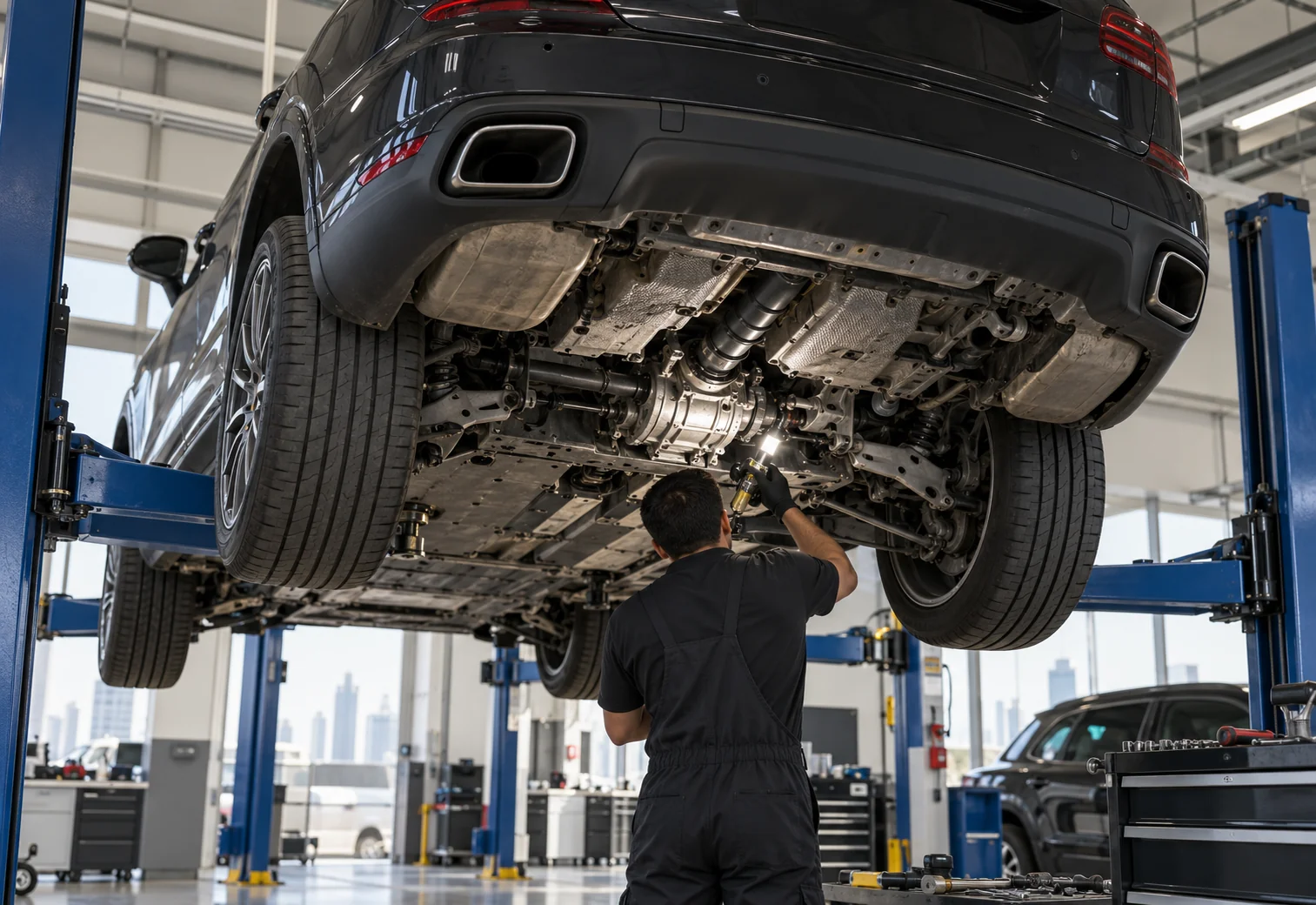
Porsche Cayenne problems depend on the generation, engine and fitted equipment. Early V8 coolant pipes, drivetrain vibration, air-suspension leaks and engine oil leaks need different checks. A reported fault pattern does not establish that your car has the fault or needs the same repair.
Start with the complete warning message, then identify the vehicle. This guide covers combustion and hybrid Cayennes from the first three generations. The battery-electric Cayenne requires separate guidance.
When to stop and when to arrange diagnosis
Follow the exact dashboard instruction and the Porsche manual for your vehicle. Colour alone does not decide whether driving is safe. Do not keep restarting a car to see whether a serious warning disappears.
| Symptom | Next step |
|---|---|
| Oil-pressure warning, overheating, steam or rapid coolant loss | Stop safely and switch off as instructed. Arrange assistance before restarting. Do not open a hot or pressurised coolant reservoir. |
| Flashing engine warning with shaking, substantial power loss or fuel smell | Stop safely and seek assistance. Do not continue driving to reproduce the misfire. |
| Chassis warning saying do not drive off, or suspension too low for safe clearance | Follow the instruction and arrange assistance. A yellow warning can still prohibit driving. |
| New clunk, vibration, recurring fluid loss or cold-start rattle | Arrange prompt assessment. Severity, warning wording and vehicle condition determine whether recovery is needed. There is no blanket safe waiting period. |
| Service reminder without a new fault symptom | Check the correct maintenance schedule and service record, then book due work. |
A disappearing warning is not a repair
Capture the message only when safely parked. Do not clear fault codes before diagnosis. A burning smell, active leak or noise that becomes louder needs assessment even when no warning lamp remains on.
Identify your Cayenne generation and engine
| Generation | Typical engine families | What changes the investigation |
|---|---|---|
| 955, introduced 2002 | 3.2 V6 and 4.5 V8 petrol, including Turbo | The early V8 coolant-pipe guidance does not apply automatically to the V6. |
| 957 facelift, introduced 2007 | 3.6 V6, 4.8 V8 petrol and later 3.0 V6 diesel | Confirm petrol versus diesel, the fitted suspension and previous component updates. |
| 958, introduced 2010 | V6 and V8 petrol, 3.0 V6 diesel, later 4.2 S Diesel, S Hybrid and S E-Hybrid | Engine, transfer-case version and campaign eligibility require VIN-specific checks. The 4.2 S Diesel belongs to this generation. |
| 9Y0 family, introduced 2017 | 9YA SUV and 9YB Coupe with turbo V6, V8 and E-Hybrid variants | Use exact model year and option codes. A 2023 air-strut bulletin is not guidance for every third-generation car. |
Launch years are orientation, not precise model-year boundaries in every market. Bring the VIN, registration, engine details and dated repair invoices. An imported car can have different equipment and campaign coverage from a UAE-delivered car.
Early V8 coolant pipes and leak diagnosis
Porsche technical information 1304 describes checking whether aluminium coolant pipes are fitted to 2003–2006 V8 Cayennes. Its inspection method can identify the relevant support using a borescope without dismantling the intake. Check the fitted parts before assuming the original plastic pipes remain.
Read Porsche’s early V8 pipe-identification guidance. This establishes inspection applicability, not a failure rate or a universal replacement interval.
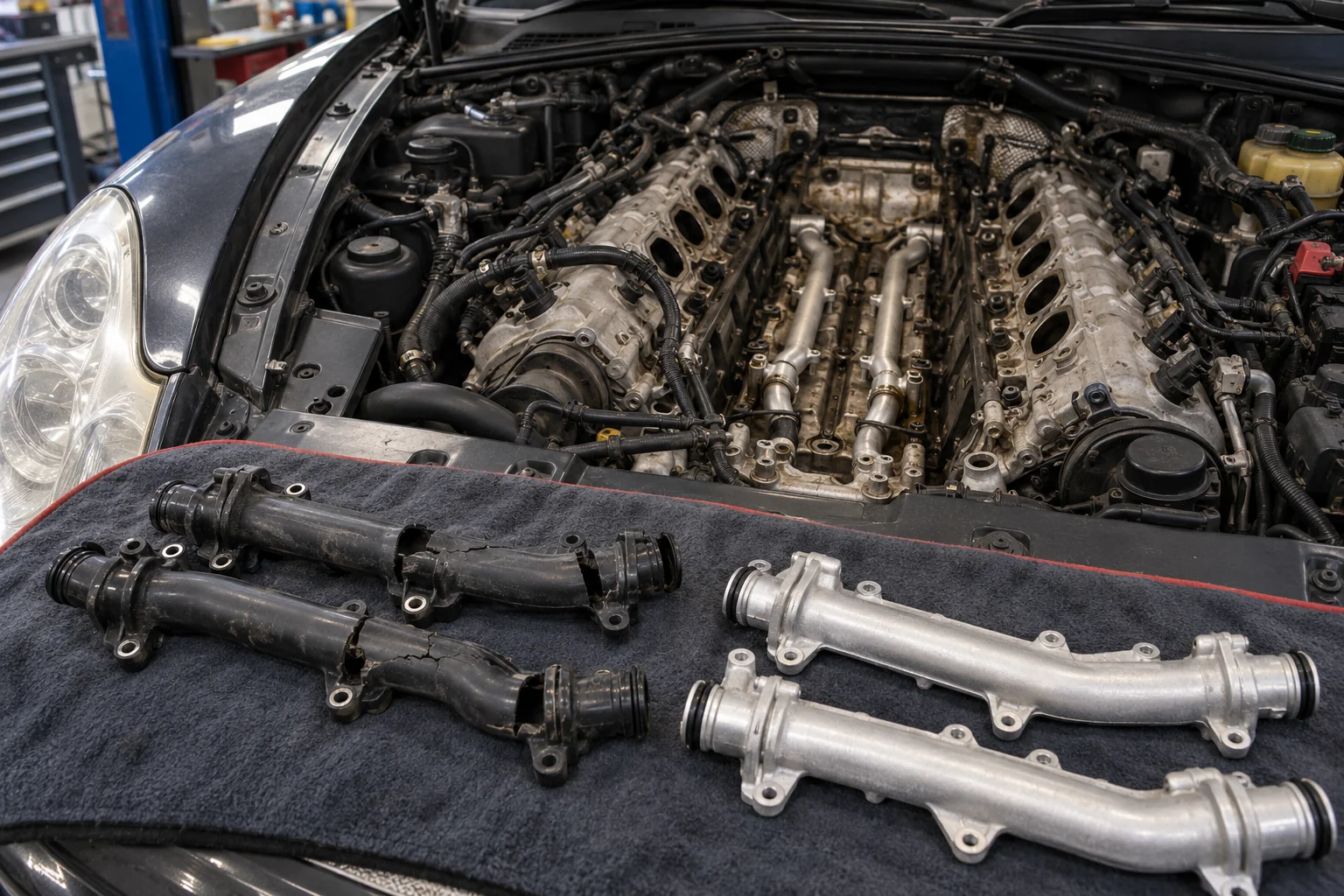
Coolant beneath the rear of the engine does not identify the source. A controlled pressure test, visual tracing and suitable access help distinguish pipes, connections, thermostat housing and pump leaks. The technician should check nearby components for contamination and explain any access needed before dismantling.
Replacement should include the compatible parts and seals, specified coolant, correct filling and bleeding, and a repeat leak check. A thermostat, starter or water pump is not automatically included or condemned because the pipes leak. Use the coolant-leak diagnosis page for investigation scope.
Separate prop-shaft vibration from transfer-case faults
A clunk on take-off or vibration under load can involve the prop-shaft support, joints, mounts, tyres or transfer case. The speed at which it occurs is useful evidence, but there is no single road speed that proves a transfer-case failure.
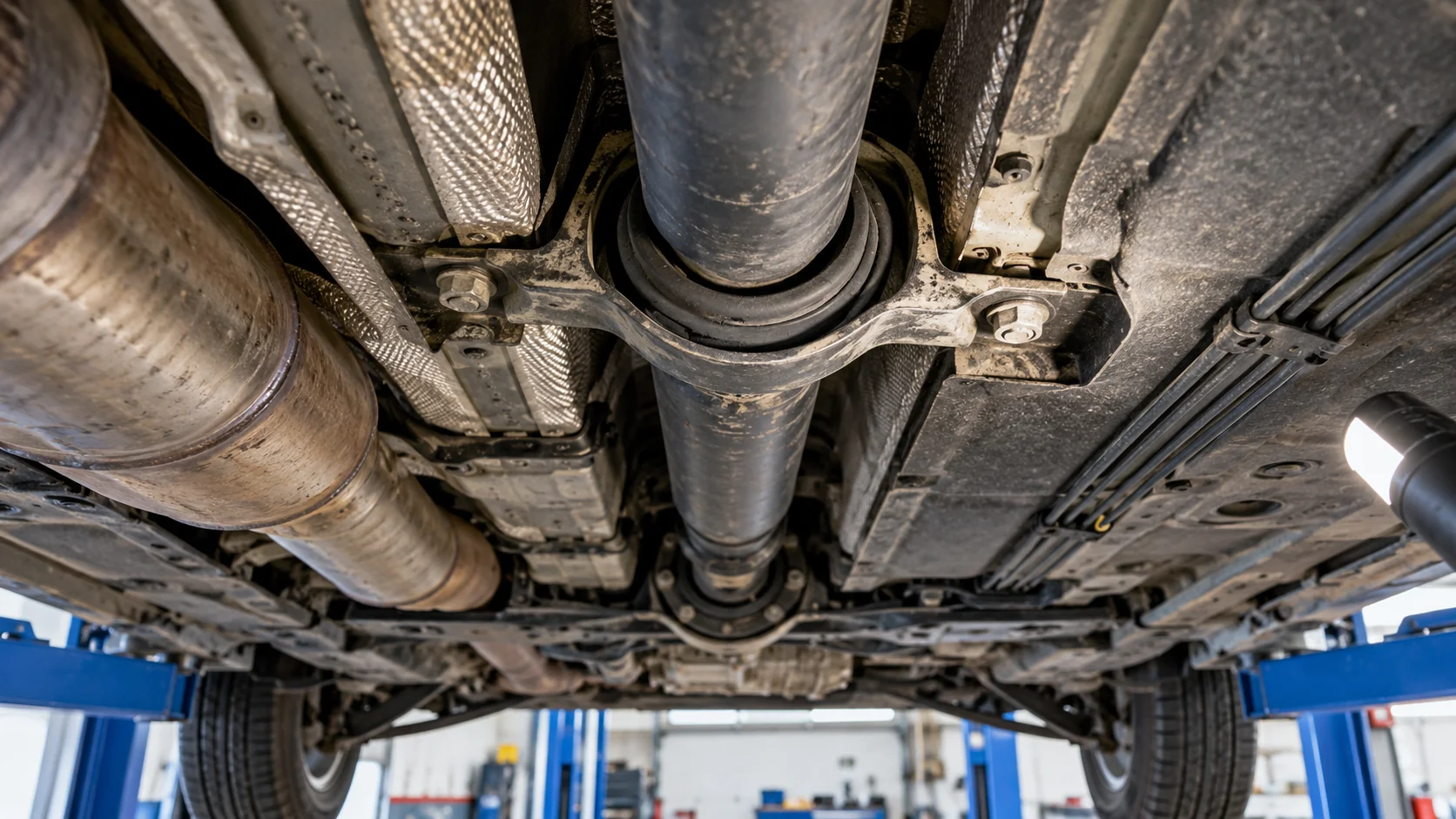
Prop-shaft support and joints
On an early Cayenne, inspect the centre support, shaft joints and relevant mounts. If the shaft is otherwise serviceable, a suitable support repair may avoid replacing the whole assembly. Worn joints or damage can require a different solution. Confirm balancing, supplier conditions and warranty in the quote.
Transfer-case shudder
For a 958 with judder under load, first establish tyre fitment and condition, fault records and the circumstances of the symptom. A technician may assess the relevant transfer-case controls and fluid history after excluding other drivetrain causes. A road test should happen only when the car is safe to drive.
Fluid service, actuator work and complete unit replacement are different scopes. Fresh fluid cannot be promised to repair internal wear. Ask which finding supports the proposed repair and whether any current campaign or coverage applies to the VIN. See gearbox and drivetrain repair scopes.
Misfires, oil leaks and engine-condition checks
A misfire code does not identify the replacement part
Ignition coils and plugs are possible causes on petrol engines, alongside fuelling, intake and mechanical faults. Fault records, operating conditions and targeted tests guide the next step. A coil-swap result can help isolate an ignition fault, but a persistent cylinder misfire may require further testing.
Oil use and bore assessment
Record oil added, mileage, smoke and noise. Check for external leaks and the correct level-measurement conditions before attributing consumption to cylinder wear. Engine family and inspection findings matter more than a broad statement that every V8 is at risk.
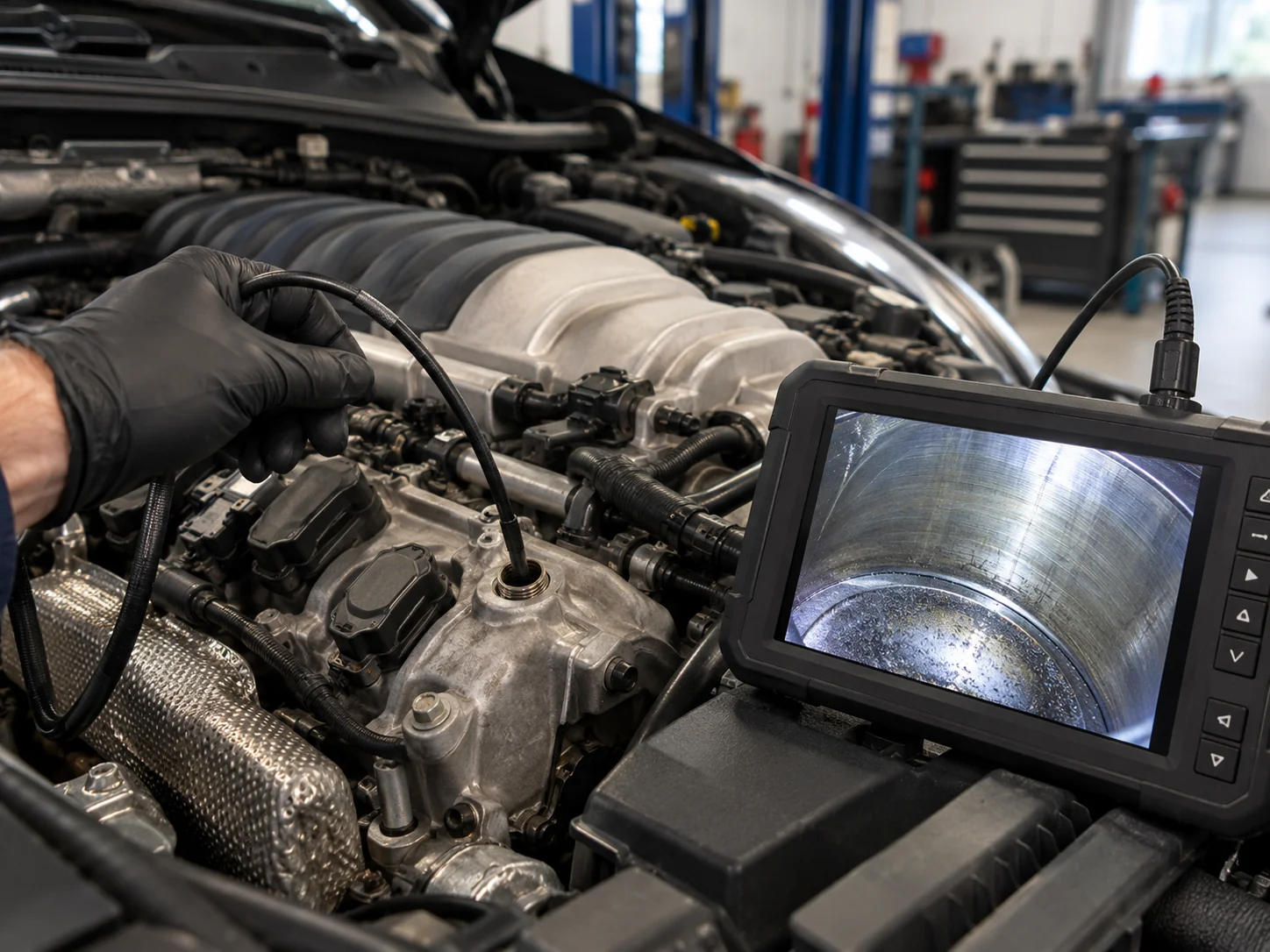
A borescope can reveal visible damage on inspected surfaces. Compression and leak-down tests answer related sealing questions but do not independently exclude all bore damage. Ask for labelled images and the limits of the inspection. If damage is confirmed, compare engine-specific machining or liner options and replacement-engine condition rather than assuming one rebuild method suits every block.
Timing-cover leaks on specified 958 engines
Porsche bulletin 2000.2 identifies Cayenne V6 turbo and V8 applications from 2011–2017. Where the stated timing-cover leak and failed-part conditions are established, it requires engine removal and a complete reseal. It does not establish that every oil leak needs engine removal.
Use oil-leak diagnosis to locate the source. A cover reseal is not automatically a timing-chain replacement.
Cam-adjuster campaign checks
Certain 2011 Cayenne S and Turbo vehicles were included in US recall 17V368, campaign AH08. Ask a Porsche Centre to check current eligibility and completion against the VIN and original market. A public recall document is not proof that your UAE vehicle is covered.
Air suspension and the 2023 front-strut bulletin
First confirm that air suspension is fitted. PASM damping control alone does not establish air-spring fitment. A low corner can involve a strut, line, valve block or another system fault. A compressor running excessively may be responding to a leak rather than being the original cause.
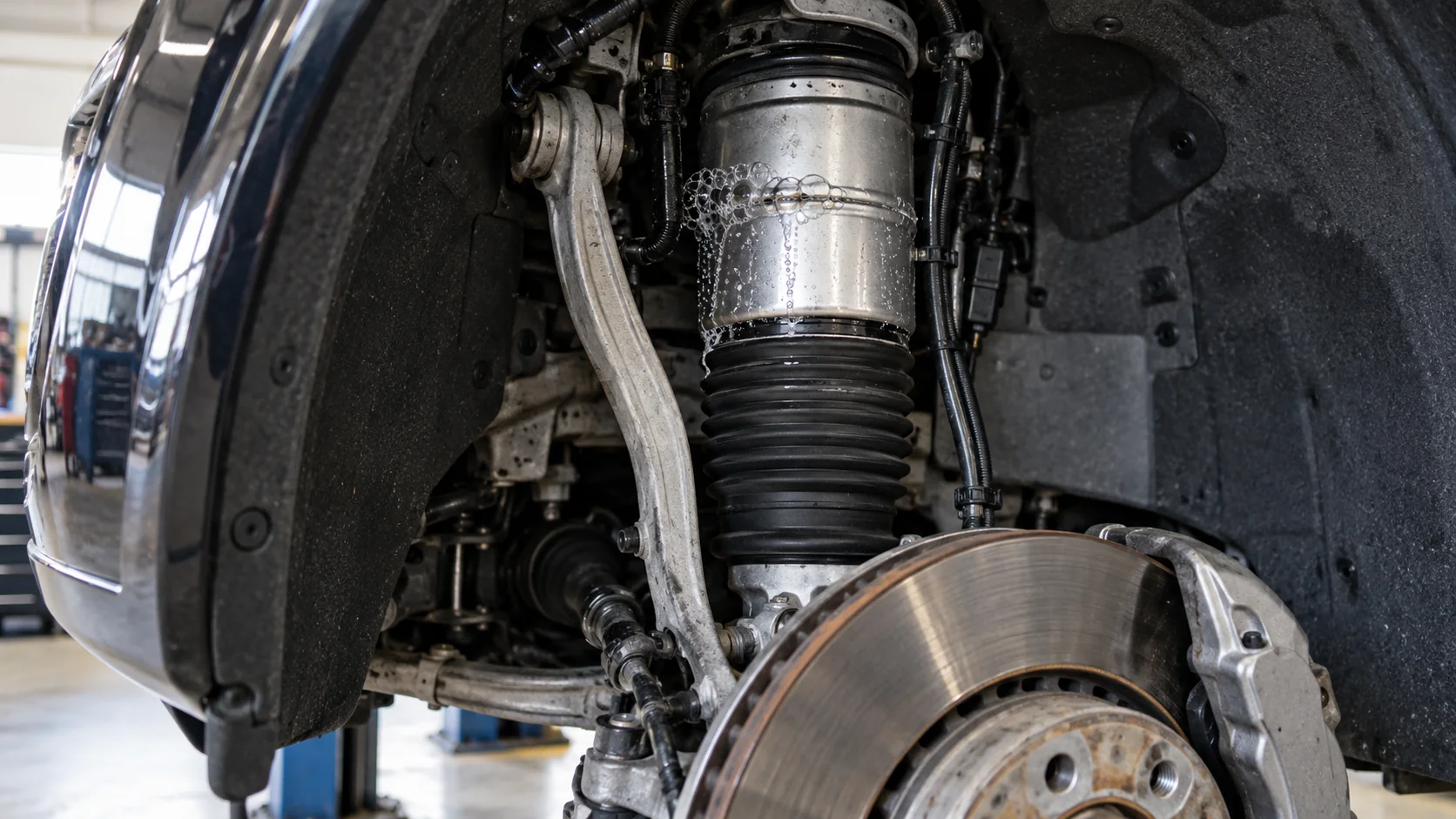
Porsche bulletin 43/25 concerns model-year 2023 Cayenne 9YA/9YB with specified air-suspension equipment. It calls for checking the front air-strut plastic welded seams. A confirmed leak at either specified seam leads to replacing both front struts under that procedure. If neither seam leaks, the bulletin says to continue troubleshooting elsewhere.
Its warnings include a yellow message telling the driver to wait for readiness and not drive off. Follow the actual message rather than a generic yellow-versus-red rule. For other faults, compare leak-test findings, height-sensor readings and compressor performance before quoting suspension repair.
Hybrid, electrical and newer-generation symptoms
On a 9Y0 turbo V6, coolant-control and cover-leak investigations must match the actual engine and installed components. A parts catalogue confirms a component exists, not that it commonly fails. Temperature records, leak location and relevant fault tests should support replacement.
Multiple electrical warnings can involve supply voltage, wiring, a sensor or network communication. Save accessible fault records, test the relevant power supply and investigate the affected system. Low voltage is a possible cause, not a reason to replace the 12V battery without testing.
Hybrid task eligibility depends on the procedure and vehicle condition. Engine, cooling or chassis work can require precautions or isolation even when the part being replaced is not the traction battery. Confirm that the workshop can perform the exact task before booking. High-voltage diagnosis, isolation and component work requiring capability outside the agreed scope must go to a suitably equipped and qualified provider. Owners should not open orange-cable connections or high-voltage enclosures.
Cayenne diagnosis costs and repair quotations
| Work | Estimate including VAT | Scope |
|---|---|---|
| Initial diagnostic assessment | AED 200 to 500 | Complaint review and agreed initial checks. Extended tracing, dismantling, programming and parts are separate. |
| Engine oil and filter service | AED 650 to 1,600 | Engine-matched approved oil within the agreed quantity, filter and routine labour. Other due items and fault repairs are separate. |
These are the estimates published on our Cayenne repair page. An oil service is not a substitute for investigating a warning. A written repair quote should identify parts, labour, consumables, tax, exclusions and any additional testing requiring approval.
For coolant pipes, ask whether identification or intake removal is needed and whether adjacent damage is included. For drivetrain work, compare support-only work with a complete shaft or transfer-case scope. For suspension, distinguish one corner from a pair and record new or remanufactured parts, core charges, alignment and calibration separately. Confirm parts lead time and written warranty terms before authorising work.
Keep evidence and maintenance decisions together
Dubai use should inform inspection priorities without inventing a universal service interval. Tell the workshop about dust exposure, short journeys, towing, off-road use or long storage. Check accessible radiator openings and service records, but leave hot, raised or electrically hazardous areas alone.
Keep the original complaint, fault report, measured results, leak photographs and agreed scope. After repair, ask what was rechecked and what remains to monitor. Intermittent faults may require further observation. For a car you are considering buying, arrange a separate pre-purchase inspection rather than treating this fault list as a verdict on the vehicle.
Manufacturer bulletins describe defined conditions and procedures. They do not rank failure frequency, prove that a car is defective or establish free repair entitlement. Current vehicle-specific service information takes precedence over a general guide.
Cayenne problem questions
Does every early V8 need new coolant pipes?
No. Establish which pipes are installed and whether there is a relevant fault. Porsche provides an identification method for the specified early V8 applications. Previous replacement records can be helpful but should match the vehicle.
Can I drive with a yellow chassis warning?
Read and follow the full message. Some yellow chassis messages explicitly prohibit driving off. Ride height, tyre clearance and the vehicle’s behaviour also matter. Seek assistance if the instruction or safe condition is uncertain.
Does shudder mean the transfer case has failed?
No. Tyres, shaft components, mounts and other drivetrain faults can produce similar symptoms. Diagnosis should establish the cause before fluid service or unit replacement is approved.
Is a newer Cayenne guaranteed to be more reliable?
No guarantee follows from age or generation alone. History, equipment, prior repairs and current inspection findings are more useful than an unsupported ranking.
Is a technical bulletin a free recall?
No. A bulletin supplies technical guidance. Recall, campaign and warranty eligibility are separate matters confirmed against the VIN, market and current records.
Discuss the symptom before approving parts
Share the model year, engine, exact warning and when the symptom happens. We can discuss the initial diagnostic scope and written quotation. For a stop instruction or severe symptoms, arrange assistance rather than driving in. Porsche Repair Dubai is an independent workshop, not an authorised Porsche dealer.