Roof A
Sliding or tilting sunroof
An opening glass or metal panel. Depending on the design, it slides within or above the roof. Equipment and mechanism vary by generation.
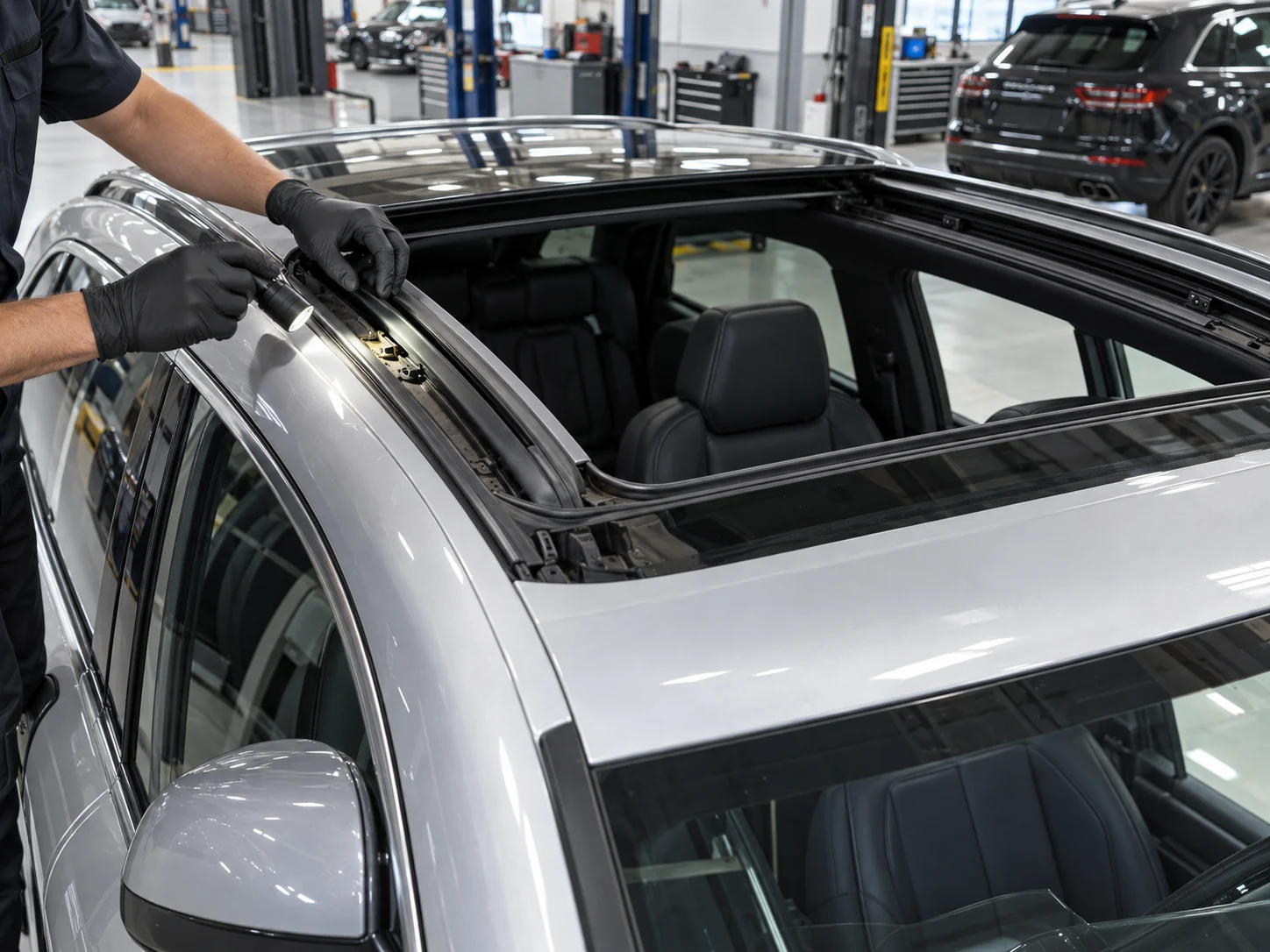
A wet footwell, a roof that stops halfway or a rattle above your head each need a different fix. We find out first whether water or movement is the problem, test the drains, seals and mechanism, then quote the repair for your exact roof.
Use these indicative budgets to plan a repair, not as fixed workshop offers. Each range covers one vehicle and the limited work described, including normal labor and 5% VAT. The final written quote identifies the fault, parts source, access work and total before approval.
Drain-flow checks, clearing accessible blockages and a repeat water test. Excludes damaged hoses, headliner removal and interior drying.
A limited hose, seal or adjustment repair after the source is identified. Includes agreed materials and retesting. Large seals, bonded glass and cassette work need a separate quote.
An isolated electrical fault with the repairable area identified. Includes the agreed small component or wiring work and function checks. Control units and widespread water damage are excluded.
Selected motor, cable, transmission or guide repairs where components are separately available. Includes agreed access and fitting. A complete cassette, glass panel or hydraulic overhaul can exceed this range.
Diagnosis of an unknown fault, major dismantling, special-order parts, fabric replacement and water-damage restoration are priced separately unless included in writing. A fixed glass roof, modern Targa mechanism or complete roof assembly needs its own estimate. Ask for the investigation fee before testing begins.
Choose a roof type below, or simply tell us your Porsche model and the problem. We identify the fitted roof during the enquiry. A photo can help, but you do not need a chassis number or technical diagnosis to contact us.
An opening glass or metal panel. Depending on the design, it slides within or above the roof. Equipment and mechanism vary by generation.
Opening panoramic systems need drain, seal and movement checks. Fixed glass roofs need a different assessment and have no opening motor or sliding mechanism.
Early Targas have removable panels. The 993, 996 and 997 use sliding glass. The 991 and 992 use a folding roof beneath a moving rear window.
Boxster and 911 Cabriolet mechanisms differ. Electric drives, cables, transmissions, latches or hydraulics are checked according to the exact generation.
Water ingress and movement faults need different tests and can occur together. Rattles, glass damage and wind noise also need assessment. A wet footwell alone does not prove the roof is the source.
Usual causes are blocked or loose drains, a tired outer seal, a misaligned panel or a leaking frame corner.
Usual causes are guide rails, cables, motors, hydraulic cylinders, sensors, microswitches or the roof control unit.
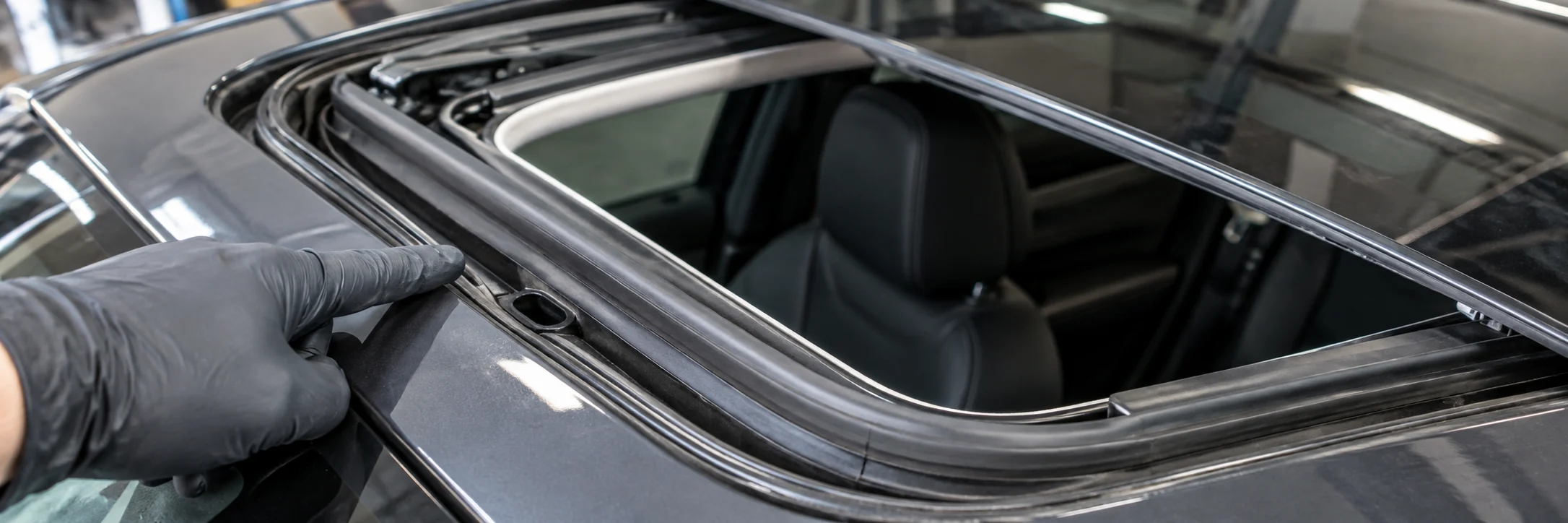
Many opening sunroof systems use a seal, water channels and drains together. Water passing the outer seal runs into a tray in the frame and leaves through drain hoses at the corners, down the pillars and out under the car. When a hose blocks or comes loose, the tray overflows and the water finds its way inside.
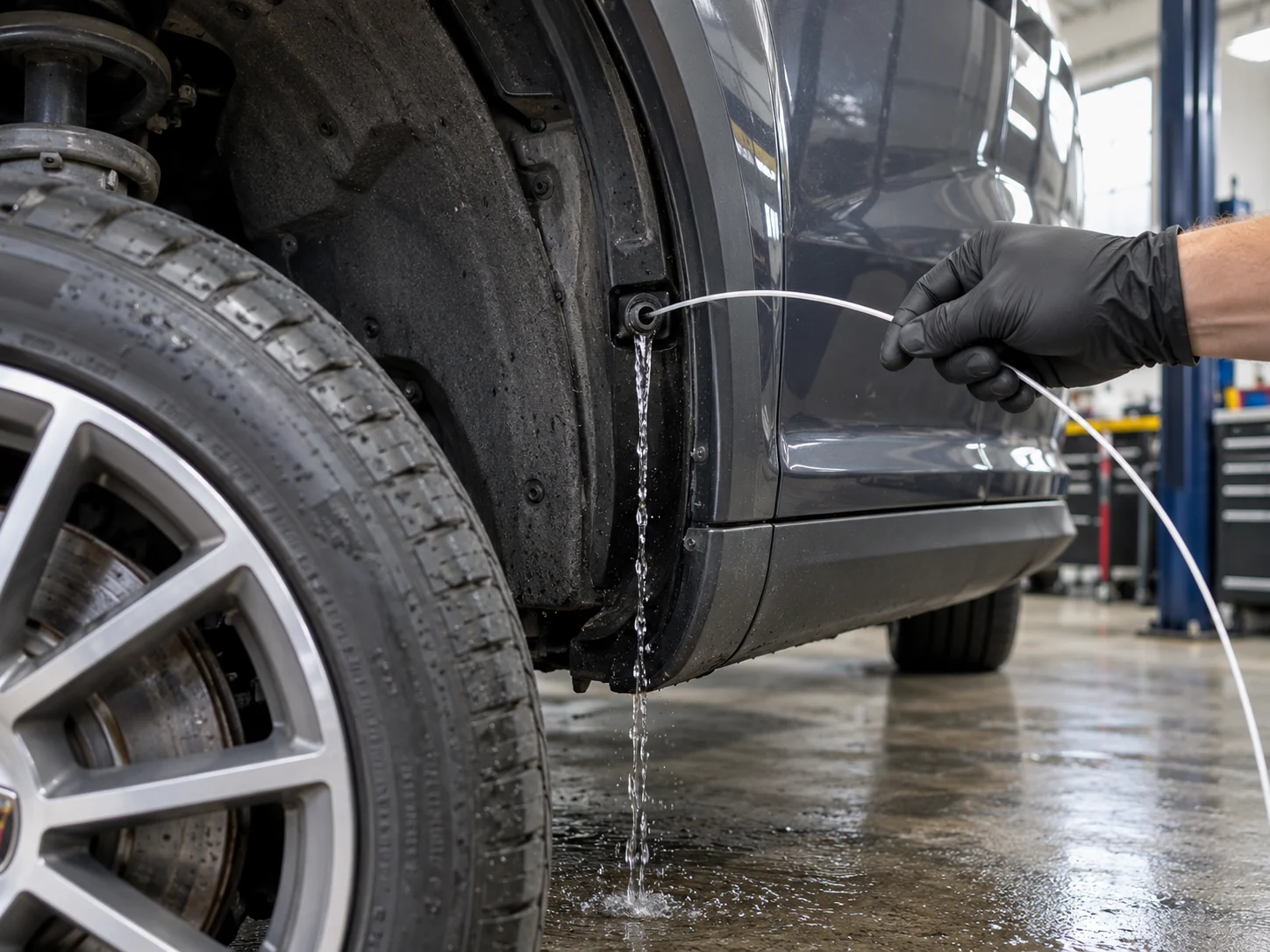
Water is poured into the frame channels with the glass open to see whether it flows out cleanly at each outlet. The cleaning method follows the applicable procedure. Certain Macan drain guidance describes access from below and warns against hose damage. That method should not be applied to every Porsche roof. A disconnected or damaged hose needs inspection and repair, not simply more cleaning.
Porsche bulletin 1903 describes water management for specified Panamera, Cayenne and Macan panoramic systems. Seals, glass position, frame joints and drains work together. The checks below are not an instruction to replace every component in sequence. Findings and the current model-specific procedure determine the repair.
Check the frame position against the applicable dimensions before deciding whether adjustment is needed.
Check panel height and gaps against the model-specific specification. Do not assume every edge should sit exactly flush.
Inspect condition and contact. Adjust or replace the seal only where the findings and repair instructions require it.
Drains are checked for blockage, leaking hoses and poor connection at the frame.
Confirm any frame-joint leak and follow the applicable repair instructions. A drain blockage alone does not justify a new frame.
A replacement frame does not correct every possible leak. Seal condition, fitting and drain connections still need checking. Any seal supplied or replaced with the frame must be listed in the quote.
Each row shows what owners usually notice, what we test, the repairs that follow and what affects the work. Your quote lists only what the tests prove.
Water at the top of a pillar, a panel that will not slide, a motor that hums but nothing moves, or wind noise at speed.
Drain flow at each corner, seal condition, panel height against the roof, motor current and the guide mechanism with the headliner lowered if needed.
Drain clearing, seal replacement, panel adjustment, guide or cable repair, motor replacement and initialisation of the roof position.
Access determines labor. Some mechanism repairs require headliner removal, while others do not. The quote separates testing, access, parts and reassembly.
Wet headliner edges, water in the boot, a creak over bumps, the front panel stuck open or a blind that will not move.
Water poured into the rails, drain outlets, outer seal fit, glass alignment, frame corners and the blind and panel motors.
Depending on the confirmed fault, work may involve drains, hoses, seals, adjustment, drives or a replacement frame. Fixed glass requires checks of the glass and bonded joints rather than an opening mechanism.
A clearable drain differs from a damaged hose, seal or cassette. Frame replacement requires more access and must follow a confirmed diagnosis.
Roof will not open, a roof fault message, a slow or jerky movement, or a leak at the roof edge.
Roof generation and fitted mechanism first, then the relevant seals, drives, sensors and fault memory. Hydraulic tests apply only to hydraulic systems.
Repair the confirmed fault using the correct generation-specific procedure. Removable panels, sliding glass and modern folding roofs need different parts and settings.
Quote panel or seal work separately from sliding-roof drives or modern folding-roof hydraulic components. Do not infer the mechanism from the Targa name alone.
Top stops halfway, fluid stains on the top lining, a top that will not latch, a torn seam, a cloudy rear window or water at the side windows.
Identify the drive system, then check electrical supply, interlocks, latch, switches, cables and linkages. Hydraulic pressure and fluid checks apply only where fitted.
Depending on the roof, repairs may involve an electric drive, transmission, cable, linkage, latch, switch, hydraulic component, seal, window adjustment or fabric.
Access, fault testing and parts availability determine timing. One failed component does not automatically require a pair or a complete top. Fabric work has a separate fitting and testing allowance.
The stopping point helps diagnosis, but the sequence differs by model. Tell us what happened during the last normal operation. Share an existing video only if you have one. Do not cycle a jammed, uneven or leaking mechanism to create a new recording.
The front latch releases from the windscreen frame. A stuck latch or a faulty switch stops everything here.
Electric drives or hydraulics move the roof, depending on the model. Uneven movement can also come from a cable, transmission or linkage fault.
The top folds into its compartment. Position sensors tell the control unit each step is complete.
A compartment lid closes on designs that have one. Other systems use a different arrangement. The correct end-position signals must be confirmed.
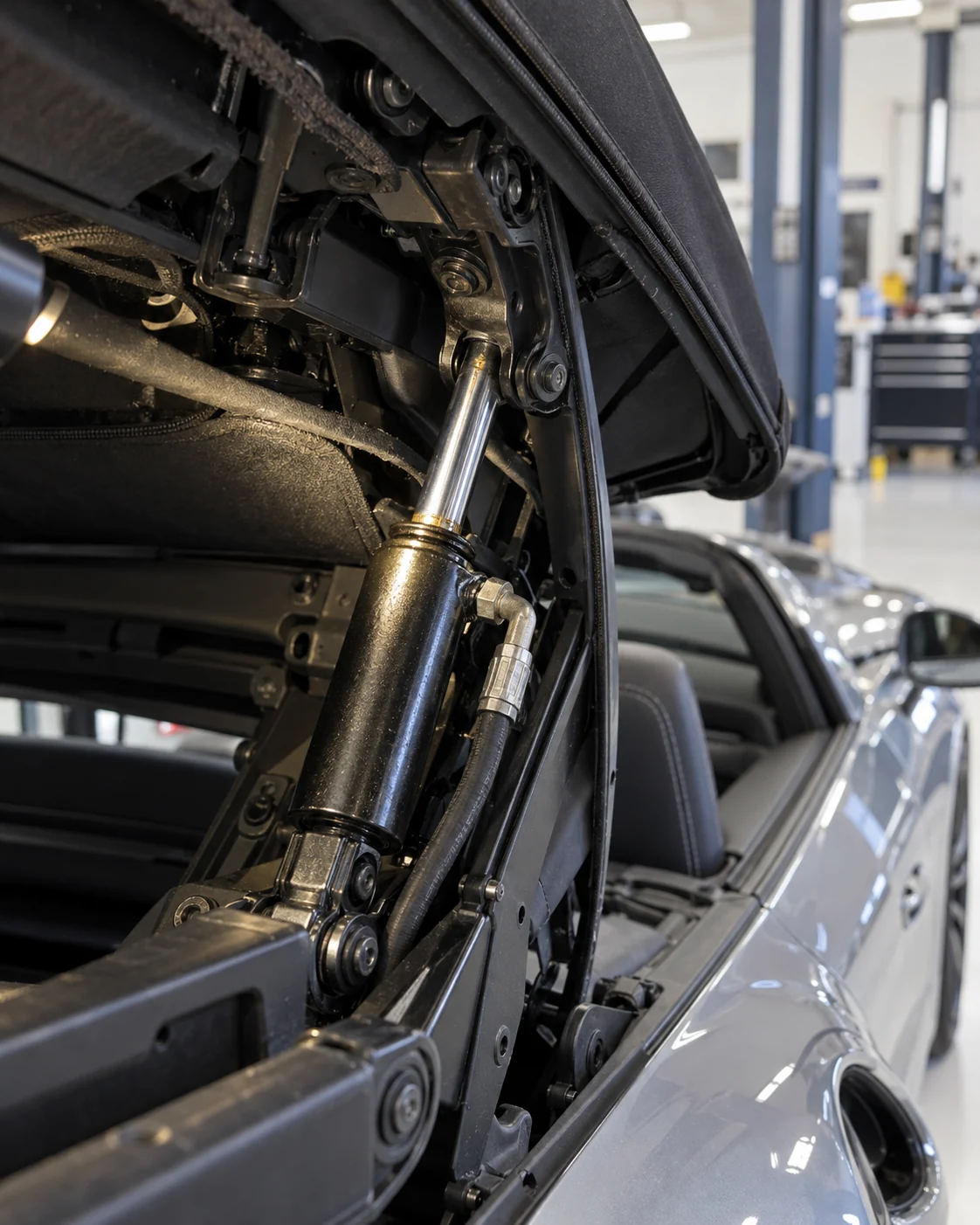
When a convertible top cylinder leaks, hydraulic fluid can run onto the lining and fabric before the top stops working. Stains are often the first sign. Prompt assessment can limit further contamination, although existing fabric or electrical damage may still need separate work.
A roof warning points us toward a test. It does not prove that the pump, motor or control unit needs replacing.
Compare the stored faults with the warning and the point where roof movement stopped.
Test power supply, interlocks and the mechanism. Low voltage, sensor connections and resistance can produce similar symptoms.
Correct the underlying fault before performing the required settings or initialization. Never use a reset to force a jammed roof.
Fixing the leak is only half the job. Water that already got inside can sit under carpets, soak sound insulation and reach control units. Porsche has recorded cases where a blocked or loose rear drain led to a wet boot trim, a rear parking assistant that stopped working and electrical faults in rear control units.
Stains, sagging and wet trim show where the water entered.
Carpets and underlay are lifted to check for standing water and wet insulation.
Connectors and modules under seats are checked for moisture and corrosion.
Boot trim, spare wheel well and any rear modules are checked for water.
A musty smell warrants a moisture check. Wet insulation may need drying or replacement. Existing corrosion and electrical faults require separate assessment.
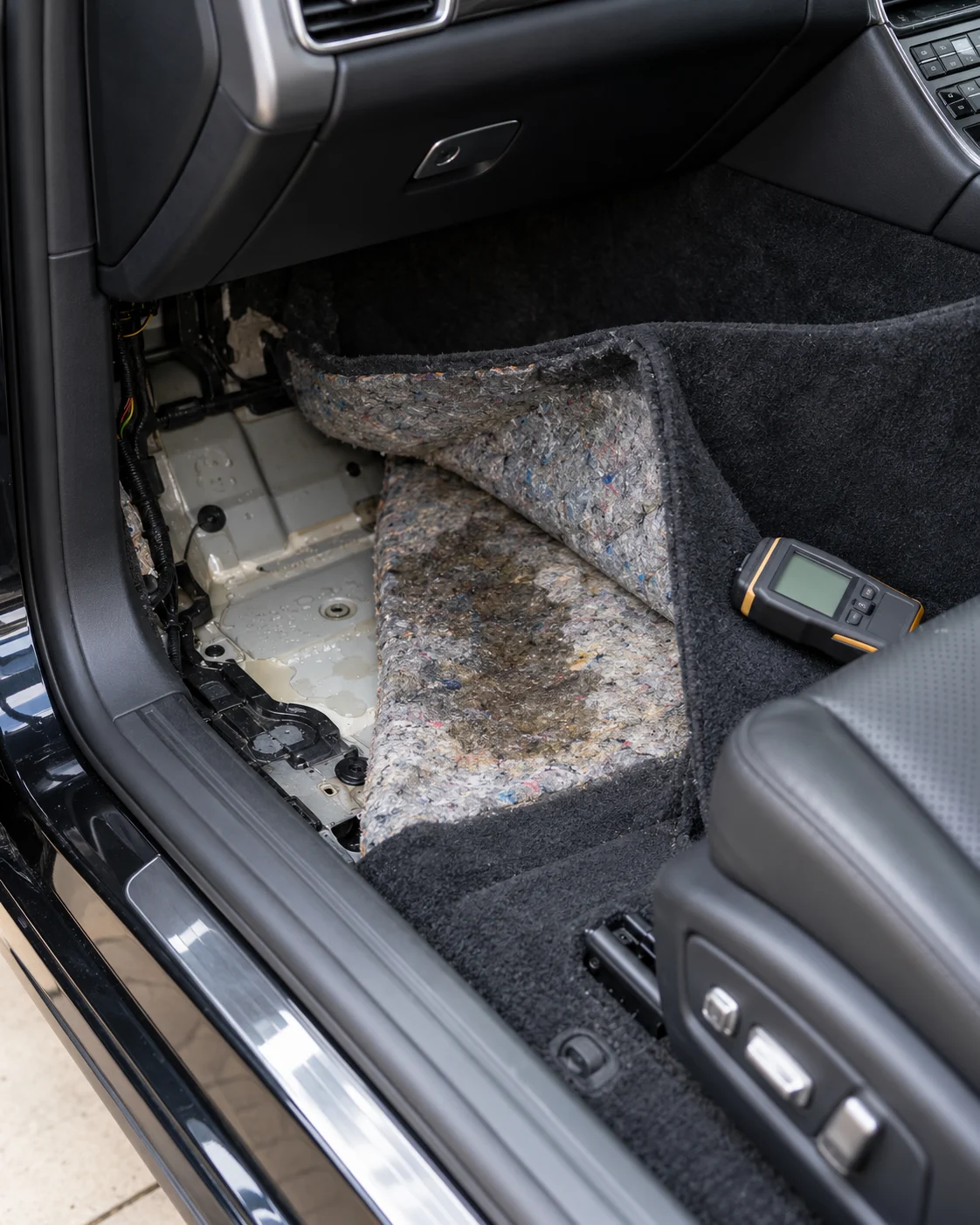
If water has reached electrical parts, faults are read from every control unit. Our computer diagnostic page explains how. Water stained leather is covered on our leather seat repair page.
A leak test recreates the water that gets into the car, one area at a time, while someone watches inside. Testing a section at a time is what separates a drain fault from a seal or frame fault.
Trims are dried and checked so new water is easy to see.
With the glass open, water is poured into each channel to confirm it leaves through every outlet.
Low pressure water is run over each seal section and corner in turn, never a pressure washer.
The headliner edges, pillars and footwells are watched with lights for the first drip.
The same test is repeated after the fix to confirm the leak has stopped.
If the roof twists, grinds or stalls, release the switch. Keep hands and objects clear of the mechanism.
Check the exact model’s emergency instructions. Another Porsche’s closing procedure may be different.
Move under cover only if safe. If the roof cannot be secured, request help before driving.
Mention water near electrical equipment and any new warnings. An existing photo is enough to start the conversation.
These illustrative quotations show how different faults change the bill. They are not records of completed customer jobs or guaranteed prices. Each assumes the stated fault is confirmed, parts are available and there is no additional hidden damage. Totals include 5% VAT.
Example total AED 630
Water-flow checks identify an accessible blockage. Existing hoses remain connected and undamaged, so no replacement part is assumed.
Excludes headliner removal, new hoses, carpet removal and electrical repairs. If water is already inside, drying and moisture checks need a separate allowance. Completion depends on access and retest results.
Example total AED 1,470
Assessment finds a localized hose connection problem. This example allows limited trim access and a compatible new hose component, with no leaking roof cassette.
Excludes a complete cassette, extensive headliner work and interior restoration. The actual part number and access requirement are checked before ordering. Wet insulation can extend the overall visit.
Example total AED 3,150
The 981 electric roof has a separately repairable drive fault. The example assumes a compatible new drive component and sound fabric, linkages and mountings.
Excludes a complete frame, fabric replacement and unrelated control-unit faults. The selected part and function tests must be itemized. Parts arrival and workshop time are confirmed separately.
A lower quote is only comparable when the part condition, access, testing, VAT and warranty scope match. Additional work should be explained and approved before it proceeds.
Two quotes both headed sunroof repair can describe very different work. One may clear an accessible drain, another may include hidden hose access and interior drying. Check what each quote covers before you compare the totals.
The roof glass is replaced on its existing frame and mechanism. The quote should name the panel, the seals and hardware supplied, the fitting method and any curing time before the car can be used.
A separately available motor, cable or guide is fitted. Ask what test showed the fault and whether the rest of the mechanism moves correctly before you approve it.
The frame and its mechanism are replaced as one unit. Ask which parts the unit includes, the exact part reference, and why a separate repair is not supported for your roof.
AssessmentTesting and any agreed dismantling.
Parts and repairA special order panel or cassette can take longer to arrive than to fit.
Finish and retestReassembly, settings, water or function tests, and any drying or curing time.
If your car still has a Porsche warranty, an extended policy or insurance cover, check those terms before you approve independent work.
Sand and debris can collect in channels and rails. Keep accessible surfaces clean and use only the products specified for your roof. Maintenance intervals and lubrication points vary by model. Do not apply a universal six-month schedule or use general-purpose spray on every seal and mechanism.
Tell us the model and whether the problem is a leak, noise, damaged glass or movement fault. Photos and existing warning messages are optional. We can request the VIN privately later if it is needed to identify parts.
Manufacturer information helps explain the differences between roof systems. These sources do not establish a diagnosis for your car or imply affiliation with Porsche. Current model-specific repair procedures take priority.
Porsche bulletin 1903 discusses seals, frame channels and drains on the models listed in the document. It supports checking the complete water-management system.
Porsche’s histories explain why Targa and Boxster mechanisms should not be grouped under one hydraulic repair process.
Explore Targa roof generations
Read about Boxster roof development
Request the identified leak or movement fault, fitted part details, relevant fault records, water or function-test results, drying work and written warranty terms. These help with follow-up if symptoms return.
Straight answers about sunroofs, panoramic roofs, Targa roofs and soft tops.
Most often a drain is blocked or loose, so the water tray in the frame overflows. A worn outer seal or a panel sitting out of line can add to it. The drains are tested first because they are the simplest fix.
Yes. Porsche has recorded cases where rear drain problems let water reach rear control units and caused warnings and electrical faults. That is why we check connectors and modules after a leak.
Not every leak needs a frame. The source must be isolated by checking drains, hoses, seals, glass position and frame joints as applicable. Replace or adjust only the parts required by the diagnosis and current repair instructions.
Drain clearing and adjustment can be short jobs. Work that needs the headliner lowered, a frame replacement or a new fabric top takes longer. We give the expected time with the quote after testing.
A top stops when the control unit does not see the next step completed. Common causes are weak hydraulic cylinders, a latch or position switch, low voltage or a lid that does not confirm it is closed. Describe where it stopped. Do not repeatedly operate a faulty roof to record a video.
Not automatically. Inspect the hydraulic system where fitted and compare the condition of the components. A paired repair may be sensible in some cases, but the reason, parts choice and additional cost should be explained before approval.
Small tears and split seams can often be repaired. Large tears, shrunk fabric or a damaged rear window usually mean a new top. We assess it from photos and in person before quoting.
We identify the Targa generation first, then inspect the applicable mechanism, seals and controls. Stored faults guide testing but do not prove a component has failed. Adjustment, lubrication or replacement follows the diagnosis and the current instructions for that roof.
Keep the car sheltered and arrange inspection. Do not drive with an unsecured roof or loose glass. If water has reached electrical equipment, warning lights appear or vehicle functions behave abnormally, stop using the car and ask about recovery. Leak size alone does not establish safety.
Pushing stiff wire or high pressure air into a drain can split or disconnect the hose and make the leak worse. The correct access and cleaning method depend on the model. A damaged or disconnected hose requires repair rather than forceful cleaning.
Yes. Testing comes first, then a written quote listing labour, parts and VAT. Nothing is replaced until you approve it.
We do not advertise blanket percentage discounts. Any offer that applies to your job is written on the quote with its terms.
Normal washing is fine, but avoid aiming pressure washers at roof seals and soft top seams. If water appears inside after washing, that is a useful clue for the leak test.
Ask about your model and roof problem. The proposed repair and parts availability are established during assessment. If your car is still under a Porsche warranty, check with your dealer first, because roof faults may be covered there.
Tell us your Porsche model and roof problem. We explain the next check and provide a written repair quote before replacement parts are ordered.
An enquiry is not a booking. The appointment is confirmed with you directly. Porsche Repair Dubai is an independent workshop and is not part of the Porsche Centre dealer network.