
01
Water pump
Impeller damage can reduce coolant circulation; a pump seal leak can cause coolant loss. Inspect the pump and confirm the leak source before replacement.
A Porsche thermostat can be a small insert in an accessible housing, an assembly buried under the intake, or a coolant control valve on newer V6 engines. Diagnosis combines temperature data with cooling-system and sensor checks. Routine thermostat or housing replacement is estimated at AED 1,200–3,000 including 5% VAT, subject to the engine, assembly and access required.
These are indicative planning estimates including 5% VAT, not fixed offers for every Porsche. The written quotation identifies the engine, required component and access before you approve work.
| Work | Estimate including VAT | Included assumptions |
|---|---|---|
| Initial leak assessment and pressure test | AED 200–650 | Initial inspection and appropriate pressure testing. Confirm included time. Extra dismantling and extended diagnosis require approval. |
| Routine thermostat or housing replacement | AED 1,200–3,000 | One applicable new assembly, required seals, routine fitting, specified coolant refill, bleeding and operating checks. |
| Deep-access or integrated control assembly | Vehicle-specific quote | Identify engine, housing or valve, intake removal, gaskets and any further procedures. Work can exceed the routine range. |
| Pump and thermostat together | Itemised combined quote | Only the approved components and verified shared labour. Do not add two standalone prices where access overlaps. |
| Hybrid or electric thermal circuit | Separate assessment | Identify the circuit, component and qualified procedures. Engine-thermostat estimates do not cover all thermal-management work. |
Compare the part brand and specification, included gaskets and fasteners, labour, coolant specification and quantity, VAT and final checks. Hoses, pumps, radiators, damaged fittings, contamination and overheating damage are separate unless listed. Ask for the expected completion time and parts lead time.
A temperature trace can support diagnosis, but cannot identify a faulty thermostat alone. Warm-up depends on ambient conditions, engine load, heating demand and the fitted control strategy. Check sensor plausibility, coolant circulation and other findings before interpreting the pattern.
Illustrative patterns only, not customer measurements or universal time and temperature limits. Do not run an engine until it overheats as a home test.
Thermostat faults show up at both ends of the scale. The symptom decides how urgent the visit is. For an overheating or stop-engine instruction, stop safely and switch off. Do not drive to demonstrate the fault. Keep clear of steam and never loosen a hot coolant cap. A low or steady gauge alone does not establish that driving is safe.
Stop safely and switch off. Continued driving risks head gasket and engine damage. Ask about recovery.
Can be a thermostat opening late, but also fans, a blocked radiator or low coolant. Book a check soon.
A thermostat sticking, air in the system or a sensor fault. Combine live readings with sensor, circulation and bleeding checks.
Often stored as fault code P0128, which means coolant stayed below the regulating temperature. A stuck open thermostat is a common cause, a sensor or wiring fault is another.
Reduced cabin heat can involve engine temperature, coolant circulation or the cabin-heating system. It does not confirm a thermostat fault.
Replacing a thermostat that was never faulty wastes money and leaves the real cause in place. These are checked before the thermostat is condemned.
Impeller damage can reduce coolant circulation; a pump seal leak can cause coolant loss. Inspect the pump and confirm the leak source before replacement.
Debris obstructing the radiator or condenser fins can restrict airflow. Inspect the cooling pack and confirm whether cleaning or another repair is needed.
A fan or fan-control fault can contribute to rising temperature at idle or in traffic. Check commanded operation and actual fan response.
A faulty sensor or connector can report a temperature the engine is not actually running at.
A leak or poor bleeding after earlier work causes swings and overheating. The leak is found and fixed first.
Agree the appropriate checks for the vehicle. More than one fault can exist. Findings should distinguish a confirmed defect from further investigation before parts are ordered.
Checked cold, with the tank and cap inspected.
Engine and cooling codes read and saved before anything is cleared.
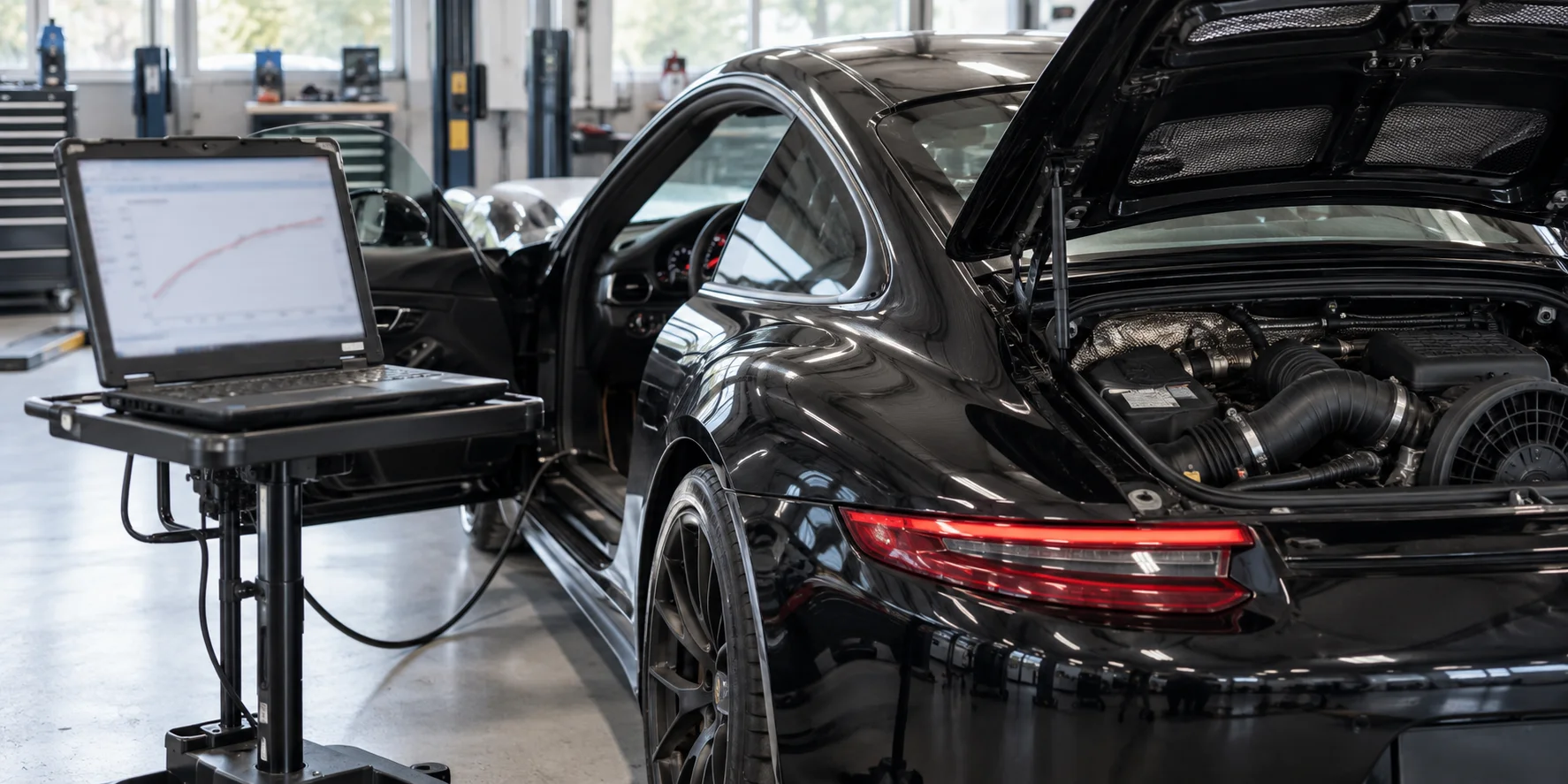
Coolant temperature logged from a cold start, as in the curve above.
Compare temperatures at appropriate points using the model-specific procedure. Sensor accuracy, flow and the control strategy affect interpretation.
System held under pressure for leaks, and fan operation confirmed.
Thermostat, pump, radiator, fan or sensor, with the exact part for your engine.
Porsche bulletin 93/11 describes a regulator that can fail to open without a related DME fault code on specified MY2011 Cayenne Hybrid vehicles with engine M06.EC. Modified regulators entered production from 19 November 2010. This example does not diagnose other vehicles. Read bulletin 93/11.
The part revision and access determine the quotation. The thermostat opening specification is not the dashboard warning threshold. Use applicable vehicle information rather than a universal temperature or model-year rule.
Confirm the exact engine code and replacement-part application. Chassis names such as 986, 996, 987, 997, 981 or 991 do not by themselves establish a common thermostat or access procedure.
Porsche bulletin 57/23 identifies specified M4801/M4851 engines, intake variants and replacement housing 948.106.060.06. Clearance work may be required for that combination, not every V8 replacement. Read the housing bulletin.
Confirm whether the repair concerns an insert, complete housing, regulator or electrically controlled valve. Displacement and model badge alone are insufficient to select a component. Include required seals and removed-part gaskets.
Identify whether the complaint concerns engine cooling or another thermal circuit. Similar warnings can have different causes. In the specified Cayenne case below, replacing the thermostat does not resolve the fault.
There is no combustion-engine thermostat. Pumps, regulating valves and sensors manage electric-vehicle temperatures. Identify the actual component and confirm available capability before agreeing work.
Porsche bulletin 22/15 covers specified MY2013–2015 Cayenne S Hybrid and S E-Hybrid vehicles up to production week 30/2014. A coolant-level sensor connection fault can produce a maximum gauge indication. Porsche states that replacing the coolant regulator will not resolve that complaint. Follow the warning, then diagnose the cause. Read bulletin 22/15.
The balance of parts and labour varies by engine and assembly. What changes the quote is how much has to come off to reach it, whether the housing is replaced with the thermostat, and how much coolant has to be refilled and bled afterwards.
Undertrays or covers off, coolant partly drained, thermostat and seal replaced, refill and bleed, warm up check.
Pipes, brackets or air intake parts moved aside. More coolant drained and a longer bleeding process.
Where the applicable repair procedure requires intake or other major-component removal, list that labour and any replacement gaskets in the quote.
A hybrid combines combustion-engine cooling with additional thermal requirements. Identify the affected circuit before selecting an engine thermostat, auxiliary pump, valve or sensor. Work near high-voltage components requires qualified personnel and the applicable procedures.
The Taycan has no combustion engine. Porsche describes a thermal-management network connecting pumps, valves, sensors and high-voltage components. A battery, charging or cabin-temperature concern needs its own assessment and quotation. Read Porsche’s Taycan thermal-management explanation.
Some jobs share most of the labour. Others do not. This is a decision we discuss with you, never an automatic upsell.
A warning, P0128 code or warm-up curve alone is insufficient. Combine applicable fault records, temperature and sensor checks, coolant level, circulation, leak testing and fan operation. The findings determine whether replacement or further investigation is justified.
Routine thermostat or housing replacement is estimated at AED 1,200–3,000 including 5% VAT under the assumptions in the early price table. Initial leak assessment is AED 200–650. Deep access, integrated assemblies, additional faults and hybrid or EV circuits need their own quotation and may exceed these ranges.
Follow the exact dashboard instruction and owner’s manual. Stop safely and switch off for overheating or a stop-engine warning. Keep away from steam and never open a hot coolant cap. A low or steady gauge does not establish that the system is safe. Arrange assistance if uncertain.
It concerns coolant temperature below the expected regulating behaviour. Thermostat operation is one possibility, but sensor signals, coolant condition and applicable test conditions need checking. Use the diagnostic procedure for the exact vehicle.
Some applications permit a separate insert, while others require an assembly. Confirm part availability and inspect the housing and connections. The quote should explain the selected replacement and required seals.
A confirmed pump fault can justify combined work. If the pump tests sound, preventive replacement is a separate option rather than a requirement. Compare shared-access savings, parts condition and warranty before deciding. Draining coolant alone does not prove the pump needs replacement.
Use the specification, mixture and filling procedure for the identified circuit. Record the coolant used and carry out applicable bleeding, leak and operating checks. Recheck the level under the specified cold conditions and report any further loss.
Stop safely if the warning instructs you to do so. A recurring warning can involve an intermittent fault, an additional problem or incomplete repair. Preserve records and arrange reassessment rather than assuming the original diagnosis was necessarily wrong.
Confirm the assessment slot, parts availability, access labour and expected collection time on the quote. An accessible assembly and an intake-removal job need different time allowances. Additional findings require an updated estimate and approval.
Request written terms before approving the repair. Confirm the supplied part, parts and labour coverage, time or mileage limit, exclusions and how to report a concern. No universal warranty duration is stated here. Keep the quote, test findings and invoice.
Send your model and what the gauge shows. We test the cooling system, confirm the cause and quote the exact thermostat, housing or valve for your engine.
Temperature warning on now? Stop safely and call before driving further. An enquiry is not a booking. The appointment is confirmed with you directly. Porsche Repair Dubai is an independent workshop and is not part of the Porsche Centre dealer network.