Porsche Clicks but Will Not Start
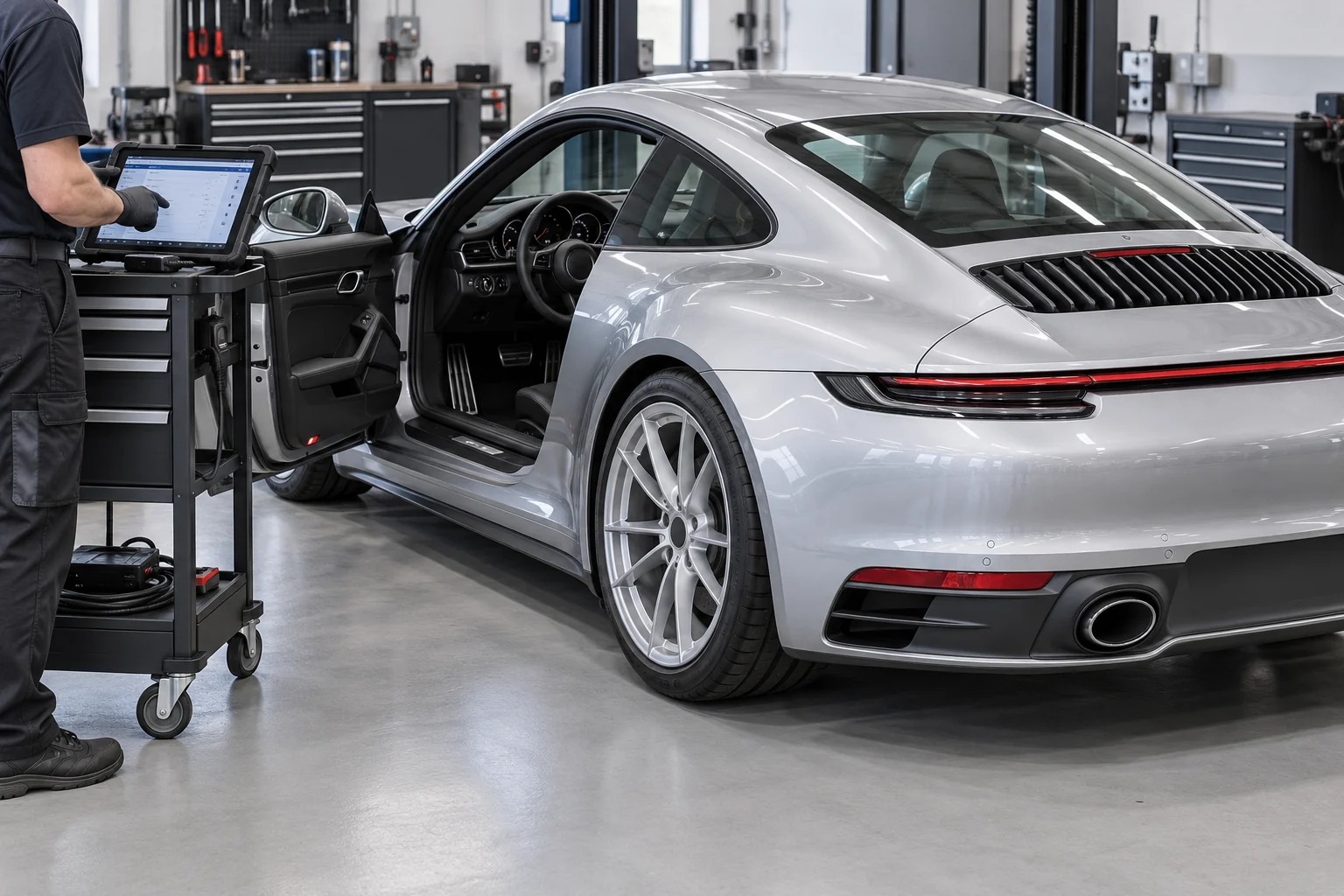
If your Porsche clicks but the engine does not turn, start with the battery supply, connections and starting system. If the engine turns at its usual speed but never fires, fuel, ignition and engine-control checks belong on a different diagnostic route. The sound helps describe the fault. It does not identify a replacement part by itself.
Put safety before another start attempt
On a road or in an exposed location, prioritise getting yourself and passengers away from traffic and arranging assistance. Stop attempts if there is smoke, a burning smell, a fuel smell, grinding or a warning telling you to stop. Do not open fuel lines, bridge electrical terminals or work underneath a stranded car.
Is the engine turning or are you only hearing a click?
For a Porsche with a combustion engine, cranking is the repeated turning sound before the engine runs on its own. A single click or a rapid series of clicks without that turning sound is a no-crank symptom. Slow, laboured turning is another useful distinction. Tell the workshop which happened during the failed attempt.
| What you hear or see | Diagnostic route | What it does not prove |
|---|---|---|
| Rapid repeated clicks, possibly with dimming or resetting displays | Check the low-voltage supply and current path first | That the battery necessarily needs replacement |
| One click, with no engine rotation | Verify supply, connections and starter operation | That the starter motor has definitely failed |
| No click and no cranking | Check supply and the model’s starting prerequisites and authorisation | That an ignition switch must be replaced |
| Engine turns slowly | Assess battery performance, cable losses and starting load | That a resting voltage reading tells the whole story |
| Engine turns normally but does not fire | Investigate fuel delivery, ignition where fitted, timing signals and engine control | That the engine has failed to turn over |
A free-spinning whirr can be the starter turning without driving the engine.
- If you cannot tell the difference, say so.
- A short recording from the driver’s seat, if already available and safe to share, can help.
- Avoid repeated attempts just to produce a recording.
Taycan, Macan Electric and hybrid owners need a further distinction. An electric Porsche is assessed by whether it becomes ready to drive, rather than whether a combustion engine cranks.
A hybrid can also be ready while its engine remains off. Report the exact readiness message and powertrain type before applying a conventional starter explanation.
Rapid clicks and low-voltage warnings
Rapid clicking with no engine rotation makes the electrical supply a sensible starting point.
A discharged battery, battery deterioration or resistance in a connection can produce similar symptoms. Working lights or a radio do not demonstrate that the supply can support starting.
Tell the technician whether the displays reset, whether the car has been parked for a long period, and whether the problem followed short trips, battery work or an accessory installation.
These are clues to test, not proof of a cause.
Discharged does not automatically mean defective
A battery that needs charging and a battery that cannot perform adequately are different findings.
- For supported lead-acid or AGM applications, an assessment may require suitable charging followed by a repeat test.
- The tester needs the correct battery technology, rating and rating standard.
- VARTA’s battery tester guidance explains why the settings and test conditions matter.
Do not buy a battery solely because the car clicked, a dashboard voltage looked low or the battery reached a particular birthday.
Where replacement is supported by testing, the Porsche battery service is the appropriate route to confirm the specification and fitted scope.
Connections need assessment under load
A battery can be charged while a poor positive connection or earth path restricts the current reaching the starting system.
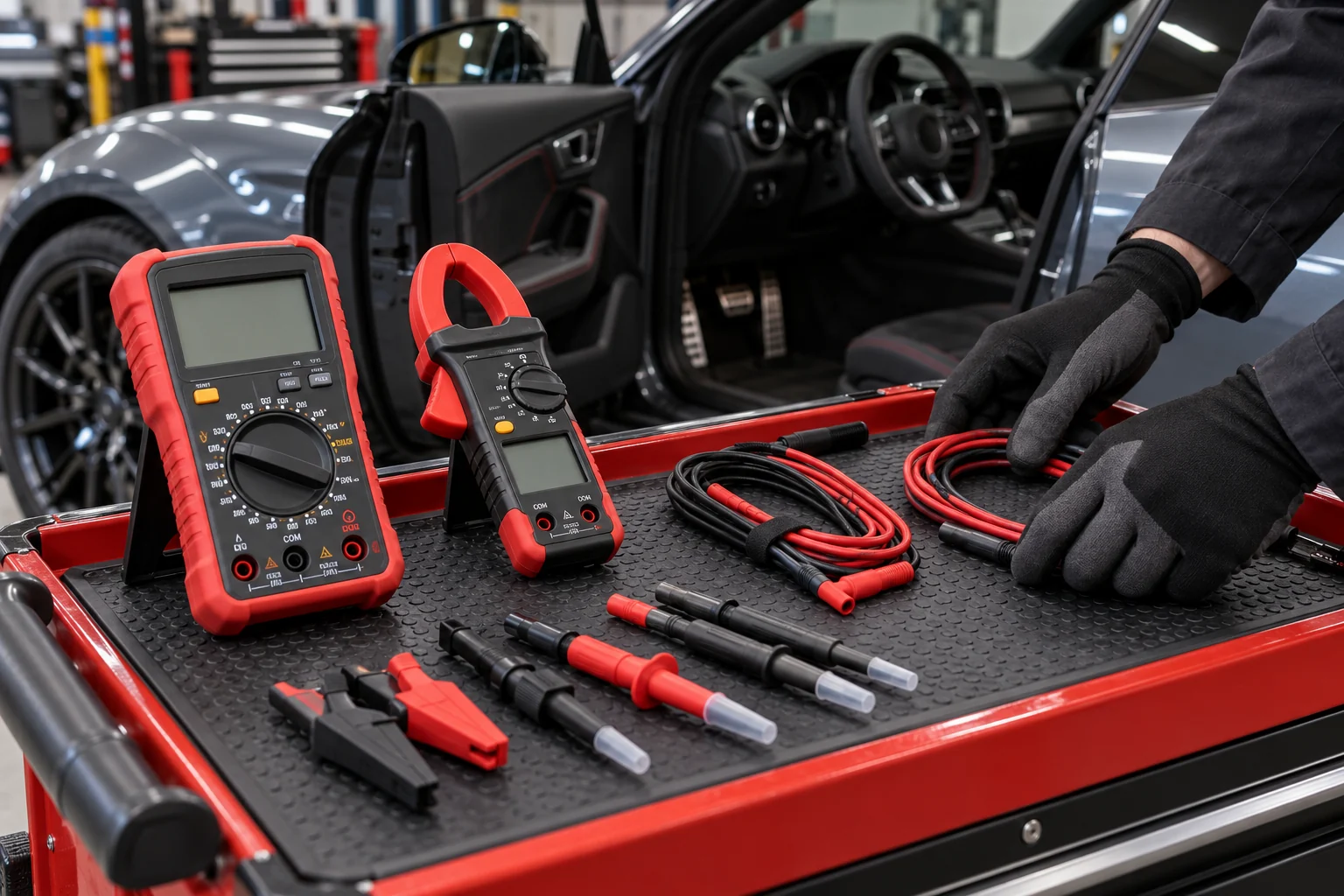
A workshop can inspect accessible connections and measure voltage losses during the relevant test. Appearance alone does not establish whether the full circuit is sound.
Leave terminal removal, cable repairs and access to concealed components to a technician using the vehicle procedure.
A connection repair may restore normal starting without replacing a serviceable starter or battery.
One click or no response from the starter
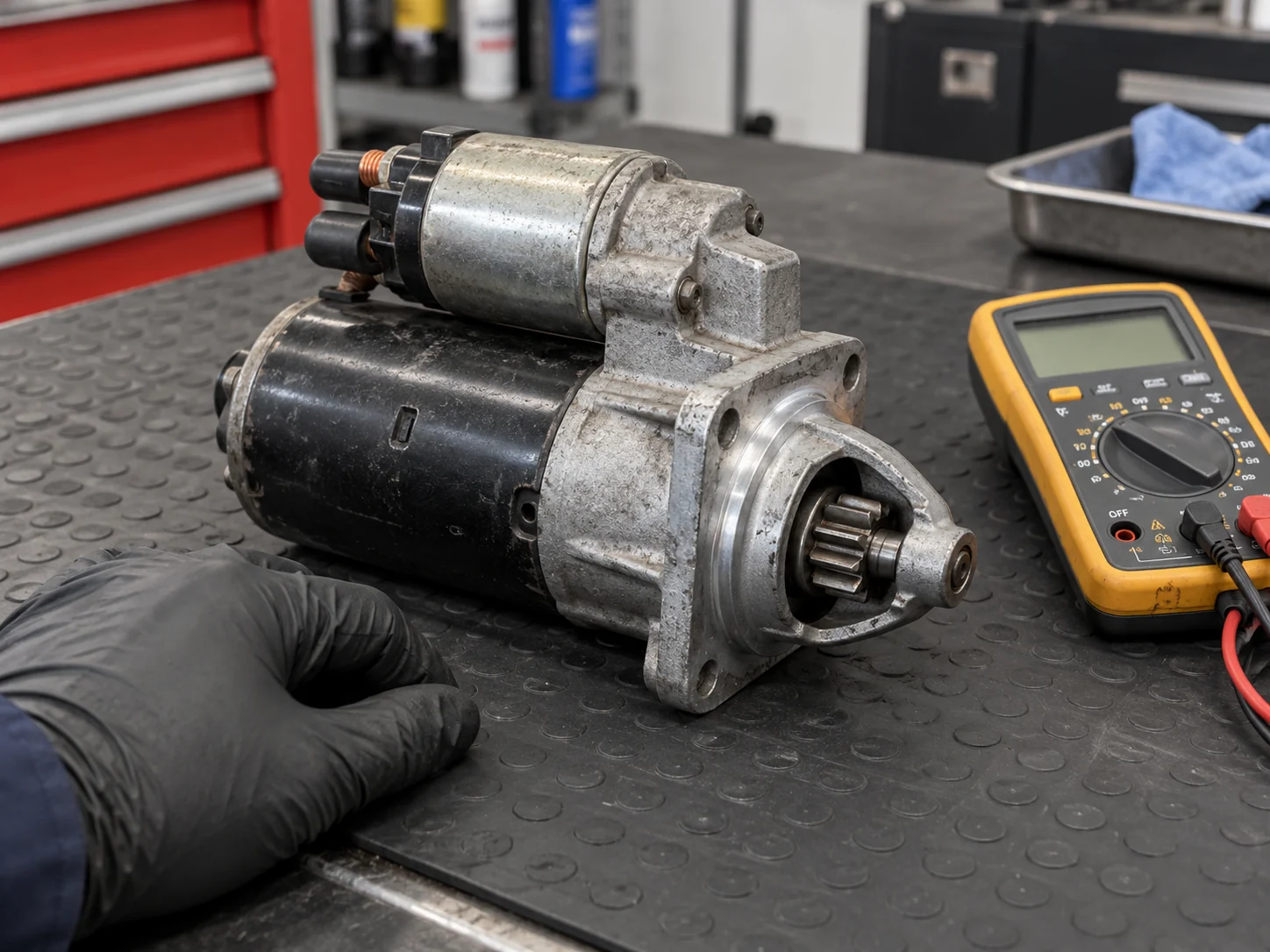
A single click is a reason to investigate the starting circuit, not a conclusive starter diagnosis.
The technician first needs to establish that the required power and control conditions reach the starter. HELLA’s starter fault guidance includes the battery and positive and earth connections in that assessment.
If the supply and control are correct but the starter does not drive the engine, the investigation can move to the starter assembly and mechanical engagement.
The result should explain which test supports the repair. Clicking alone cannot distinguish a supply problem from worn contacts or another internal fault.
Starting prerequisites are worth reporting
When safely parked, check that you are following the normal starting procedure for your model, including the required brake or clutch input and the specified selector position. Read any key-recognition or selector message. If a spare key is available, mention it when asking for guidance. Use the manual’s specified emergency key-recognition procedure rather than guessing a key location.
Silence can result from a missing start request or authorisation as well as a power-supply fault.
It does not establish a faulty ignition switch. On a Porsche with relevant starting electronics, a workshop may need to check the recorded start request, interlock status, supply and fault information together.
Do not tap the starter, bridge a relay or bypass a selector or clutch interlock.
DENSO’s starter troubleshooting guidance also distinguishes a turning starter from a turning engine and warns about damage from prolonged cranking. Stop repeated attempts and let the evidence direct the next step.
The engine cranks normally but will not fire
This is crank-no-start.
A fuel pump or restricted fuel supply can prevent an engine from running while the engine still turns. Those faults should not be described as preventing the starter from turning the engine over.
After checking that the cranking supply is adequate, the workshop follows the relevant engine procedure.
Depending on whether the car is petrol or diesel, the investigation can include fuel pressure and delivery, injector operation, ignition on petrol engines, engine-speed and timing signals, or mechanical condition. It should not start by replacing every component on that list.
Fault codes guide tests rather than authorise parts
A stored code needs interpreting with its status, accompanying symptoms and relevant live data. For example, DENSO identifies intermittent starting and no-start among possible camshaft and crankshaft sensor symptoms, with signal and wiring checks needed to investigate. A symptom shared by several faults cannot identify a sensor on its own.
Report whether the engine stopped while driving, failed after refuelling, recently had work completed or only fails when hot.
- Also report an unusually fast, uneven or grinding cranking sound.
- Those changes can alter the diagnostic priority.
- They are reasons to stop attempts and seek advice, not instructions to inspect timing components at the roadside.
If there is a strong fuel smell, stop attempts and arrange assistance.
Do not loosen a fuel line to check flow, test for a spark by hand or use starting fluid as a general workaround.
Why one charging-voltage reading cannot diagnose every Porsche
A failed start does not establish an alternator fault. On vehicles that use an alternator, the workshop needs the correct specification and operating conditions. HELLA’s regulator test guidance calls for manufacturer-specific measurements at different engine speeds and electrical loads.
A single reading without those conditions cannot provide a universal pass or fail result.
Battery state, connections and charging-system control also need context. Do not disconnect a battery while an engine runs as a test.
Different Porsche powertrains use different electrical arrangements.
An electric vehicle’s low-voltage charging system cannot be assessed by assuming that it has the same engine-driven alternator as a conventional petrol car. The model and battery technology must be identified first.
If a supported battery recovers after charging but the symptom returns, the next question is why it lost charge.
Appropriate charging-system checks, usage review or a controlled parked-current investigation may be needed. A successful boost is useful evidence, but does not prove battery health or explain the original discharge.
Find the correct Porsche jump points before connecting equipment
There is no single jump-start connection diagram that applies to every 911, 718, Cayenne, Macan, Panamera or Taycan. Battery technology, connection points and permitted assistance differ with equipment and model year. If you cannot identify the correct procedure, request qualified assistance instead of using another model’s instructions.
- Select the exact vehicle. Use the VIN or the model and model year on Porsche’s owner’s manual website. The printed manual or the corresponding My Porsche manual can also provide the vehicle-specific information.
- Find the relevant assistance section. Look for jump-lead starting, external power supply or the equivalent battery-assistance heading. Confirm that the procedure applies to the fitted battery and powertrain.
- Identify both specified connection points. Use the positive connection and earth point shown in that manual. Do not assume the battery’s physical location, a convenient metal bracket or a point on a similar Porsche is suitable.
- Confirm the equipment and full procedure. Follow the specified supply, connection order, restrictions and disconnection instructions. Where the manual requires professional help, arrange it before connecting equipment.
Porsche’s manual access guidance explains selection by VIN or model year. If the car’s screens are unavailable because of the electrical fault, the manual website can still be checked on a phone.
Lithium batteries need the appropriate assessment
Porsche’s January 2023 technical information for specified 12-volt lithium-equipped models explains that a protection function can disconnect the battery, making the vehicle appear de-energised.
It directs jump-start questions to the relevant Driver’s Manual. This supports checking the exact system rather than assuming that every apparently flat battery is defective.
That document covers specified equipment on Cayenne, 911 Carrera and Taycan generations.
It does not authorise a universal reset, charger mode or roadside recovery sequence. Never use a generic lead-acid test result or charging setting to judge an unidentified lithium battery.

What to send when arranging assistance in Dubai
Give the workshop your location, model year, powertrain and exact warning message. Say whether you heard one click, rapid clicks, slow turning or normal cranking. Explain whether the car is in a basement, has restricted access or cannot select neutral. These details help the assistance provider choose suitable equipment.
Tell the recovery operator that it is a Porsche and disclose any electric or hybrid system, all-wheel drive, low ride height or locked wheels.
The operator should follow the model’s transport and loading instructions. Do not improvise a tow-start or drag the car to free a locked drivetrain.
For fault assessment and booking, use the Porsche not-starting service.
A useful diagnosis identifies the failed function, relevant test findings, proposed repair and how normal operation will be checked. It also separates diagnosis, recovery, parts, labour, tax and any additional work in the quotation.
Before approving replacement, ask what ruled out a supply or connection fault and what evidence identifies the proposed part.
After repair, ask whether starting and the relevant electrical checks passed, and whether any remaining fault needs monitoring. A stored low-voltage warning should be interpreted in context rather than treated as a list of failed modules.
Porsche clicking and no-start questions
Does a single click mean the starter has failed?
No. Supply, positive and earth connections, the start command and starter operation need checking. The sound alone does not identify which component needs repair.
Why does my Porsche click rapidly while the lights still work?
The supply may operate smaller electrical loads while failing to support starting. A discharged or deteriorated battery and poor connections can produce similar symptoms. Arrange suitable testing before buying parts.
Can a fuel pump stop the engine turning over?
A fuel-delivery fault can stop a cranking engine from firing. A no-crank complaint needs a separate starting-system investigation. Tell the technician whether the engine actually rotates.
Can I use the same jump-start points on every Porsche?
No. Identify the exact vehicle, battery equipment and manual procedure, including the designated positive and earth connections. If the procedure or equipment is uncertain, request qualified assistance.
Does starting after a boost prove I need a new battery?
No. It shows that the response changed with external assistance. Battery condition, connections and the reason for losing charge still need assessment. A suitable charge-and-retest process may be appropriate for supported batteries.
What if my Taycan or Macan Electric clicks but is not ready?
Report the exact drive-readiness message. Do not diagnose it as a conventional starter fault or infer a high-voltage battery failure from clicking alone. Follow the model’s manual and arrange appropriate assistance.
Technical references support the distinctions explained here. Use the current instructions for your exact Porsche and fitted electrical system for any vehicle procedure.