
Porsche Electrical Problems and Diagnostic Checks
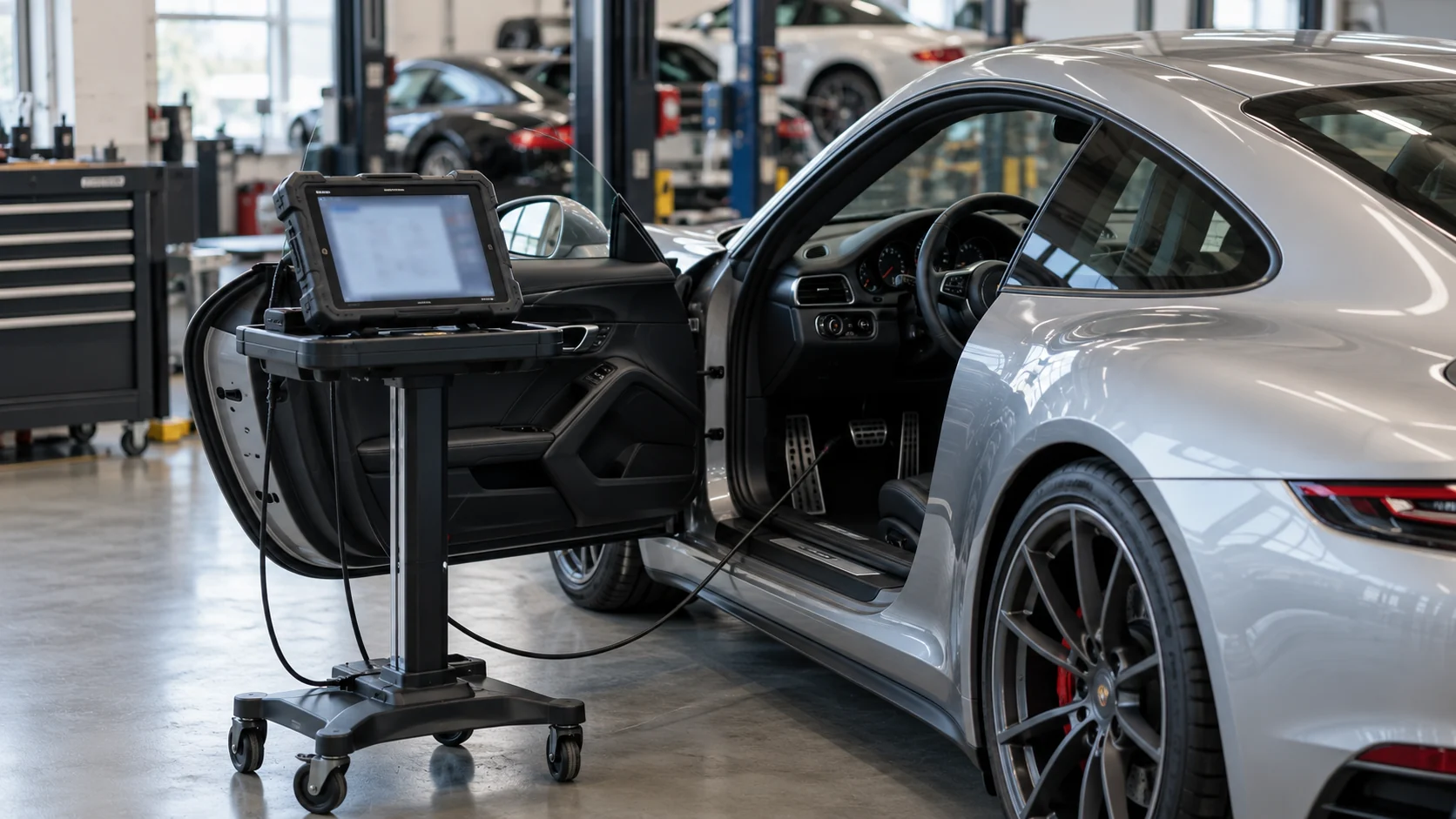
Several Porsche warning lights appearing together can start with an unstable low-voltage supply, but they do not prove that the battery, alternator or ECU has failed. Diagnosis should connect the exact symptoms to battery condition, charging behaviour, wiring measurements and fault records before parts are authorised.
When to stop and arrange assistance
Follow any dashboard instruction to stop safely. Smoke, a burning smell, a hot or damaged battery, loss of essential lights, altered braking or steering, or a high-voltage warning needs prompt professional assistance. Avoid further starting attempts or charging damaged equipment. If there is fire or immediate danger, move people clear and contact emergency services.
Match the symptom to the first diagnostic checks
This table describes a workshop investigation, not a diagnosis from a warning light alone. Record the exact message, when it appeared and whether the engine actually turns during a starting attempt.
| What you notice | Checks to request | What the symptom does not prove |
|---|---|---|
| Several warnings after slow cranking or a flat battery | Battery charge and health, connections, supply behaviour during the event and a recorded system scan | That every reporting module needs replacement |
| Charging warning while driving | The exact warning instruction, model-specific charging system, cables and control data | That a new battery alone will solve it |
| Battery repeatedly discharged after parking | Charge and health first, then shutdown and sleep-current logging under defined conditions | That an ECU is automatically responsible |
| One window, lamp or accessory stops working | That circuit’s fuse, supply, ground, connector, command and component operation | A failure of the whole vehicle network |
| Rapid clicks, one click or no cranking | Low-voltage supply and starting-circuit checks appropriate to the model | A fuel-pump fault preventing the engine from rotating |
| Engine rotates normally but will not start | Start authorisation, engine-management faults and appropriate fuel, ignition or mechanical tests | A failed ECU from the symptom alone |
A useful report distinguishes stored historical faults, faults currently present and symptoms reproduced during testing. A screenshot of many codes without interpretation is not a repair plan.
Separate low battery charge from a failed battery
A discharged battery has insufficient stored energy at the time of the check. A failing battery cannot deliver or retain the required performance under the applicable test conditions. The two can occur together, but a low reading alone does not establish which problem is present.
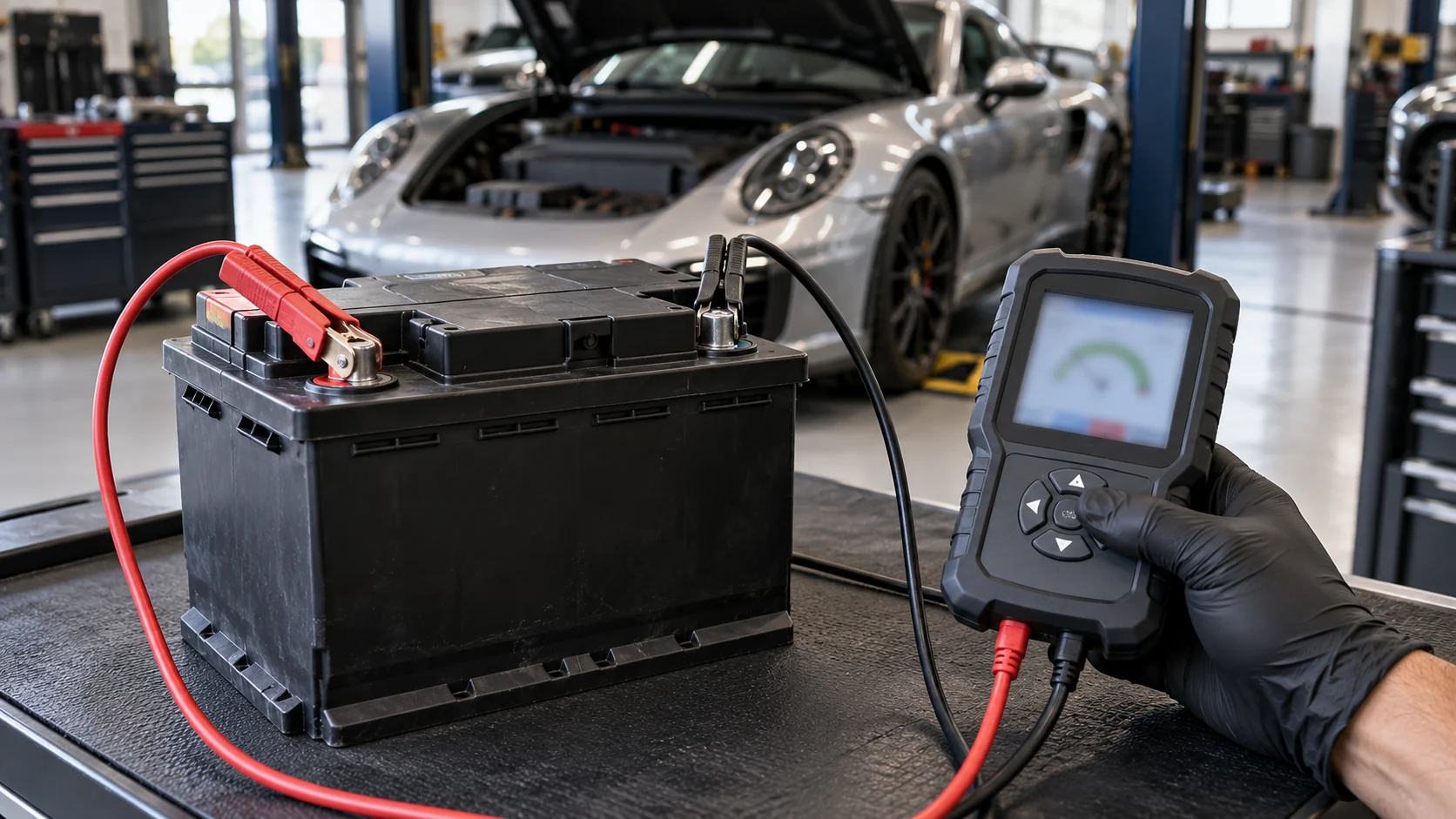
The workshop should identify the fitted battery chemistry, rating, age and model suitability before selecting a charger or test method. A lead-acid or AGM test setting is not automatically appropriate for a lithium battery. If safe and suitable, a discharged battery may need controlled charging before a meaningful retest.
Ask for a test record showing the selected battery type and rating, state of charge, test result and any retest after charging.
Where starting performance is relevant, the supply should also be assessed during the starting event. Temperature and the battery’s recent charging or operating history affect interpretation.
Connections matter too.
A battery can test acceptably while a loose connection or excessive resistance in a cable causes a supply problem under load. The inspection should include the relevant connections and measurements rather than relying on the appearance of the terminals.
If testing confirms replacement is appropriate, our Porsche battery replacement service is the next destination.
Confirm the correct battery specification and whether registration, coding or adaptation applies to that model. These procedures are not identical across all Porsche generations.
Verify the affected functions after correcting the supply
A shared supply problem can trigger several genuine fault records. It does not make every warning fake or prove that every named control unit has failed.
- Preserve the complete warning messages, initial scan and available event data.
- Establish and correct the demonstrated battery, charging, connection or parked-current problem.
- Complete the installation or adaptation procedure required by that vehicle when applicable.
- Recheck the affected functions and investigate any current or returning warning. A clear dashboard alone is not the completion test.
For the separate decision between charging and replacement, see our discharged or failing Porsche battery guide.
Software examples require the assigned vehicle and procedure
Porsche's WKL7 campaign instructions for assigned 2020 type 992 vehicles specify supported vehicle voltage during programming and warn of control-unit damage if it is not maintained.
Those programming requirements are not everyday charging-voltage limits for every Porsche.
The January 2026 WSS6 instructions concern the 12-volt battery sensor on assigned Taycan Y1A, Y1B and Y1C vehicles within the stated 2020 to 2026 model-year range.
- The document describes incorrect calculated battery data and possible failure to start after prolonged parking.
- It does not establish that every Taycan or a particular UAE vehicle is affected.
- Confirm VIN assignment, market eligibility and current instructions through the appropriate Porsche service channel.
Why one charging-voltage range cannot cover every Porsche
A single engine-running reading should not be used as a universal pass or fail rule. On an electronically controlled charging system, output can change with electrical demand, battery temperature, state of charge and operating conditions. A reading must be compared with the applicable model’s procedure and control data.
For an alternator-equipped vehicle, ask the technician to record the test conditions, electrical loads, relevant commanded and actual values, and the condition of its drive and connections where applicable.
Voltage, current and, when needed, output ripple help answer different questions. A plausible voltage reading does not by itself establish that charging capacity is adequate.
Pico Technology’s alternator voltage and current guidance explains why electrical load, engine speed and battery condition matter.
Its examples are general diagnostic guidance, not Porsche-specific acceptance limits.
Electric and hybrid models need the correct system identified
Do not assume that every Porsche uses a conventional engine-driven alternator to support its low-voltage network.
For example, Porsche’s electric Macan battery and charging documentation identifies a DC/DC converter supplying its 12-volt electrical system. That example should not be extrapolated into a test procedure for every Macan, Cayenne or 911.
A low-voltage battery and a traction battery have different roles.
Low-voltage symptoms do not establish a traction-battery failure, while a healthy low-voltage battery does not rule out a high-voltage-system problem. High-voltage warnings, orange cables and traction components require suitably trained personnel and model-specific procedures.
When the battery loses charge while parked
Start with the battery’s charge and health, usage history and charging-system assessment. An overnight discharge might involve an accessory, an incorrect installation, an intermittent wake-up event or a battery with reduced capacity. It is not evidence that a particular model has an inherently defective control unit.
If excessive parked draw is suspected, request a current log that includes the vehicle’s shutdown and sleep behaviour.
The workshop should record the test duration, locking state, key location, connected accessories and any relevant wake-up events. An instantaneous measurement immediately after switching off is not a settled sleep-current assessment.
The acceptable current and required observation period must come from the applicable technical information.
Opening a door, operating a handle or using a nearby key can alter the state being measured. Intermittent faults may need longer monitoring than a short appointment allows.
Pico Technology’s parasitic-drain test guidance describes these test conditions and notes that acceptable draw depends on the vehicle and application.
Its generic example values are not universal Porsche limits.
Tell the workshop about a dashcam, tracker, aftermarket alarm, audio upgrade, charger or recent battery replacement.
Provide the installation date if known. Agree whether investigation of non-original equipment is included in the diagnostic authorisation.
Check wiring and power supplies before condemning a module
A communication fault names an observed problem, not necessarily the failed part. A control unit may be unavailable because its supply, ground, connector or communication path is faulty. Several faults can also share one upstream cause. The wiring diagram and the circumstances of the failure should guide the checks.
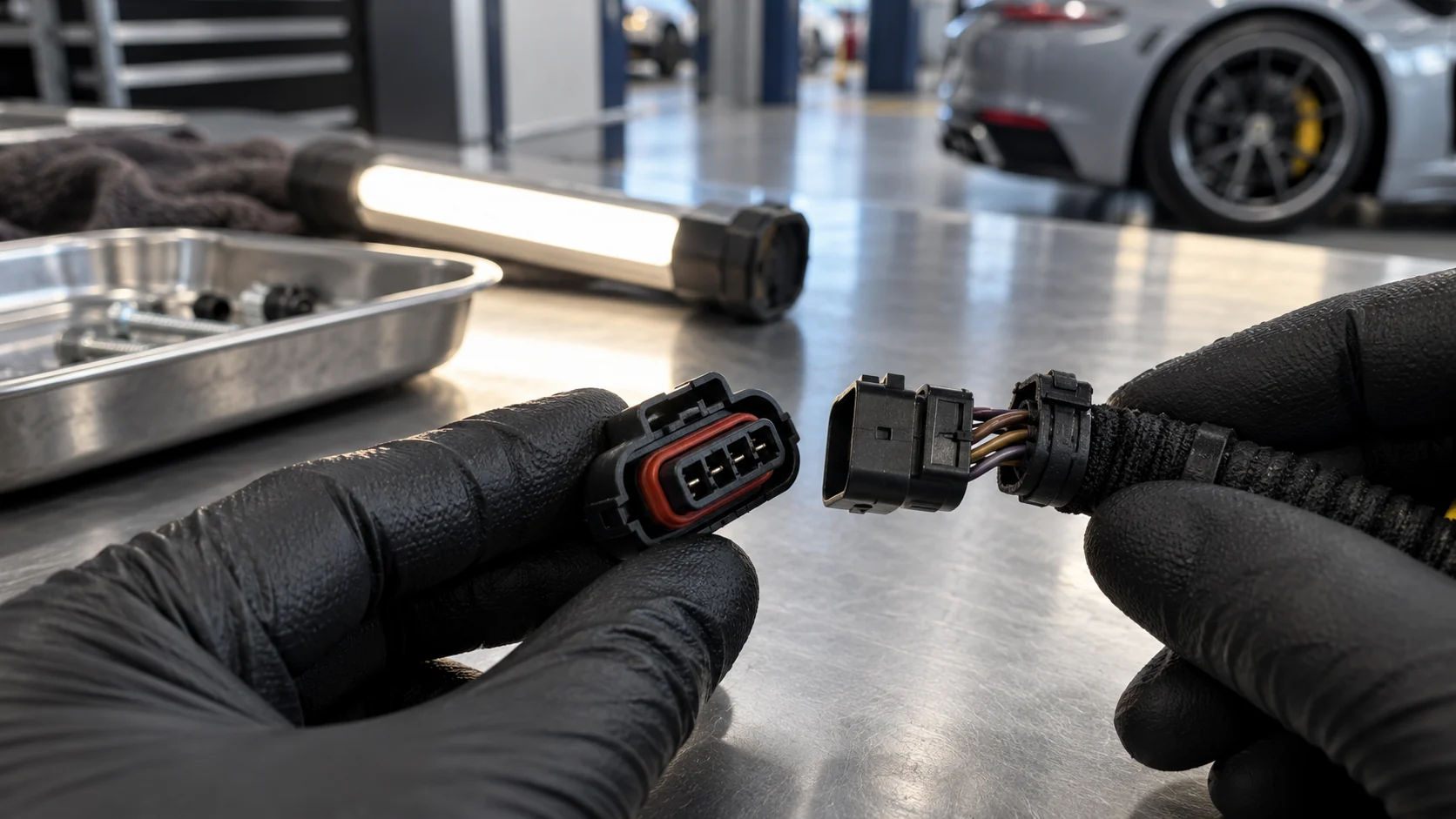
A workshop assessment may include checking the affected circuit’s supply under load, voltage drop along its ground path, connector pin fit and relevant signal or network activity.
Continuity alone can miss a connection that becomes resistive under operating load. Tests must use the right connection method and limits for the circuit.
Pico Technology’s measurement-connection guidance explains how supply, ground and signal checks help establish what reaches the ECU or component.
These are technician-level tests, not instructions to probe unfamiliar connectors at home.
Symptoms after washing, water exposure or recent work
Give a clear timeline.
- Explain whether the symptoms began after heavy rain, washing, an accessory installation, collision repair or work around the affected area.
- Damp carpet, visible corrosion, disturbed wiring or damaged seals can direct an inspection.
- None of those observations alone proves where water entered or which module is damaged.
If water entry is confirmed, the repair plan should address its source and the affected circuits.
Replacing a wet component without resolving the entry path can leave the underlying problem. The affected model, circuit, exposure history and inspection findings should determine the next tests.
How a shared connection can affect several functions
Suppose locking and window faults appear together.
A reasonable investigation would first establish the low-voltage supply and record the faults, then check shared supplies, grounds and relevant communication paths. If a defective connection is demonstrated, it can be repaired and the affected functions retested before a module is considered.
This example describes a diagnostic sequence, not a fault diagnosis for your vehicle.
Your report should identify the actual test results, the repair carried out and the post-repair checks.
Compare repair, software work and replacement
The remedy should follow the confirmed cause. Ask which options are technically suitable and what evidence supports the recommendation.
| Confirmed finding | Possible next step | What should be verified |
|---|---|---|
| Damaged connection, terminal or repairable wiring | Approved circuit or connector repair | Correct materials, sealing, routing and repeat measurements |
| Applicable software issue | Approved update or guided programming | Correct vehicle/software applicability, supported power supply and post-work checks |
| Internal module fault established | Suitable specialist repair or replacement, depending on the unit | Compatibility, security restrictions, coding needs and written warranty terms |
| Battery fails the appropriate assessment | Correct replacement and any required adaptation | Cause of discharge, specification, installation and retest |
A reset is not proof of a repair.
- Clearing faults before recording them can remove useful context.
- After work, ask for a repeat scan, function checks and any repeat load or sleep-current test relevant to the original complaint.
- Some intermittent problems need follow-up monitoring.
Where ECU work is supported by the findings, see our Porsche ECU repair service.
Confirm coverage for the exact part number and vehicle before removal or programming. “OEM” wording alone does not establish whether a unit is new, remanufactured, repaired or used.
Agree the diagnostic scope, price and warranty in writing
An initial scan and a detailed intermittent-wiring investigation are different jobs. Before booking, ask what the diagnostic charge covers, the authorised time allowance, whether a report is included and when approval will be requested for further testing.
- Parts and labour — Identify the proposed part, its condition and source, labour, consumables and any removal or refitting work.
- Programming — State whether coding, adaptation, online access or software work is required and included.
- Tax and other charges — Show VAT treatment and any recovery or additional diagnostic costs separately.
- Warranty — Confirm the provider, duration or mileage limit, covered parts and labour, exclusions, claim process and treatment of coding or removal costs.
- Completion — Identify the checks included before handover and any issue that remains under investigation.
If a promotion is quoted, ask for its start and expiry dates, eligible work, exclusions and applicable terms. Keep the current written quotation and coverage details before authorising a repair.
What to record before the appointment
Photograph the warning message when safely parked. Note whether the car was starting, moving, charging or parked when it occurred, how long it had been unused, and whether the symptom is repeatable. Bring service invoices and details of recent battery or accessory work.
Use the correct Porsche owner’s manual for your VIN for warning instructions, fuse information and permitted charging or starting assistance.
External power points and procedures vary. Do not substitute a video for a different model or assume direct battery access is required.
Do not disconnect the battery with the engine running to “test the alternator”, fit a larger fuse, repeatedly replace a fuse that blows again, or disconnect unfamiliar modules to see what happens.
These actions can create additional faults and remove useful evidence. Avoid handling orange high-voltage cables or components.
For storage or repeated short-trip use, discuss a compatible maintenance charger and the applicable connection method.
A charger cannot repair a failed battery, excessive drain or charging-system fault. Routine care should follow the vehicle’s requirements rather than a universal annual scan or six-month replacement rule.
Porsche electrical diagnosis questions
Can a low battery cause several warning lights?
It can affect several systems, but that possibility does not establish the cause of every warning. The battery, connections, event conditions and recorded faults need assessment. Follow any instruction to stop safely.
Does a charging warning always mean the alternator has failed?
No. The charging architecture and the exact message must be identified. Cables, connections, control behaviour and other components may need testing. Some Porsche models use a DC/DC converter rather than a conventional alternator for their low-voltage supply.
Does a communication code mean I need a new ECU?
No. The reporting code needs to be considered alongside supply, ground, connector and communication checks. Module replacement should be supported by the applicable diagnostic procedure and evidence.
Why does my battery keep going flat after parking?
Possible explanations include inadequate charge, reduced battery capacity, accessory consumption or abnormal shutdown behaviour. Charge and health testing should come before a model-specific parked-current investigation. There is no single acceptable current figure for every Porsche.
Can wiring be repaired instead of replacing a module?
If the fault is proven to be in repairable wiring or a connection, an approved repair may resolve it. The circuit and affected functions must be retested. Not every connector, harness or module is suitable for repair.
Is every OEM module replacement covered by warranty?
Coverage depends on the supplied part, the provider and the written terms. Confirm duration, mileage, parts and labour coverage, exclusions and programming costs on the quotation. This guide makes no blanket warranty promise.
Describe the fault before booking
Send the model, year, exact warning message and when the fault occurs. Include recent battery or accessory work. We can then confirm the appropriate diagnostic booking scope and quotation. Porsche Repair Dubai is an independent workshop.
See our Porsche diagnostic inspection service for the investigation scope and booking options.