Porsche 911 Common Problems by Engine and Generation
Porsche 911 problems depend on the engine and equipment fitted. Early Carrera checks include IMS configuration, oil leaks, ventilation and cylinder condition. Later cars need their own cooling, ignition, transmission and electronic diagnosis. Identify the variant first, then use symptoms and test results to decide the next step.
Which symptoms mean stop driving
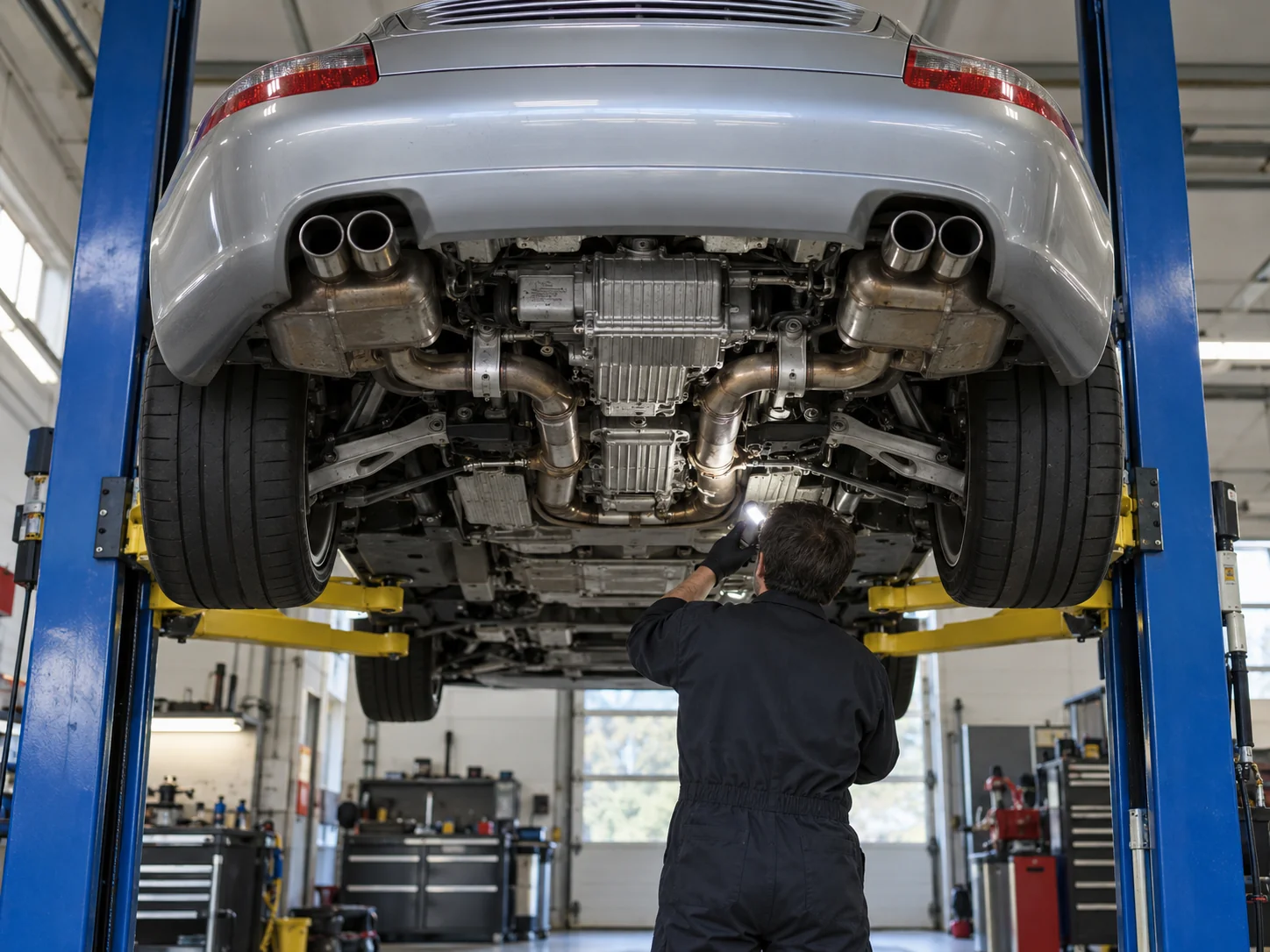
A persistent flashing engine warning, severe misfire, oil-pressure warning, overheating instruction, sudden knock or major fluid loss needs immediate attention. Reduce load, stop safely and switch off when the vehicle instructions require it. Arrange recovery if the warning persists or the engine runs badly. Do not keep restarting an engine that knocks or will not turn.
A steady warning with smooth running still needs prompt diagnosis. Read the complete dashboard message. Check a coolant warning before another journey, even if the gauge looks normal. A light, stable external oil weep is different from falling oil level or oil reaching hot exhaust parts.
Porsche Centre guidance on a flashing engine warning explains the risk of catalytic-converter damage. Follow the handbook for the exact vehicle.
Match the generation to the actual engine
This guide covers water-cooled 911 models from the 996 onward. Registration year can misidentify a changeover car. Confirm model year, variant, engine code and replacement-engine history. Carrera, Turbo and GT cars within one generation can use different engines.
| 911 application | Engine distinction | What it changes |
|---|---|---|
| 996 Carrera | M96 3.4 or 3.6 | IMS configuration, ventilation, leaks and cylinder condition need engine-specific checks. |
| 997.1 Carrera and Carrera S | Base 3.6 M96.05 and S 3.8 M97.01 | The base Carrera and Carrera S use different engine codes. Bearing configuration and engine history matter. |
| 996 Turbo and GT models, 997.1 Turbo and relevant 997 GT models | Mezger-derived dry-sump engines | The Carrera sealed IMS-bearing retrofit advice does not apply. Cooling joints and usage history need their own assessment. |
| 997.2 Carrera and 991.1 Carrera | MA1 or 9A1 family | No Carrera-style intermediate shaft. Cylinder wear remains possible. |
| 997.2 Turbo | Different direct-injection 3.8 engine | Keep it separate from the earlier Mezger Turbo. Identify GT variants individually. |
| 991.2 Carrera and 992 Carrera variants | Later turbocharged engine families | Cooling, charge-air, ignition, transmission and electronic faults need symptom-led diagnosis. |
| 992.2 GTS with T-Hybrid | Hybrid drivetrain with a 3.6 flat six | High-voltage work requires suitably qualified personnel and vehicle-specific data. |
See LN Engineering’s engine applicability information and Porsche’s 997 Turbo S history. These identify designs, not the condition of an individual car.
What to check on each generation
| Generation or variant | Useful checks | Avoid this assumption |
|---|---|---|
| 996 Carrera | Oil-filter debris, IMS configuration, separator operation, cooling leaks, plugs and coils. Inspect bores when justified. | Every start-up puff means a rebuild. |
| 997.1 Carrera | Separate 3.6 from 3.8. Assess oil consumption, cylinder condition, ventilation and coolant loss. Read bearing records. | Every engine accepts an external IMS retrofit. |
| Mezger Turbo and GT | Relevant bonded coolant fittings, pressure testing, over-rev data, maintenance and track-use records. | The M96/M97 Carrera failure list applies unchanged. |
| 997.2 and 991.1 Carrera | Transmission history, ignition faults, cooling, oil leaks and symptoms that justify imaging. Check dynamic mounts if fitted. | No IMS bearing means no possible cylinder wear. |
| 991.2 Carrera | Locate coolant loss, test pump and thermostat operation, investigate boost or misfire faults and read PDK fault memory. | A bulletin proves every similar symptom has one cause. |
| 992.1 and 992.2 | Battery supply, faults, software level and calibration after relevant repairs. Identify chassis, lift and hybrid equipment. | Every warning is software or every 992 has the same drivetrain. |
This is not a failure-rate ranking. A published procedure explains a condition without establishing its frequency. The 996 repair, 997 repair and Carrera repair pages explain workshop scope.
IMS bearing and rear main seal are different issues
The intermediate shaft drives the camshafts on relevant M96/M97 engines. Bearing configuration determines whether an external retrofit is possible or crankcase disassembly is needed. Early dual-row, smaller single-row and later larger bearings require identification from engine information and the installation itself. Transition years and replacement engines make year-only advice unreliable.
Historic warranty figures are not a current lifetime failure probability. A quiet engine or clean filter cannot certify a bearing. Keep the engine number, retrofit product, installation date, invoice and product-specific service requirements together.
Oil between engine and gearbox can come from the rear main seal, IMS flange or another source. Locate it before quoting. Combining confirmed seal work with an approved clutch job may reduce duplicated access labour, but an oil trace alone does not justify a clutch replacement.

The IMS bearing guide explains identification and preventive choices.
Smoke and oil use need more than one possible explanation
Start-up smoke can involve ventilation, incorrect oil level, residual oil, valve-seal wear or cylinder wear. Turbocharged cars introduce other possibilities. An isolated puff is different from persistent smoke with rough running or falling oil level.
| Finding | Useful investigation | Limit |
|---|---|---|
| Smoke with whistle or abnormal filler-cap suction | Measure crankcase vacuum and inspect the breather circuit. | Cap feel alone does not identify a failed part. |
| Increasing oil use, tapping or uneven soot | Check leaks, plugs and ventilation, then cylinder imaging and supporting tests. | Noise or one sooty outlet does not prove scoring. |
| Coolant loss and persistent steam | Investigate coolant loss with applicable pressure and engine tests. | Colour alone cannot diagnose a head gasket. |
| Misfire under load | Retrieve faults and test ignition, fuelling and mechanical condition as indicated. | A cylinder code does not automatically mean a bad coil. |

Use the air oil separator guide for ventilation and the bore-scoring guide for inspection limits. Normal compression alone does not exclude cylinder damage.
Mezger cooling joints and over-rev records
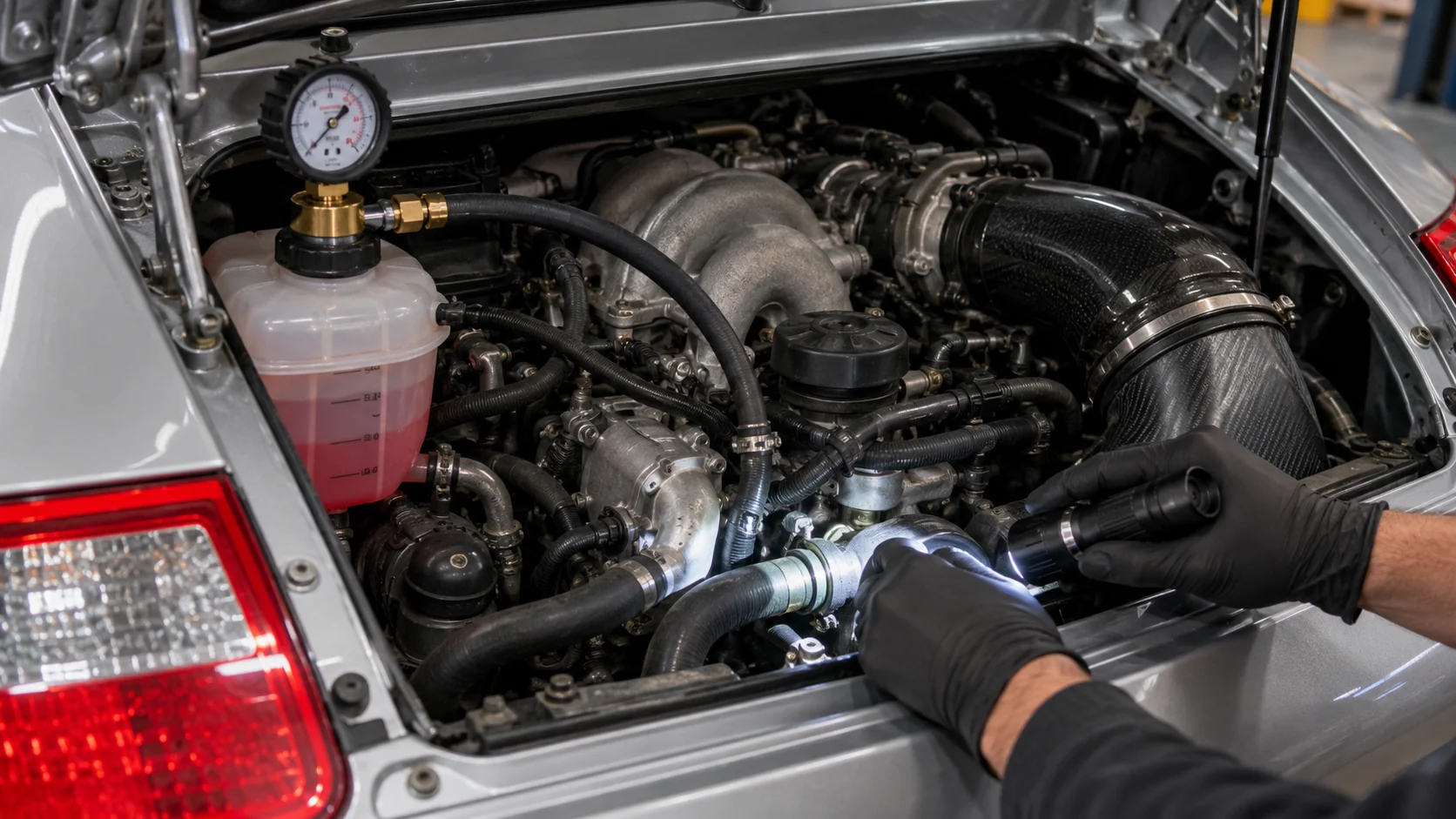
On applicable Mezger engines, bonded coolant fittings can leak or move. Inspect the actual joints, pressure-test and discuss access and repair options. Pinning, welding or component replacement depend on the assembly and specialist assessment.
A Digital Motor Electronics report, or DME report, records defined ignition ranges and operating hours. The 996 commonly uses two ranges and the 997 uses six. RPM thresholds differ between Carrera, Turbo and GT3. One six-step danger scale cannot describe them all.
Read the model-specific thresholds, ignition counts, total operating hours and hours of the latest event together. These inform inspection but do not establish damage or warranty eligibility alone. LN Engineering’s over-rev reference illustrates the differences. Current warranty decisions belong to the provider.
Check the rest of the car as well
| Area | Symptoms | Next check |
|---|---|---|
| Suspension and mounts | Clunk, vibration, uneven tyre wear or chassis warning | Inspect joints, bushes, mounts and fitted adaptive equipment before alignment or calibration. |
| Brakes and tyres | Pulling, vibration, noise or pressure loss | Check fitment, condition, brake wear and mechanical movement. |
| Air conditioning and water ingress | Weak cooling, wet carpets or musty smell | Identify refrigerant, drainage, body-seal or roof-drain causes. |
| Cabriolet and Targa roof | Roof stops or binds | Record the stage of movement. Do not force the mechanism. |
| Manual, Tiptronic or PDK | Slip, hesitation or harsh engagement | Identify the gearbox, retrieve faults and verify its service history. |
Dubai heat and dust make cooling condition and debris inspection relevant. They do not prove a particular fault or justify one universal service interval. Use the requirements for the actual car.
Separate recalls from service bulletins
A safety recall has a defined affected population. A workshop campaign can be assigned to particular VINs. A technical service bulletin describes a condition and procedure. None is a universal repair instruction for an entire generation.
Ask a Porsche Centre to check VIN eligibility and completion records before paying for potentially covered work. For imported cars, establish the original market and local eligibility. A warning after chassis work calls for the specified mechanical and calibration checks, rather than an assumption that recalibration always fixes it.

What to expect from diagnosis and pricing
Provide the complete warning, model, engine, mileage, service record and when the symptom occurs. Preserve codes and freeze-frame information before clearing them. Agree tests and a spending limit before dismantling.
| Work scope | Guide price including VAT | Boundary |
|---|---|---|
| Initial diagnostic assessment | AED 200 to 500 | Scan, saved faults and agreed initial checks. Specialist testing and dismantling are additional unless listed. |
| Oil and filter service | AED 650 to 1,600 | Confirm oil approval, quantity, filter and final vehicle-specific price. |
| Borescope, compression or leak-down | Written quote before work | Specify cylinders, access, images, sealing, fluids and included tests. |
| IMS, separator, cooling or internal repair | Quoted against findings | Itemise parts, labour, machining, related damage and warranty terms. |
These guide ranges come from the 911 repair page. A scan fee does not include every mechanical test. For a pre-purchase inspection, confirm in writing whether cylinder imaging is included.
A useful report identifies the tested system, readings or images, limitations and next step. “No fault found” should describe the checks completed, not promise future reliability.
Porsche 911 problem questions
Which 911 engines have the IMS bearing concern?
Relevant 996 and 997.1 Carrera M96/M97 engines have the sealed-bearing design discussed in retrofit guidance. Identify the bearing from engine information and replacement history. Later Carrera MA1/9A1 engines do not use that intermediate-shaft arrangement.
Are all 997 Turbo engines Mezger?
No. The earlier 997.1 Turbo uses a Mezger-derived engine. The 997.2 Turbo moved to a different direct-injection 3.8 design. Identify Turbo and GT variants individually.
Is the 997.2 immune to bore scoring?
No. Its engine differs from M96/M97, but cylinder wear can occur. Symptoms and inspection findings determine whether imaging is appropriate.
Can I keep driving with a flashing engine light?
A persistent flashing light or strong misfire needs immediate action. Reduce load, stop safely and follow vehicle instructions. Arrange assistance instead of continuing normal driving for several days.
Does a PDK warning mean a new gearbox?
No. Retrieve faults and perform the appropriate electrical, fluid, mechanical or calibration checks before choosing a repair.
Which 911 should I avoid buying?
A year blacklist is not a substitute for inspection. Compare engine identity, maintenance, previous repairs and present findings. A refusal to allow relevant checks increases uncertainty.
Discuss the symptom before approving repairs
Send the model year, Carrera or Turbo or GT variant, mileage, exact warning and when it happens. If the engine knocks, smokes heavily or has a persistent flashing warning, ask about recovery rather than driving in.
Related help includes PDK diagnosis, engine repair scope and oil-leak diagnosis.
Porsche Repair Dubai is an independent workshop and is not affiliated with Porsche AG. Model names identify the vehicles discussed. Vehicle-specific workshop instructions and the condition of the car determine diagnosis and repair.