
Porsche Bore Scoring Symptoms and Borescope Inspection
Bore scoring is cylinder-surface damage that may cause rising oil use, noise or smoke, but those symptoms have other causes. A documented borescope inspection can reveal visible damage. It cannot measure every defect or predict remaining engine life. Engine design and inspection access determine what can be concluded.
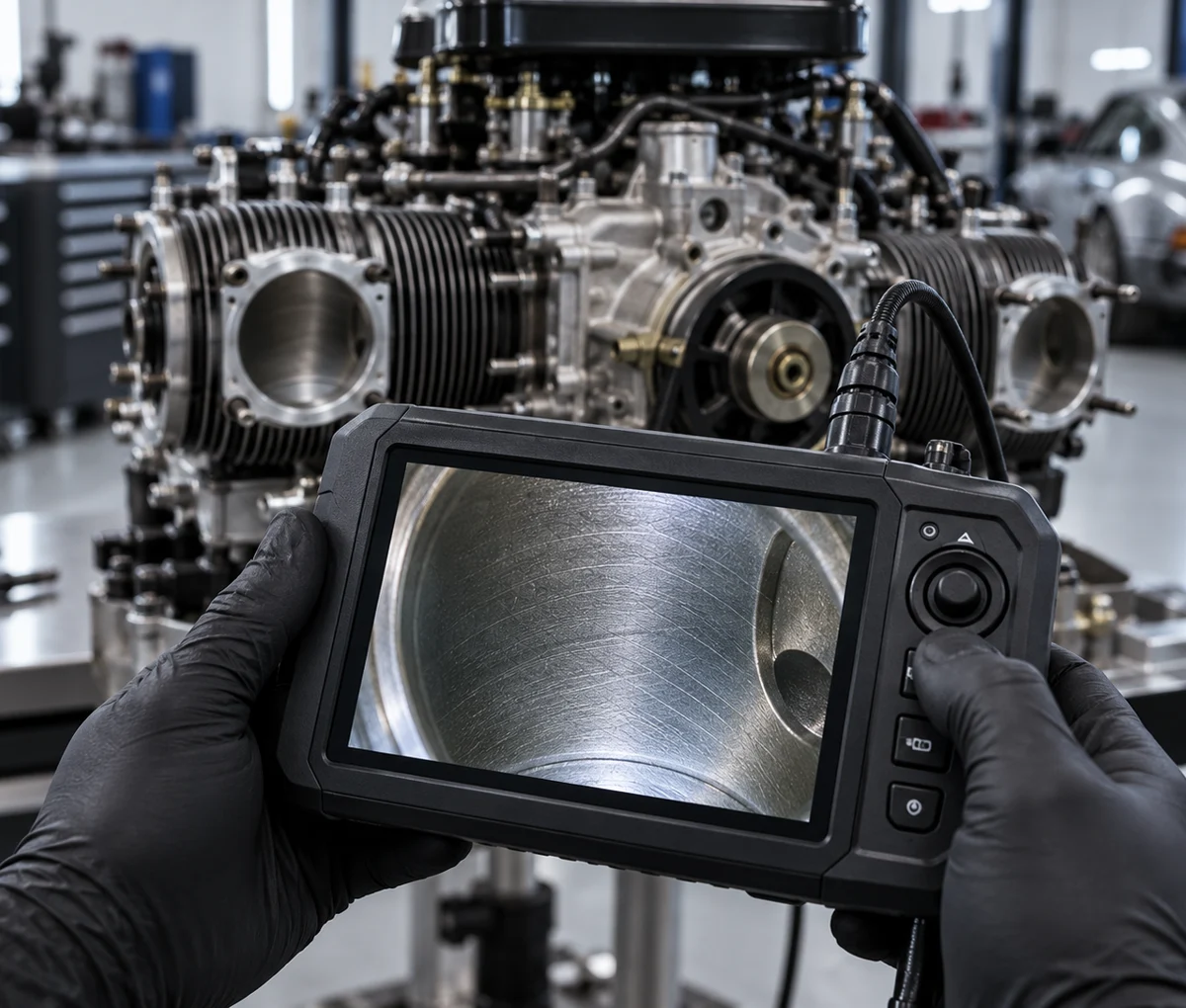
What bore scoring means
Bore scoring is damage to the cylinder running surface associated with contact and wear between the piston, piston skirt, rings and bore. Visible vertical marks need interpretation. Oil, glare, carbon streaks and normal surface polishing can look alarming in one image. A report should distinguish clear damage from an inconclusive view.
Lokasil and Alusil are aluminium-silicon cylinder technologies. Their surface structure and piston coatings contribute to the intended sliding contact. Lubrication, fuelling, temperature and surface damage can affect that relationship. This does not mean every aluminium engine eventually fails.
LN Engineering’s discussion of scoring describes mechanisms and diagnostic clues. It reflects specialist repair experience, not a population-wide failure survey.
Which engines need particular attention
| Engine or application | Relevant distinction | Inspection decision |
|---|---|---|
| 996 Carrera 3.4 and 3.6 | M96 family. Specialist reports particularly discuss the larger 3.6 alongside 997 engines. | Use symptoms, history and purchase risk. Do not dismiss a 3.4 solely because it is smaller. |
| 997.1 base Carrera 3.6 | M96.05 | Confirm the engine fitted, including replacement or rebuild records. |
| 997.1 Carrera S 3.8 | M97.01 | A relevant application when assessing oil use, noise or a used purchase. |
| 987.1 Cayman S and later 987.1 Boxster S 3.4 | M97.21 and M97.22 applications | Separate these from base engines and the earlier 3.2 Boxster S. |
| Base 2.5 and 2.7, and Boxster S 3.2 | Different applications within the wider family | Lower reported incidence does not exclude wear. Symptoms still justify investigation. |
| 997.2, 991.1, 987.2 and 981 | MA1 or 9A1 applications with different construction | Scoring can occur. Do not automatically transfer the M96/M97 inspection route. |
| Cayenne and other V8 applications | Engine code and bore construction vary | Use a V8-specific procedure and inspect all cylinders. Flat-six bank assumptions do not transfer. |
| Mezger-derived and later coated-bore engines | Different cylinder construction | Do not assign M96/M97 risk or claim immunity to all cylinder damage. |
These classifications identify relevant applications. They are not numerical probabilities or a ranking. Check engine-code applicability alongside the car’s records.
Related model guidance covers 996, 997, Boxster and Cayman repairs.
Symptoms raise suspicion but do not prove scoring
| Finding | Other possible causes | Useful evidence |
|---|---|---|
| Increasing oil consumption | External leaks, ventilation faults, valve seals and turbo systems where fitted | Recorded top-ups over distance, correct oil-level procedure and leak checks. |
| Rhythmic tapping or knocking | Injector noise, lifters, exhaust leaks or other mechanical faults | Noise location, operating conditions and cylinder inspection. |
| Uneven exhaust soot | Fuelling faults or exhaust-layout effects | Fuel trims and plug condition. Confirm the exhaust layout before mapping an outlet to a bank. |
| Oil on the plug firing end | Oil entering the cylinder through several routes | Inspect the combustion end separately from external plug-well oil. |
| Misfire | Ignition, injector, air leak, compression or valve fault | Fault memory, component tests and mechanical checks. |
| Wear metals in oil | Several wear sources, contamination or sampling differences | Comparable sample trends, filter inspection and imaging. |
Scoring may exist without obvious smoke or high oil use. Conversely, smoke does not prove scoring. The air oil separator guide explains an alternative cause.
Stop safely for an oil-pressure warning, severe knock, overheating instruction, persistent flashing engine light or rapid fluid loss. A borescope appointment is not permission to continue driving with those symptoms.
Choose an inspection route for the engine
A borescope records accessible surfaces. Access, piston position, lens condition and lighting determine what it can show. The technician must record the route and any areas that could not be assessed.
| Route | Where it helps | Important limit |
|---|---|---|
| Spark-plug hole | Views accessible cylinder walls with the piston appropriately positioned. Used on many engines. | Part of the lower surface may be hidden. A clean visible area does not certify the entire bore. |
| Sump access on relevant M96/M97 engines | Can expose lower cylinder areas missed from above, using the applicable procedure. | Additional access, oil handling and resealing. It cannot be promised for every Porsche engine. |
| Repeat view or specialist assessment | Useful for marks obscured by oil, glare or poor access. | An inconclusive result must remain inconclusive until adequate evidence is obtained. |
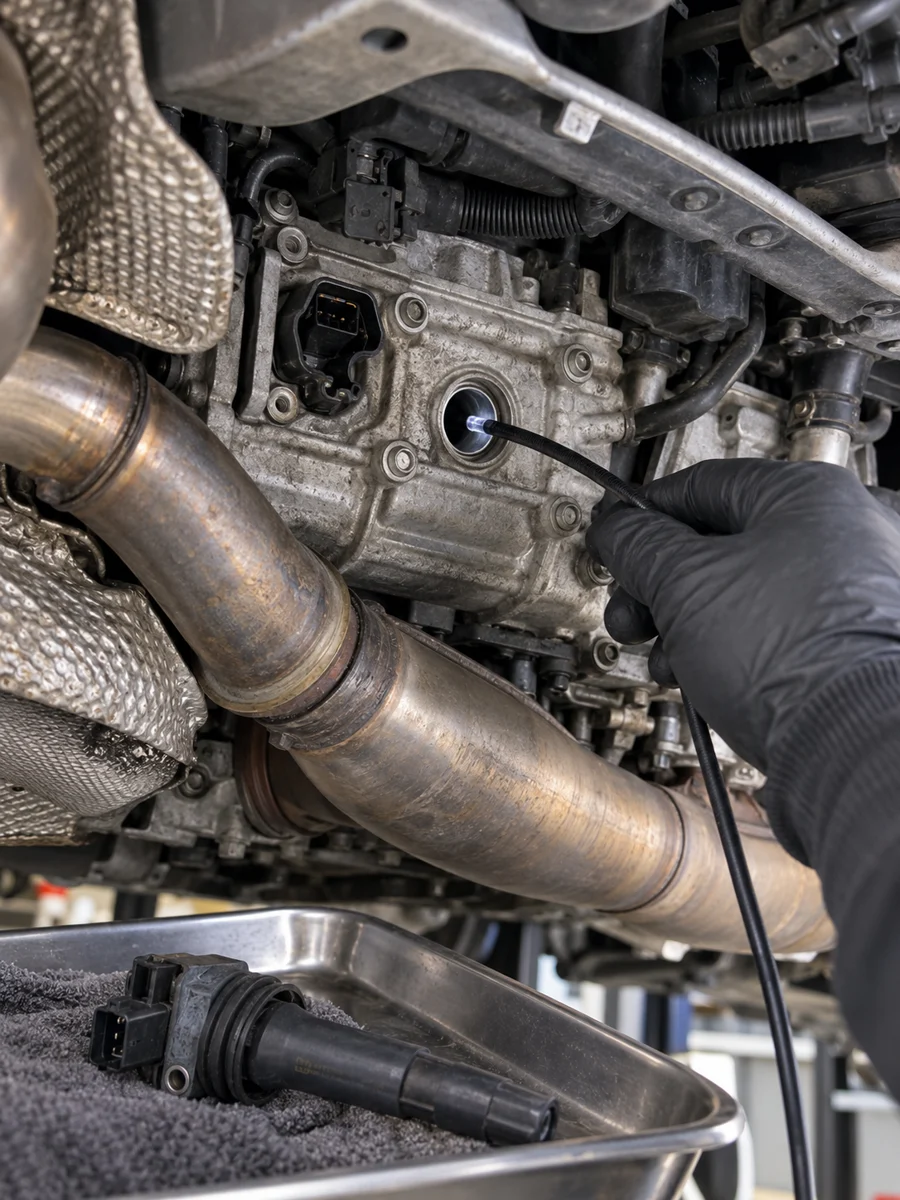
For M96/M97 engines, LN Engineering’s borescope procedure emphasises lower-bore inspection from the sump. Its guidance distinguishes later Alusil applications inspected through the plug hole. Confirm the procedure for the exact engine.
Bank 2 and cylinders 4 to 6 are frequently discussed in M96/M97 specialist reports. That is not a reason to inspect only that bank or transfer its numbering to a V8. Request a record for every cylinder. Inspection and controlled engine rotation are workshop tasks.
What the camera and supporting tests can establish
| Test | Useful finding | What it cannot promise |
|---|---|---|
| Borescope | Visible marks, surface appearance, affected cylinder and repeatable photographs. | Groove depth, roundness, piston clearance or remaining engine life. |
| Compression | Comparison of cylinder sealing under recorded test conditions. | Normal readings do not exclude early or localised cylinder damage. |
| Leak-down | Leakage under test conditions and possible escape paths. | Some crankcase leakage is expected. Interpretation needs the procedure and comparisons. |
| Oil analysis | Wear-metal and fuel-dilution trends from comparable samples. | It cannot locate a damaged cylinder or detect every size of wear particle. |
| Opened filter | Visible debris that can prompt investigation. | A clean filter does not establish healthy bores or bearings. |
| Crankcase vacuum | Evidence about ventilation regulation and possible leaks. | It cannot independently identify ring wear or exclude intermittent ventilation faults. |
Use observations to answer a specific question. Imaging can establish visible damage, but rebuilding decisions may require dimensional measurement after disassembly. A clean inspection records the areas seen that day, rather than guaranteeing future reliability.
What a useful inspection report contains
Ask for cylinder-labelled images and a written description. This reporting checklist is not a customer case or a factory grading system.
- Vehicle identification, engine code, mileage and relevant repair history.
- Engine condition and temperature, inspection date, access route and equipment.
- Images by cylinder and surface, with enough context to repeat the view.
- A description such as no visible damage, marks requiring review, visible scoring or inadequate view.
- Obscured areas or missing views that prevent a conclusion.
- Supporting results with units and conditions, where tested.
- The agreed next step and separate repair scope if justified.
Do not describe a groove as a measured depth from a photograph. If the report says severe, it should explain the visible findings and symptoms separately from dimensions obtained during disassembly. A second opinion is reasonable before major engine work.
Repair or monitoring depends on the findings
Oil changes and additives do not restore a damaged cylinder surface. However, one mark in a photograph does not automatically require an immediate rebuild. Establish whether the finding is clear, symptoms are progressing and supporting tests indicate urgency.
| Finding | Reasonable next decision | Boundary |
|---|---|---|
| No damage visible in adequately documented areas | Address other proven causes and retain the report. | Hidden areas and future wear remain outside the result. |
| Unclear marks or incomplete access | Repeat suitable views or obtain specialist review. | Do not label an incomplete inspection a clean engine. |
| Confirmed damage without urgent symptoms | Discuss monitoring versus planned repair, with oil-use records and review triggers. | No guaranteed remaining mileage can be predicted. |
| Damage with severe noise, rapid oil loss or urgent warnings | Stop use and assess repair or replacement. | Further running may worsen damage. |
Repair routes can include machining and suitable cylinder replacement or surface treatment, a specified rebuild, or a matched replacement engine. The choice depends on construction, measurements, piston and ring compatibility and the specialist process. Re-ringing without assessing the bore does not correct its geometry.
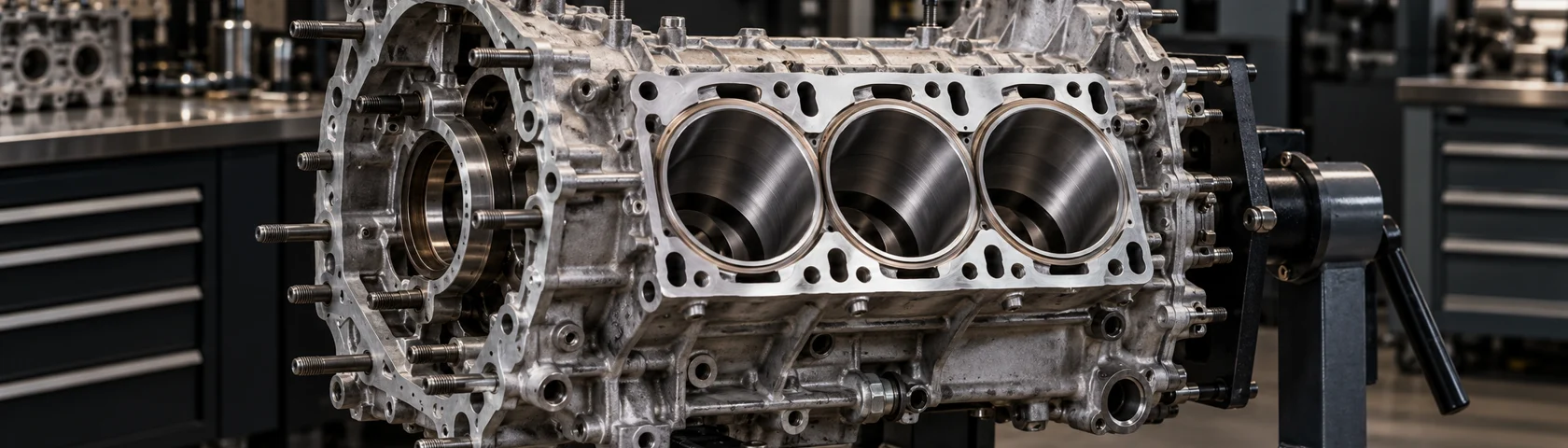
The engine repair page explains scope. Ask which cylinders are addressed, which components are reused, how other wear is assessed, and what warranty, running-in and follow-up requirements apply.
Inspection and repair pricing in Dubai
A general vehicle inspection is not automatically a full cylinder examination. Agree access, all-cylinder coverage, image reporting and additional tests before booking. Sump access may add oil, sealing materials and labour.
| Scope | Published guide amount | What to confirm |
|---|---|---|
| Standard pre-purchase inspection | AED 525 to 945 including VAT | Cylinder imaging is additional unless specifically listed. |
| Initial engine diagnosis | AED 420 to 1,260 including VAT | The agreed test list. Do not assume imaging, compression and leak-down are all included. |
| Borescope inspection | Vehicle-specific written quote | Cylinder count, access, images, report, consumables and VAT. |
| Internal engine work | Preliminary allowance of AED 15,750 to 52,500 and above | Not a fixed bore-scoring rebuild price. Machining, parts and replacement engines need a defined scope. |
For a limited planning example, the linked pre-purchase page shows an illustrative 2007 911 inspection at AED 1,400 including VAT, comprising AED 800 for the standard inspection and AED 600 for an agreed accessible-cylinder borescope examination. The AED 600 is an example allowance, not a universal borescope tariff. Sump access, further dismantling and additional mechanical tests require their own quote.
See pre-purchase inspection and engine diagnosis for service scope. A rebuild budget should identify removal, installation, machining, pistons, rings, bearings, approved related parts, fluids, testing and exclusions.
Use the findings when buying a Porsche
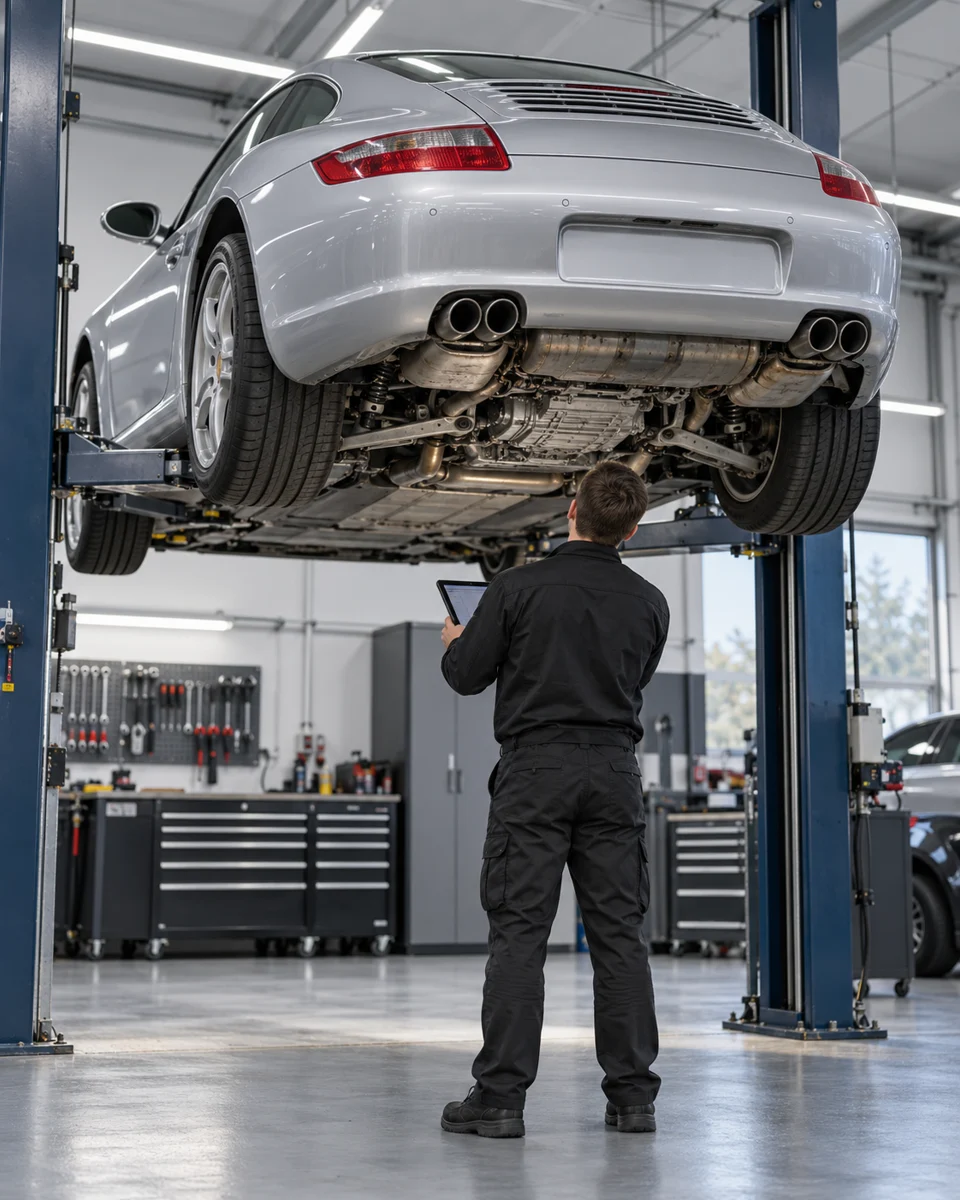
Arrange inspection before committing to purchase. Request service history and rebuild invoices. Ask for a cold starting condition if that forms part of the agreed checks. A warmed car may prevent assessment of the original cold-start symptom.
- Confirm the actual engine and previous cylinder work.
- Obtain permission for proposed access and all-cylinder inspection.
- Read the complete report, including unavailable views.
- Compare any repair quote with the purchase price and your tolerance for uncertainty.
- If scoring is confirmed on any cylinder, seek specialist advice and negotiate or decline on the full findings.
Do not restrict a buying decision to bank 2. A V8 needs eight-cylinder coverage and a report matched to its own layout.
Care advice that does not promise prevention
Use the Porsche oil approval and viscosity specified for the engine and conditions. Viscosity alone does not establish suitability. Keep the level within the specified range using the correct measurement procedure and investigate changes in consumption.
Drive gently until the engine and oil reach operating temperature, following the handbook. A start after the engine has cooled is still a cold start in Dubai. Warm ambient air does not mean the oil is already at operating temperature.
Address verified fuelling, injector, ventilation and cooling faults. For repeated short trips, storage or track use, agree a suitable maintenance plan instead of one universal shorter interval. Avoid changing grades or using additives solely to hide a symptom.
Bore-scoring questions
Can normal compression rule out bore scoring?
No. Compression measures sealing under the test conditions. Visible damage can coexist with reassuring readings. Interpret the results with images and symptoms.
Does a clean borescope guarantee a healthy engine?
No. It records the visible areas at inspection. It cannot guarantee future life or assess unrelated components such as an IMS bearing.
Can scoring exist without smoke?
Yes. Symptoms may be absent or subtle. Equally, smoke has several possible causes and cannot diagnose scoring alone.
Does every scored engine need an immediate rebuild?
No single answer covers all findings. Consider confirmed damage, noise, oil use, debris and warnings. Monitoring cannot repair the surface or guarantee remaining mileage.
Can a borescope measure groove depth?
No. It shows appearance. Depth, roundness and clearances require suitable measurement, usually after disassembly.
How long does inspection take?
Access and tests determine the time. Plug-hole examination differs from sump removal, oil handling and resealing. Confirm duration and whether the car must arrive cold.
Ask for a defined cylinder inspection
Send the model, year, engine if known, mileage and whether you are buying or investigating symptoms. Ask for the access route, cylinder coverage, image report and total authorised test cost.
For other smoke causes, read AOS failure and testing. For wider model checks, see 911 common problems or Cayenne common problems.
Porsche Repair Dubai is an independent workshop and is not affiliated with Porsche AG. Model names identify the vehicles discussed. Vehicle-specific workshop instructions and the condition of the car determine diagnosis and repair.