How to Choose Porsche Tyres and N Ratings in Dubai

The best tyres for your Porsche are the approved tyres for its exact model, generation and fitted wheel package, chosen for the way you use the car. Start with the front and rear sizes, load and speed ratings, and correct Porsche N marking. Then compare road comfort, wet grip and track suitability within that compatible shortlist.
A 911 Carrera, GT3 and Turbo can need different tyres. A petrol Macan and an electric Macan are different vehicles, and a Taycan does not become compatible with every tyre carrying an EV label. This guide explains how to turn those details into a suitable set before paying for fitting in Dubai.
Find the correct tyre specification before choosing a brand
Gather the model year, exact variant and wheel details. The registration year alone may not identify the model year or generation. Use the vehicle documents, tyre-pressure label and the correct owner's manual, then have the fitment checked against current Porsche information for the vehicle. Existing sidewalls are useful evidence, but a previous owner may have fitted the wrong tyres or changed the wheels.
- Identify the car and wheels. Record the model, generation, variant and powertrain. Confirm whether the wheels are the original package or an approved alternative. Share the VIN privately with the workshop when a precise vehicle lookup is needed.
- Read both axles. Photograph a front and rear sidewall. Capture the complete size, load index, speed symbol, tyre name and N code. Record wheel diameter and any extra-load designation such as XL.
- Verify the approved combination. Check both sizes as a pair, including wheel width and offset where the package has changed. Matching the diameter alone does not establish clearance, load capacity or approval.
- Choose a compatible set for your use. Ask for the exact product specification on the quotation, with compatible front and rear tyres and confirmed availability for every position being replaced.
For current vehicles, a Porsche Centre can confirm the latest approved fitment for the exact car and wheels. For older cars, use the model and generation entries in Porsche Classic's official tyre approval lists. Check the document date, dimensions, axle pairing and any footnotes. A classic approval list should not be treated as a catalogue for a newer vehicle.
Read the whole sidewall specification
A marking such as 245/35 ZR20 (95Y) XL contains several separate requirements. It is an example for decoding only, not a fitment recommendation for your Porsche.
| Marking | What it tells you | What to confirm |
|---|---|---|
| 245/35 | Nominal section width in millimetres and sidewall height as a percentage of that width | The exact size specified for that axle |
| ZR20 | High-speed radial designation and a 20-inch wheel diameter | The full service description, not just ZR |
| (95Y) | Load index and speed category, with parentheses forming part of the specification | The required load and speed specification in the vehicle's approval data |
| XL | An extra-load designation | Required construction and the correct operating pressure |
| N code | Porsche approval specification for that tyre | Compatibility with the model, wheel package and other tyres |
Porsche's sidewall guide explains size, load and speed indices. A higher load index alone does not make a different tyre suitable. Keep the complete approved specification together, including any construction requirement.
What Porsche N markings mean
The N marking identifies a tyre specification tested and approved by Porsche. It is separate from the size, load index and speed symbol. Two tyres can share a brand name and dimensions while having different construction or compounds, so the unmarked version is not automatically the same product.
Older approval codes include N0 and N1.
- Newer model-specific codes include NA0 and NF0.
- In the newer system, the letter after N identifies the model line and the number identifies the tyre development generation. A higher number is not a universal quality score. Do not replace an N0 with an N1 simply because the number is larger.
- Confirm that the replacement specification and full set are approved for your car.
Read Porsche's explanation of N-marked tyres for the manufacturer approval process. Michelin's Porsche marking guide also explains the model-specific letters.
The code helps identify a candidate, while the exact vehicle and wheel approval determines fitment.
An N mark on its own does not prove that a tyre fits every Porsche.
- Check the specific size and axle application.
- Likewise, an EV, acoustic-foam or fuel-efficiency label does not replace the Porsche approval check.
- If warranty coverage matters, confirm the terms of your own policy before changing specification.
What to check for your Porsche model
Use your model to narrow the search, then verify the generation and wheel package. Use the checks below to narrow your shortlist before comparing compatible tyres.
| Model | Fitment details to establish | Selection priority |
|---|---|---|
| 911 | Generation, Carrera or GT/Turbo variant, front and rear sizes and wheel diameters | Road use versus the specific GT or track application |
| 718 Boxster and Cayman | Generation, standard or GT variant and staggered wheel package | A compatible axle set and the intended road or track role |
| Cayenne | Generation, powertrain, body variant, approved load rating and wheel package | Correct capacity for the vehicle and use with passengers or luggage |
| Macan | Petrol or electric platform, generation, wheel package and axle sizes | Platform-specific approval before comparing comfort or efficiency |
| Panamera | Generation, variant, wheel package and required load/speed specification | Touring comfort and wet-road behaviour within approved choices |
| Taycan | Variant, generation, wheel design, both axle sizes and required load specification | Approved fitment, then efficiency, noise and handling priorities |

Choose tyres for daily roads, touring or track use
Once fitment is established, compare the compromises that matter to your driving. Brand reputation alone cannot tell you how a particular tyre will behave in your exact sizes.
| Your use | What to prioritise | What to check |
|---|---|---|
| Daily Dubai driving | Approved road tyres with predictable handling, wet grip and suitable ride comfort | Occasional heavy rain as well as everyday dry-road use |
| Long-distance touring | Comfort, noise and rolling resistance within the approved choices | External rolling-noise figures do not directly measure cabin noise |
| Planned track days | The approved application and tyre-maker track guidance | Temperature limits, wet behaviour, wear and inspection before returning to the road |
A track-oriented tyre is not an automatic upgrade for a daily driver.
- Michelin describes the Pilot Sport Cup 2 as optimised for dry track use and warns about aquaplaning on wet roads, particularly when worn.
- Its official Cup 2 usage recommendations explain those limits.
- Check the exact variant, including whether it is a Cup 2 or Cup 2 R, before comparing it with a road tyre.
Summer road tyres and track tyres are separate choices.
Dubai's warm climate does not make a semi-slick suitable for every journey. For trips into colder conditions abroad, review the tyre's operating limits and the destination's requirements before travelling.

Compare products using evidence for the exact variant
Ask each supplier to identify the full tyre name, size, load/speed rating and approval marking.
- Compare manufacturer information for that specification.
- If using an independent comparison, check the tested size, vehicle, surface, temperature, tyre age and test date.
- Results from another size or an unmarked version may not transfer to your shortlisted tyre.
A useful comparison records wet braking, dry handling, comfort, noise and wear separately.
- A single “best” label hides those tradeoffs.
- A recommendation for a quiet motorway car may differ from one for a track-day car, even when both sets are compatible.
- Ask which benefit supports the recommendation and what compromise comes with it.
Keep the front and rear tyres compatible
Start with a matched, Porsche-approved set. Confirm the same tyre make, product and required N specification across the vehicle, while retaining the correct front and rear dimensions. Where an approval document specifies a particular front/rear combination, follow that documented pairing.
If only two tyres are worn, measure all four before ordering.
- Replacing an axle pair can be appropriate only when the remaining tyres are compatible and their condition and wear are acceptable under the vehicle's instructions.
- All-wheel-drive models also need attention to permitted rolling-circumference differences.
- Ask the workshop to check the model-specific requirements rather than applying a universal tread-depth difference.
After a single puncture, do not decide on one replacement from a photograph alone.
The remaining tyres, exact specification and applicable manufacturer guidance determine whether a single tyre, axle pair or complete set is appropriate. A discontinued product may make a compatible full-set change the sensible choice.
Staggered wheels limit tyre rotation
Different front and rear sizes cannot be swapped front to rear.
- Directional patterns and wheel specifications can impose further restrictions.
- Follow the model's instructions before rotating tyres.
- Rotation cannot correct an alignment fault or damaged suspension.
If there is inner-edge wear, pulling or vibration, arrange a mechanical and wheel check before fitting new tyres.
Our guide to tyre rotation and wheel alignment explains the distinction. A measured diagnosis helps avoid putting a new set onto the same unresolved fault.
Tyre age and measured condition both matter in Dubai
There is no single mileage replacement interval for every Porsche. Inspect tread, damage, pressure history and age together. Mileage alone cannot show whether a tyre is safe to keep in use.
For Dubai renewal inspection, RTA states that tyres are valid for a maximum of five years from manufacture and damaged tyres must be changed to pass. See the tyre-validity question in RTA's vehicle renewal service guidance.
This local inspection limit takes priority over longer age figures you may encounter in overseas advice. It is a maximum, not a promise that any tyre will remain serviceable for five years.
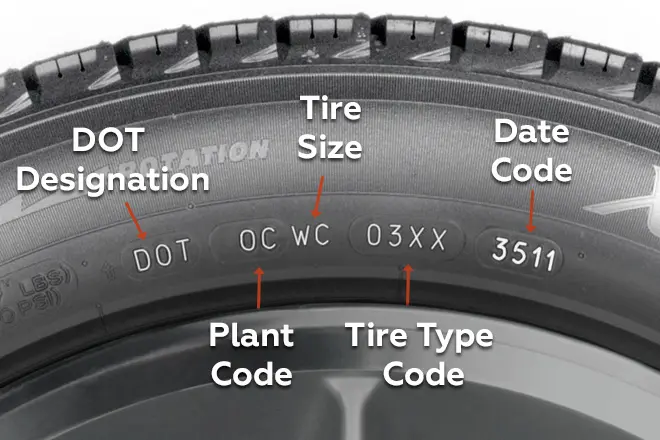
Read the four-digit production-date code on each tyre.
- For example, 2424 means week 24 of 2024, not an expiry date.
- The complete date marking may be visible on only one side.
- Check every tyre because replacement dates can differ.

- Measure tread across the width. Record the inner, centre and outer areas in several positions around each tyre. An outer shoulder can look acceptable while the inner edge is heavily worn.
- Check damage and air loss. A bulge, exposed cords, a significant cut or rapid pressure loss calls for stopping safely and arranging assistance. Cracking or persistent vibration needs professional assessment.
- Assess wet-road capability. A tyre can lose useful wet performance before it looks bald. Ask for actual tread readings and a replacement recommendation based on condition and the applicable requirements.
- Check age alongside storage and use. Heat, parking conditions, pressure and impacts affect the assessment. A recent manufacture date cannot rule out damage, and deep tread cannot cancel the local age limit.
Do not treat 3 mm as a universal Porsche legal or pass/fail threshold. Keep the vehicle and tyre-maker guidance, measured condition and current Dubai inspection requirements distinct. Do not wait for an age limit if there are signs of unsafe damage.
Set pressure from the vehicle instructions
Use the pressure specified for the fitted tyre size and vehicle load.
- Check pressures when cold as directed by the manual, and check again before a long journey.
- The maximum pressure printed on the tyre sidewall is not the vehicle's everyday target.
- Do not bleed pressure from a hot tyre simply to reach a cold-pressure figure.
After a tyre change, check the TPMS settings or relearn procedure required for the car.
A warning that returns needs investigation for leakage, sensor issues or an incorrect setting. Repeatedly resetting it does not fix the cause.

N marking and XL do not mean run-flat
N approval, extra-load construction and run-flat capability are different characteristics.
Do not assume a Porsche has run-flat tyres because it has TPMS or no spare wheel. Confirm the actual tyre technology and vehicle approval before changing construction.
After pressure loss, follow the vehicle manual and the instructions for the fitted tyre.
- There is no universal distance or speed allowance that makes an ordinary deflated tyre safe to drive.
- A sealant kit or compact spare has its own compatibility and operating limits.
- Puncture repair suitability also depends on the tyre, damage and applicable vehicle and tyre-maker guidance.
Build a shortlist that a supplier can actually quote
Complete the vehicle details first, then compare only products confirmed for that application. Keep a copy of the approval reference and its date. A missing approval or unavailable matching rear tyre means the option is not ready to order.
| Record | What to enter |
|---|---|
| Vehicle | Model year, generation, variant, powertrain and installed wheel package |
| Front and rear specification | Both sizes, load and speed designations, construction and permitted axle pairing |
| Candidate product | Exact manufacturer, product version, N specification and supplier reference |
| Approval evidence | Applicable Porsche document or confirmation for this vehicle and wheel package, with date |
| Reason to choose | Road comfort, wet-road use or track requirement supported by information for the actual variant |
| Supply and total | Matching set availability, manufacture dates, fitted AED total, VAT and exclusions |
For a road-tyre quotation, send the workshop your vehicle and both axle specifications. Confirm supply and fitting scope before booking. If a wheel is damaged, use wheel damage assessment. For pulling or vibration, discuss wheel balancing and alignment checks rather than assuming new tyres will solve the cause.
Compare tyre quotations in Dubai on the same basis
Ask for a written quotation for your confirmed fitment.
A price listed only against “Porsche 911” or “Macan” cannot establish the cost of your particular front and rear set. Wheel diameter, product version and approval specification can change the quotation.
Check the following items before accepting a lower total.
A cheaper quote may cover a different tyre version or fewer services.
- Exact tyres and quantities full product name, both axle sizes, load/speed specification and N marking.
- Confirmed supply availability of the complete compatible set, production-date information and fitting date.
- Fitting and balancing removal, fitting, balancing, valves or TPMS parts and disposal, with inclusions itemised.
- Separate work whether alignment measurement, adjustment or repairs are included or charged separately.
- Final AED total the price per tyre and total, with VAT treatment stated clearly.
- Written cover the tyre warranty, fitting workmanship terms, exclusions and claim process.
Availability and appointment timing need confirmation against the exact specification. If a supplier proposes a substitute, repeat the approval and axle-matching checks before agreeing. Keep the quotation and invoice so the product fitted can be checked against what you ordered.
Questions about Porsche tyre selection
Which tyre brand is best for a Porsche?
Choose from the approved products available in your exact fitment, then compare them for your driving needs. No single brand or product is the best choice across every Porsche model, wheel package and road or track use.
Can I mix N0 and N1 tyres?
Do not assume they are interchangeable. They identify different development specifications. Confirm the approved set for the vehicle and keep the axle pairing and front/rear compatibility required by Porsche.
Can a Taycan use any EV tyre?
No. An EV label does not establish size, load capacity, speed specification or Porsche approval for a particular Taycan. Check the exact vehicle and wheel fitment first.
Do all four tyres need replacing together?
The answer depends on compatibility, wear, damage and the vehicle's requirements. Measure all four and check the approval information before deciding. A single damaged tyre does not automatically establish that a single replacement is suitable.
Can tyres with plenty of tread still fail a Dubai inspection?
Yes. Age and damage are separate from tread depth. RTA's renewal guidance gives a maximum age of five years from manufacture and requires damaged tyres to be changed to pass.
Porsche Repair Dubai is responsible for this guide. Read our workshop information and editorial standards or report a correction with the page URL and the statement concerned.
Sources checked 26 October 2026
Manufacturer references and RTA guidance are linked beside the relevant explanations. Porsche Repair Dubai is an independent workshop. Vehicle-specific approval and a physical tyre inspection determine the final recommendation.