Skip to content

Buying guide, cosmetic and functional parts

Choosing Porsche carbon fibre parts in Dubai

Choose a carbon part by the job it does, the exact car it fits and the evidence that comes with it. A mirror cover changes how a car looks. A wing, a wheel or a roof panel changes how it behaves, and needs far more proof than a nice weave.

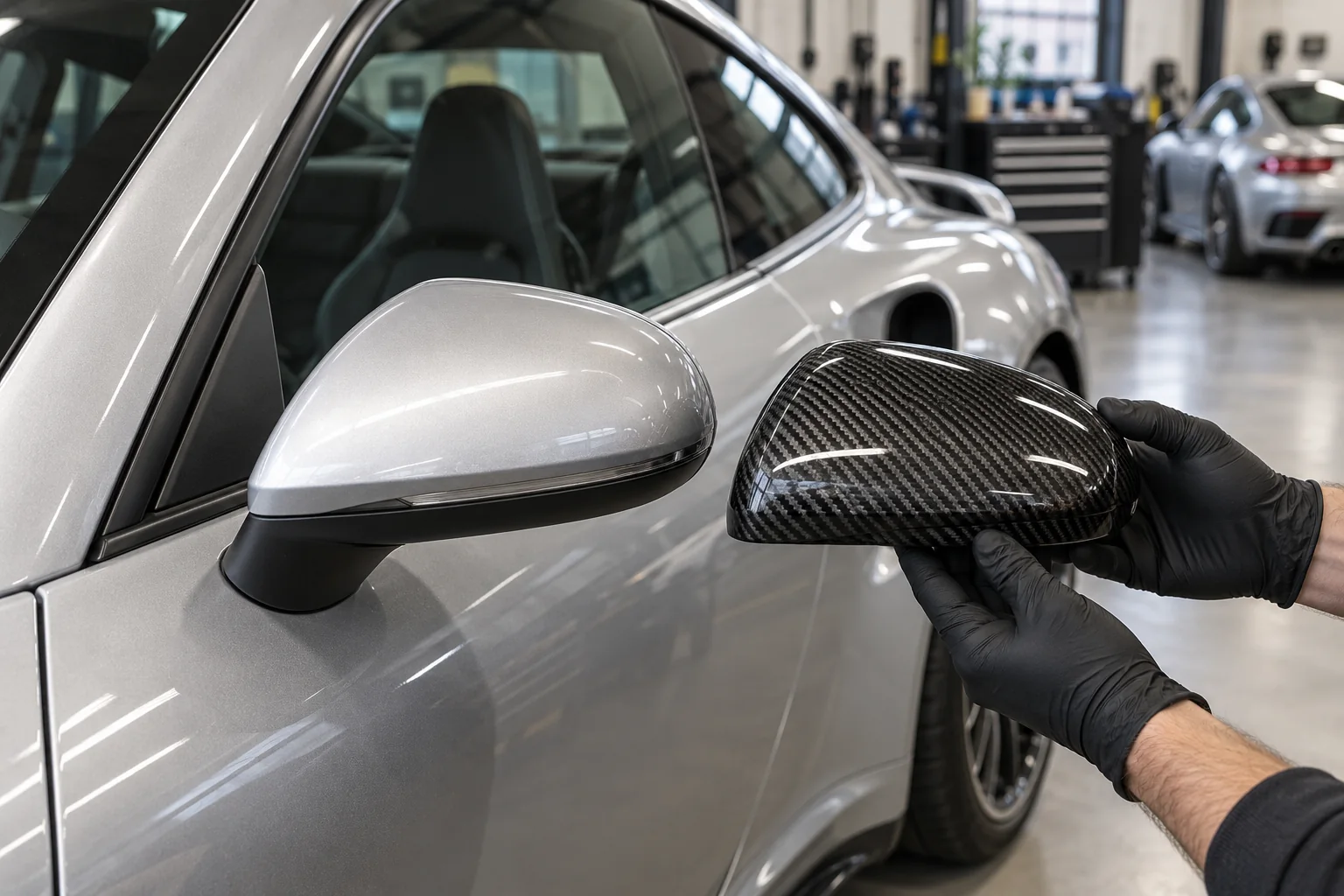
Gloved hands holding a carbon fibre mirror cap beside a silver Porsche mirror
  • Cosmeticlooks, fit and finish
  • Functionalairflow and mass, with test data
  • Structuralloads and safety, specialist only

How do you choose a carbon fibre part for a Porsche?

1

Name the job

Decide whether the part is decorative, aerodynamic or load bearing. The evidence you need rises sharply from the first to the last.

2

Match the exact car

Confirm the part number against your VIN, model year, body style and fitted options, not just the model name.

3

Ask for proof

Request fitting instructions, the full contents list and test data for any claim about weight, downforce or strength.

Step one

What kind of carbon part are you buying?

A carbon look film, a carbon faced plastic trim and a carbon fibre reinforced polymer replacement are three different products. Ask what the whole part is made of, not only what the visible face looks like.

Role Typical parts Evidence to request Who should fit it
Overlay Stick on mirror covers, cabin trim covers Material, adhesive, clearances, removal method Careful owner or workshop
Replacement trim Mirror caps, cabin inlays, engine covers Part number, mounting tabs, clips, instructions Workshop with the instructions
Aerodynamic Splitters, wings, diffusers, side blades Vehicle specific kit, mounting points, test data Workshop following the kit maker
Load bearing Wheels, seat shells, roof, bonnet, chassis braces Component engineering, approval, installation procedure Specialist with the exact procedure

Cosmetic describes the purpose, not freedom from safety checks. Even a cabin cover must not block a control, a sensor or an airbag deployment path.

How it is made

Prepreg, forged, wet layup or film, what the words really tell you

Prepreg and autoclave

Carbon fabric arrives already impregnated with resin, then cures under heat and pressure. Autoclave curing is used for high performance parts because small air bubbles reduce strength.

Tells you the likely process. Does not tell you the layup, thickness or what the part was tested for.

Forged carbon

Chopped fibres are pressed into a mould, which gives the marbled look. Because fibre direction cannot be controlled, strength can be limited or variable compared with laid fabric.

Tells you the look and moulding method. Does not tell you it suits a loaded part.

Wet layup over fibreglass

A carbon top layer is laid by hand over a fibreglass or plastic base. It can look identical from the outside at a lower price.

Tells you to ask what sits underneath. Does not tell you it saves weight.

Carbon look film or print

A printed film or water transfer finish over the original part. It changes the appearance only and adds a little material.

Tells you it is a finish. Does not tell you anything about strength.

Factory examples

Where Porsche itself uses carbon fibre

These factory examples show what documented carbon parts look like. Their figures belong to those exact parts and cars, not to every carbon product sold online.

2017

Braided carbon wheels

Offered on the 911 Turbo S Exclusive Series. Porsche states the set is about 8.5 kg lighter than the alloy wheels, a 20 percent saving, and 20 percent stronger.

2022

992 GT3 RS body

Porsche lists the doors, front wings, roof and front lid as CFRP, plus CFRP in the standard full bucket seats.

Weissach

Weissach package

On the GT3 RS it adds CFRP anti roll bars, rear coupling rods and a rear axle shear panel. The CFRP rollover bar saves around 6 kg against steel.

2025

911 Turbo S cabin

Porsche describes carbon decorative panels on the dashboard, doors and centre console as factory equipment.

Porsche also sells carbon parts through Porsche Tequipment and personalised items through Porsche Exclusive Manufaktur. Factory parts still have part numbers tied to specific cars and options.

Sources of parts

Factory, branded aftermarket or unbranded, how they differ

Check Porsche Tequipment or factory Branded aftermarket Unbranded online
Part number Porsche part number tied to models and options Maker part number, quality varies by brand Often only a listing title
Fitment data Model, year and option codes Usually stated, confirm against your VIN Often fits all claims
Instructions Workshop instructions for the part Supplied by better makers Rarely supplied
Test evidence Developed with the car Ask for it, some publish wind tunnel or track data Usually none
Returns Through the dealer network Depends on the seller Often difficult from overseas

None of these sources removes the need to check the exact car. Even a factory part can be wrong if the option codes do not match.

Step two

Why the model name is not enough for fitment

A listing that says fits 911 or fits Cayenne covers many generations, bodies and option combinations. One listing for a 992 carbon mirror kit, for example, splits into three versions depending on whether the car has electrically folding mirrors and which ParkAssist or Surround View option is fitted, using codes such as 6XA, 6XV, KA0, KA2 and KA6.

Fitment check

  1. VINgeneration, model year and market
  2. Option codesmirrors, cameras, sensors, lighting
  3. Body and sidecoupe, Cabriolet, Targa, left or right
  4. Earlier changesbumpers, mirrors or trim already replaced
  5. Contentsclips, brackets and hardware in the box
Two carbon pattern mirror trims showing the outer finish and the underside mounting tabs
The underside tabs decide the fit as much as the visible weave.

Get the confirmed application and the return terms in writing before you order. Ask who pays return shipping if the part does not match, and whether a trial fit affects the return.

Eight questions to ask the seller before you pay

  1. What is the full part number, and which model years, bodies and option codes does it fit?
  2. Is it an overlay, a carbon faced part or carbon through the whole thickness?
  3. What is underneath the top layer, and how was it made?
  4. What is the measured weight of the part and of the original it replaces?
  5. Which clips, brackets and fasteners are in the box?
  6. Are written fitting instructions included, and do they cover aluminium contact points?
  7. What was the part tested for, and can I see the evidence?
  8. What are the return terms if it does not fit my confirmed car?

If a seller cannot answer the first and last questions in writing, it is safer not to order.

Step three

Weight and strength claims, what to accept and what to question

Carbon is always lighter

Ask for the measured mass of the complete part with its hardware, and of the original part it replaces. An overlay sits on top of the original, so it adds weight.

Carbon is many times stronger than steel

A material figure says nothing about a finished part. Strength depends on fibre direction, layup, thickness, resin and how the part is mounted.

This saves time on track

Body panel mass, rotating wheel mass and cabin trim mass affect a car differently. Do not accept a lap time or fuel promise turned straight from a percentage.

Same weave, same quality

The visible pattern cannot show hidden layers, voids or the base material. Ask what the product was tested for.

Gloved hand holding an inspection light beside a carbon fibre front splitter

Aerodynamic parts

Buy splitters and wings as a tested package

A carbon finish does not prove that a splitter or wing creates useful downforce. The Manthey kit for the 992.1 GT3 is a good example of real evidence. Its maker describes coordinated aero, chassis and brake changes tested in the Porsche wind tunnel and on track. One similar looking part fitted on its own does not carry that result.

  • Measure ground clearance against your car park ramps and speed humps.
  • Check cooling openings, cameras, radar sensors and towing access stay clear.
  • Keep active aero parts working as designed.
  • Have a part that has struck the road checked, even if the face still looks fine.

Safety

Zones where a carbon part needs extra care

A

Airbag paths

Dashboard, steering wheel, door and seat trims can sit near airbag deployment areas. A cover must never change how they open.

B

Pedestrian protection

Bonnets and front panels are designed for impact behaviour as well as looks. A replacement must match the original design intent.

C

Sensors and cameras

Mirror, bumper and grille parts can carry cameras, radar or ParkAssist sensors. Openings and angles must match.

D

Wheels and seats

These carry life critical loads. Fit only documented parts for the exact car, by a specialist with the procedure.

Fitting

There is no universal carbon torque table

A fastener setting depends on the joint, the insert, the bracket and the hardware. Bolt size alone cannot tell an installer how to clamp a composite part, and a value from another kit should never be reused.

Adhesive choice, surface preparation and curing time must come from the instructions for that part and that bonding system. A trial fit should find gaps and misaligned holes before anything is bonded, drilled or enlarged.

Composite edges and finishes also mark easily, so trim tools, protective tape and a clean bench matter during fitting. If a part needs cutting or drilling that the instructions do not mention, stop and ask the maker, because that can void the product warranty and weaken the part around the hole.

Watch the aluminium joints

Carbon fibre in direct contact with aluminium or mild steel can cause galvanic corrosion, but not with stainless steel or titanium. Many Porsche brackets and body parts are aluminium, so ask how the kit maker isolates the contact, for example with an insulating layer or sealant.

  • Supplied fasteners and their material
  • Isolation washers or layers
  • Sealant or adhesive named in the instructions
  • Any recheck the maker specifies

Dubai sun and heat on carbon parts

Carbon composites last well when protected from the sun, which is why parts carry a UV resistant clear coat or paint. In Dubai, cars parked outside face strong UV for most of the year, so the quality of that clear coat matters as much as the carbon.

  • Yellowing or haze means the clear coat is ageing.
  • Fine cracks or lifting need a check before they let moisture in.
  • Film or ceramic coating on top needs a compatibility check with the maker.

Heat matters too. Dark carbon panels and cabin trims behind the windscreen can get very hot in summer, so ask the maker for the temperature limits of the resin, the clear coat and any adhesive tape used to hold an overlay. A cover held only by tape can lift once that tape softens. Washing with the right products also helps, and our guide on washing a Porsche safely covers film and coated finishes.

Carbon mirror caps with aged and glossy clear coat finishes

Paperwork

Approval, insurance and warranty in the UAE

Approval

The UAE federal traffic law announcement states that substantial changes to vehicle shape, chassis, body, engine power or colour need approval from the licensing authority. RTA vehicle inspection guidance covers substantial body changes and referral to its technical committee.

Insurance

Tell your insurer about the change before the work. Keep the invoice and part number so a claim can be assessed against what is actually fitted.

Warranty

A modification does not automatically void the whole car warranty, but the affected parts may not be covered. Ask for the position in writing for your car.

A foreign certificate or a seller calling a part road legal does not approve it for a Dubai registered car. Ask RTA how your exact proposal is handled.

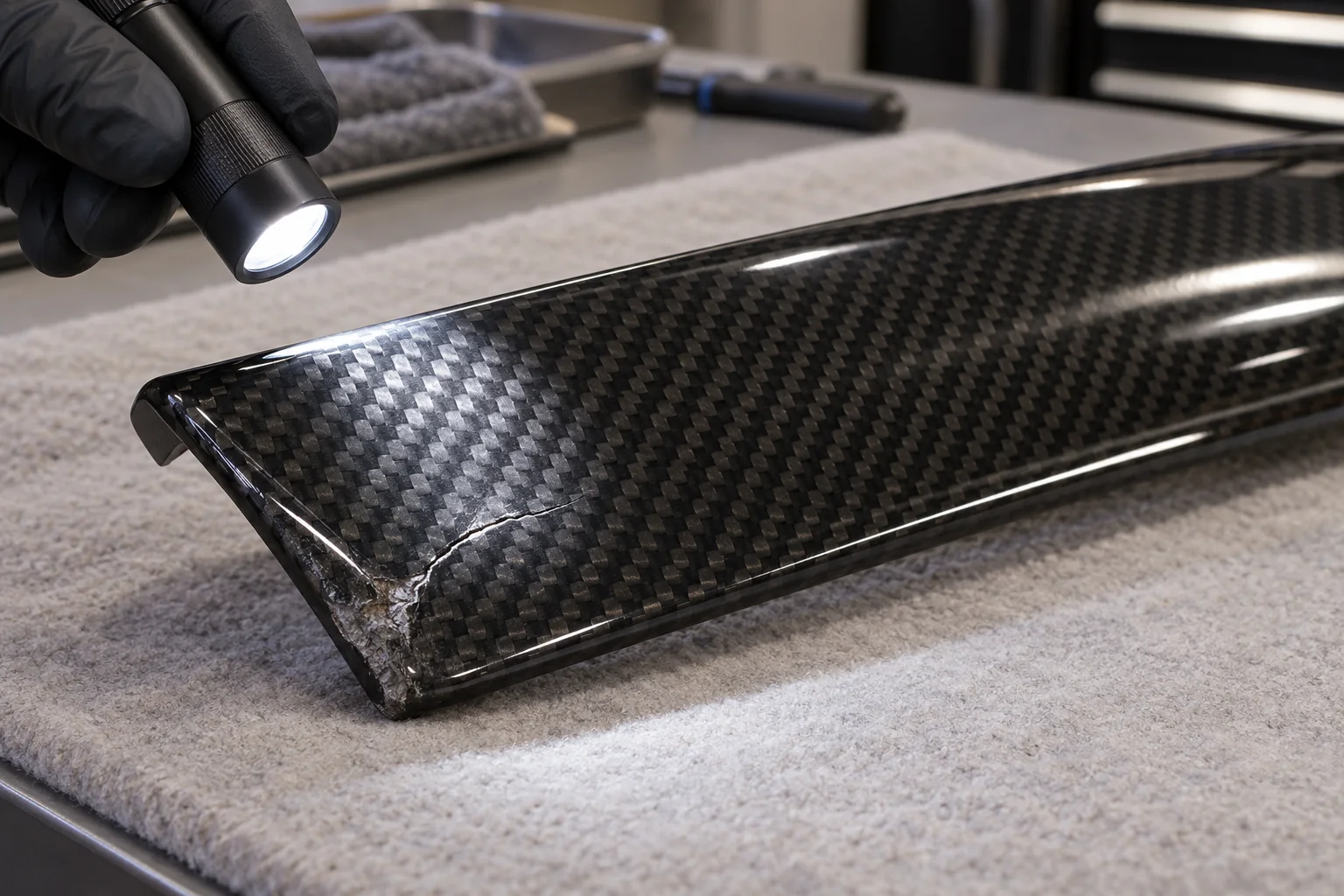
Inspection light showing a crack and scuffed edge on a detached carbon fibre trim panel

Used parts and damage

Can damaged carbon fibre be repaired?

Epoxy carbon composites are stiff but brittle. They tend to crack rather than bend, and impact damage between layers, called delamination, can sit under a surface that still looks glossy.

Usually a finish job

Light scratches or clear coat wear on decorative trim, with sound mounts and no cracks.

Needs a specialist decision

Cracks, loose mounts, soft spots, lifting layers or any damage on wheels, seats or loaded panels.

For a used part, ask for its history and clear photos of both faces, the edges and every mounting point. Never sand, drill or hide a suspect area to make it fit.

What a fair carbon parts quote should include

Part and part numberShipping and import dutyMatching clips and bracketsPreparation and fittingPaint or clear coat workSensor or camera checksApproval stepsVATCost to return to standard

Price

Fitting is quoted after we see the part, its contents and its instructions, because the work changes from a ten minute mirror cap to a full panel swap.

Defects

Agree in advance how poor fit, finish faults, missing hardware and transit damage are handled, and who pays for removal and refitting.

Records

Keep the invoice, part number, instructions, approval papers and the original parts. They help with insurance, resale and any return to standard.

Carbon trim with fitting instructions and mounting clips

Carbon fibre parts questions

Short answers for owners comparing carbon parts for a 911, Cayenne, Macan, Panamera, Taycan, Boxster or Cayman.

Is a carbon look cover the same as a carbon part?

No. A cover is a finish over the original part. A replacement part is made of composite through its thickness. Ask what remains underneath and how the piece attaches.

Will a carbon mirror cap improve handling?

Not in any way you would notice. Choose cosmetic trim for its looks and fit, not for a performance claim.

Is forged carbon stronger than woven carbon?

Not by default. Forged carbon uses chopped fibres with no controlled direction, so its strength can be variable. It is popular for looks. Loaded parts need test data either way.

Can I order a carbon part by model name only?

No. Confirm the VIN, model year, body and option codes against the full part number, and get written confirmation and return terms first.

Are factory Porsche carbon parts better than aftermarket?

Factory parts come with part numbers, fitment data and instructions for specific cars. Good aftermarket parts can offer the same, so judge each part on its documents.

Do carbon parts need approval in Dubai?

Substantial changes to shape or body need licensing authority approval under UAE traffic law. Cosmetic covers are usually minor, but ask RTA about anything that changes the body.

Why does carbon trim turn yellow?

The clear coat ages under UV. Strong sun in Dubai speeds this up, so a good UV resistant clear coat and shade help.

Can a cracked carbon wheel be repaired?

Treat any crack in a wheel as a replacement until the maker says otherwise. Wheels carry life critical loads.

Does a workshop need special tools to fit carbon parts?

It needs the part instructions, the correct hardware, care with aluminium joints and trim tools that will not mark the finish. Structural parts need the specialist procedure.

Should I keep the original parts?

Yes. The original mirror caps, trims or panels let you return the car to standard for sale, warranty work or an inspection, and they are often expensive to buy again.
Check the part before you pay for it

  • Fitment checked against your VIN and option codes
  • Instructions and hardware reviewed before ordering
  • Safety zones, sensors and aluminium joints considered
  • A written quote before any work starts

Send us

Your model and year, the part number, a link or photos of the part and its fitting instructions.

Porsche Repair Dubai is an independent workshop in Al Quoz. We are not affiliated with, authorised by or connected to Porsche AG. We do not stock or sell carbon parts unless agreed in writing.

Call WhatsApp
Scroll to Top