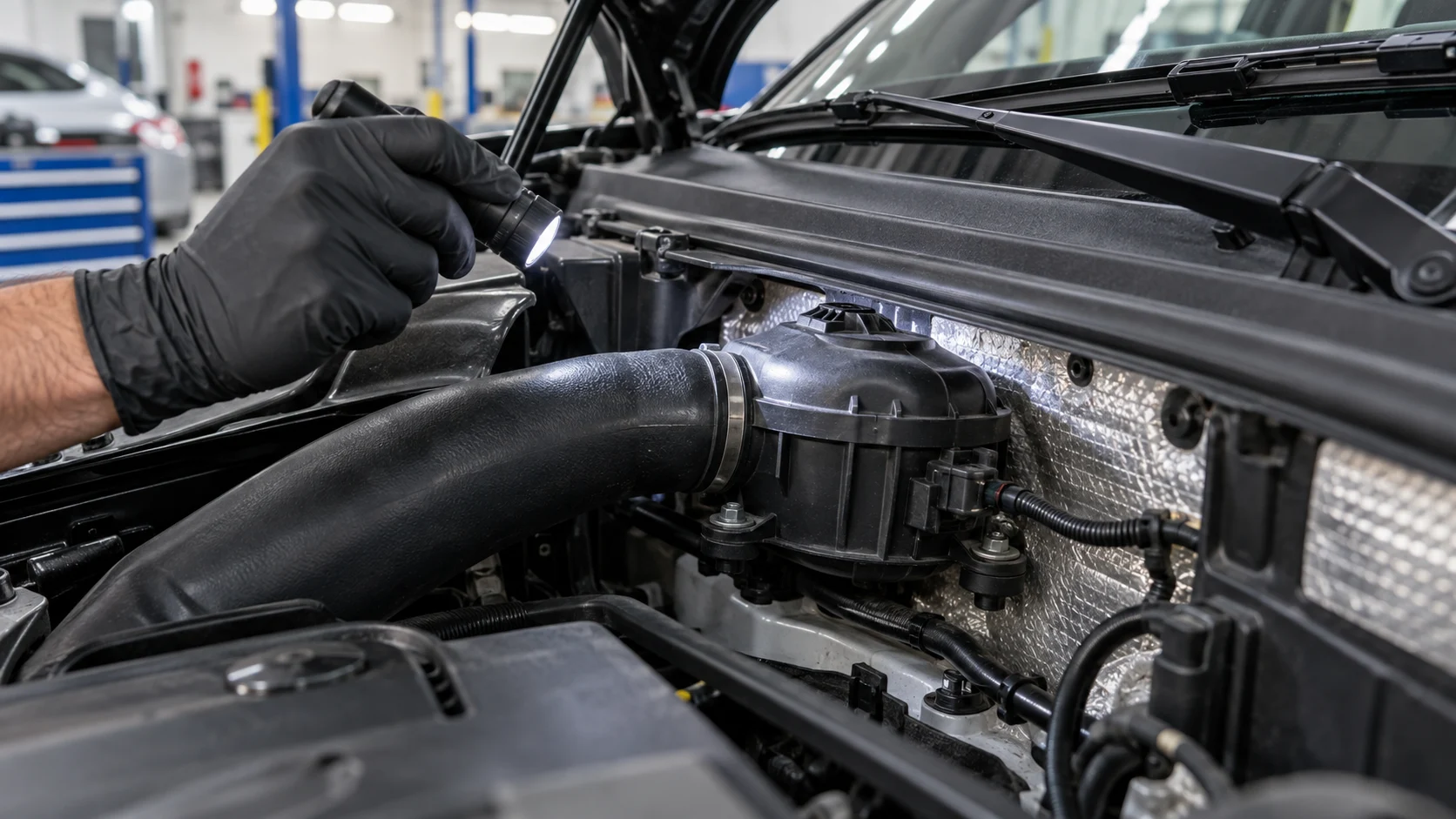
Sound symposer
Intake side
Works with real induction sound from the intake tract. On some models a valve switches it, often linked to the Sport button. Faults usually involve the membrane, the duct, a vacuum line or the switching valve.
Engine sound guide
The sound symposer carries real intake sound from the engine towards the cabin through a membrane. It is not a speaker and it is not the sports exhaust. Here is how it works, which cars have it, and how to tell a normal mode change from a fault.
By Porsche Repair Dubai. Last reviewed 30 October 2026.
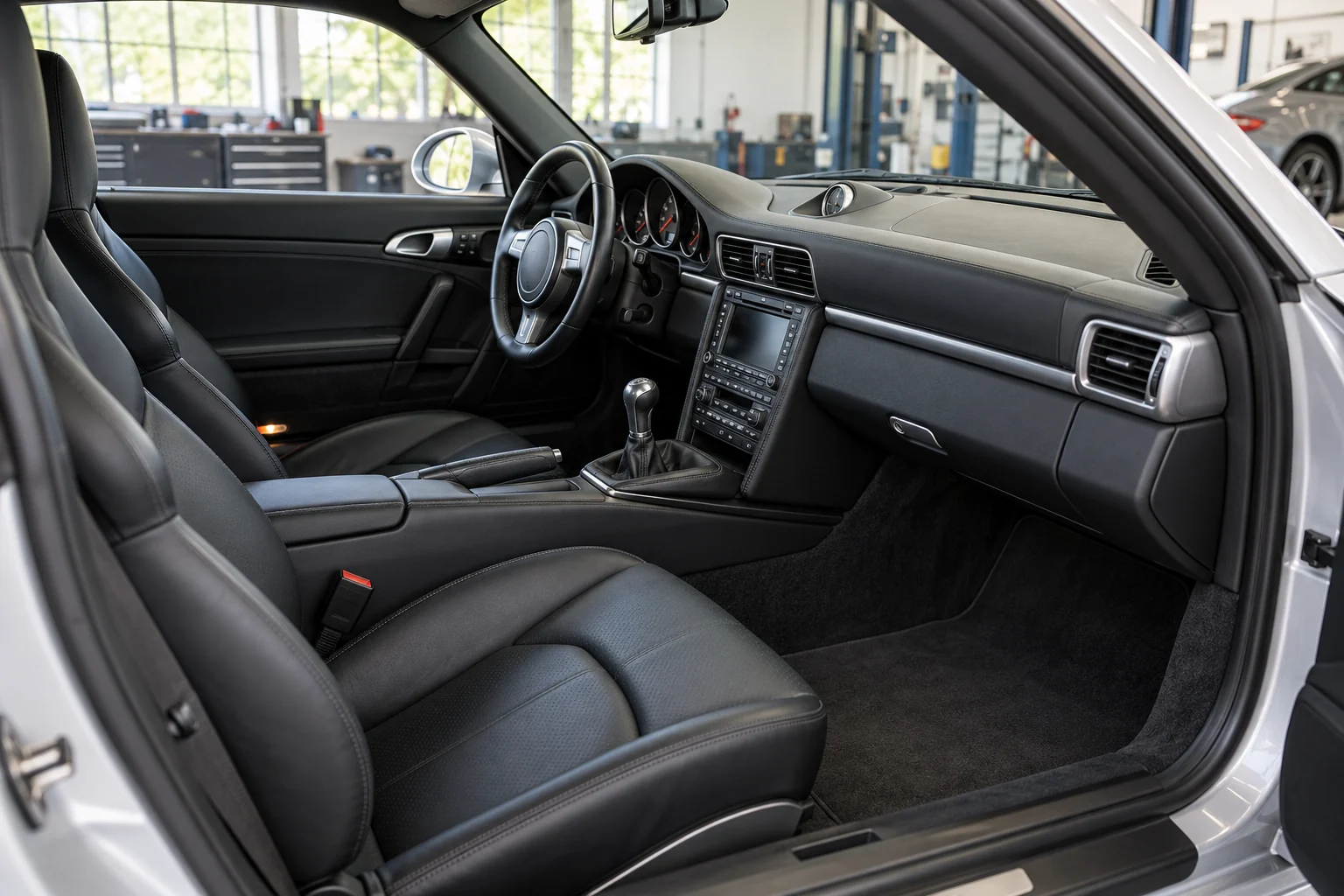
Intake, exhaust or speakers?
Short answer
It picks up pressure pulses in the intake tract between the air filter and the throttle valve and passes them through a thin membrane towards the cabin. Occupants hear more of the real engine induction sound, especially under load. It adds no power, it does not change how the engine runs, and it is separate from the exhaust flaps and from any electronic sound played through speakers.
How it works
Porsche described the principle when it launched the Panamera GTS in 2011. An acoustic channel picks up intake vibrations between the air filter and the throttle valve, and a membrane passes that sound on towards the cabin through the A pillar area. The membrane is a barrier. Sound crosses it, air does not.
Clean air enters the intake. Pressure pulses travel back from the engine as the valves open and close.
The tap point sits between the filter and the throttle valve, where induction sound is strong.
A thin diaphragm vibrates with those pulses while keeping the intake sealed from the cabin.
The sound arrives near the windscreen base or A pillar, so occupants hear more of the engine.
Location, routing and controls differ by model and year. A diagram from one car is not a fitting instruction for another, so the actual layout must be checked on the vehicle in front of the technician.
Why it exists
Modern sports cars are built with thick glass, sealed doors, insulation and engine covers that keep road and wind noise down on a long drive. The same measures also hide much of the engine sound that drivers expect from a Porsche. The symposer gives some of that induction character back without making the whole car louder outside.
Because it carries sound and not air, the symposer has no effect on intake air volume, fuel delivery or emissions. Removing it, blocking it or replacing it with a different part does not make the engine stronger. Any seller claim that a symposer change adds power should be treated with caution.
On cars where a valve can open or close the sound path, the driver gets a quieter setting for long journeys and a fuller sound in sportier modes. How that valve is controlled, and whether it is linked to the Sport button, depends on the model and year, so the owner manual for your car is the reference.
Three different systems
These three features can all change what you hear, but each has its own sound source, its own hardware and its own faults. Knowing which one your car has avoids paying for the wrong inspection.
Intake side
Works with real induction sound from the intake tract. On some models a valve switches it, often linked to the Sport button. Faults usually involve the membrane, the duct, a vacuum line or the switching valve.
Exhaust side
Flaps and alternative silencer passages change the actual exhaust note. The flaps are moved by actuators, but the sound is still physical exhaust sound. Faults involve the flaps, actuators, vacuum or electrical control, and the silencer.
Electronic
An electronic sound feature on cars such as the Taycan, tuned to the driving state and heard inside and outside. It is separate from the pedestrian warning sound that electric cars must make at low speed.


Words you will hear
Fitment
The examples below come from dated Porsche documents. They show where the hardware is documented. They are not a complete list, and a used car may have been changed since it left the factory.
2011
Intake sound carried through an acoustic channel and membrane, described at launch.
Porsche Cars North America launch release
2012 to 2013
A sound symposer change over valve appears in Porsche technical information WC43.
Porsche technical information WC43
2014
Sound symposer vacuum lines are the subject of workshop campaign WE11.
Porsche campaign WE11
2015
An optional sports exhaust combined with a switchable sound symposer at the January 2015 announcement.
Porsche Newsroom, Detroit 2015
2019
No symposer. Porsche Electric Sport Sound is the electronic sound option on these cars.
Porsche Newsroom, Taycan sound
Check your own car
Owners often assume a symposer from a tailpipe design, a button or an advert. None of these proves it. Five checks give a reliable answer.
Normal or not
There is no single engine speed or loudness level that proves a symposer is healthy. What matters is whether your car behaves as its own manual describes and as it did before.
Symptom map
Windscreen base or A pillar
Possible loose symposer mounting, a split duct or a tired membrane. Trim rattles can sound similar.
Engine bay at idle
Often an intake or vacuum leak. The symposer line is one candidate among several hoses, so the leak must be traced.
Rear of the car
Points towards the exhaust, its flaps or a silencer, not the intake side.
Everywhere, after pressing Sport
Could be a switching valve, a vacuum line, a control fault or simply a car that never had the feature.
Cabin, electric model
Electronic sound settings, software or speaker faults, which need a different check from an intake system.
Any location
Treat the warning first. A sound change does not explain away a fault message.
Campaign file WE11
Porsche campaign WE11 covered certain 2014 911 Turbo and Turbo S cars of the 991 generation. A sound symposer vacuum line could slip off. Porsche stated that this could affect other vacuum controlled engine actuators and could bring up a cooling system fault message.
This is a specific, dated fault on specific cars. It is not a diagnosis for every cooling warning or every quiet cabin. Campaign eligibility and whether the work was already done must be checked by VIN with an authorised Porsche Centre.
Follow any stop instruction on the dashboard. Exhaust fumes in the cabin, smoke, severe rough running, a sudden loss of power or an overheating warning need prompt attention. Park safely and arrange assistance where continued driving may be unsafe. Never reach around a hot or running engine to look for a noise, and never handle a phone while driving. A passenger can record a sound during an otherwise safe journey.
Diagnosis
Check that the car actually has a symposer, a sports exhaust, an electronic sound feature or a mix.
Recreate the conditions you describe, engine warm, same mode, similar load, and separate cabin sound from outside noise.
Look at the membrane housing, the duct, clips, vacuum lines and the switching valve where fitted, using the correct workshop information.
Stored faults and supported actuator tests help, but a code alone does not prove a valve is faulty.
The recommendation should match what the tests showed. A line refit, a hose, a valve and a full assembly are separate items.
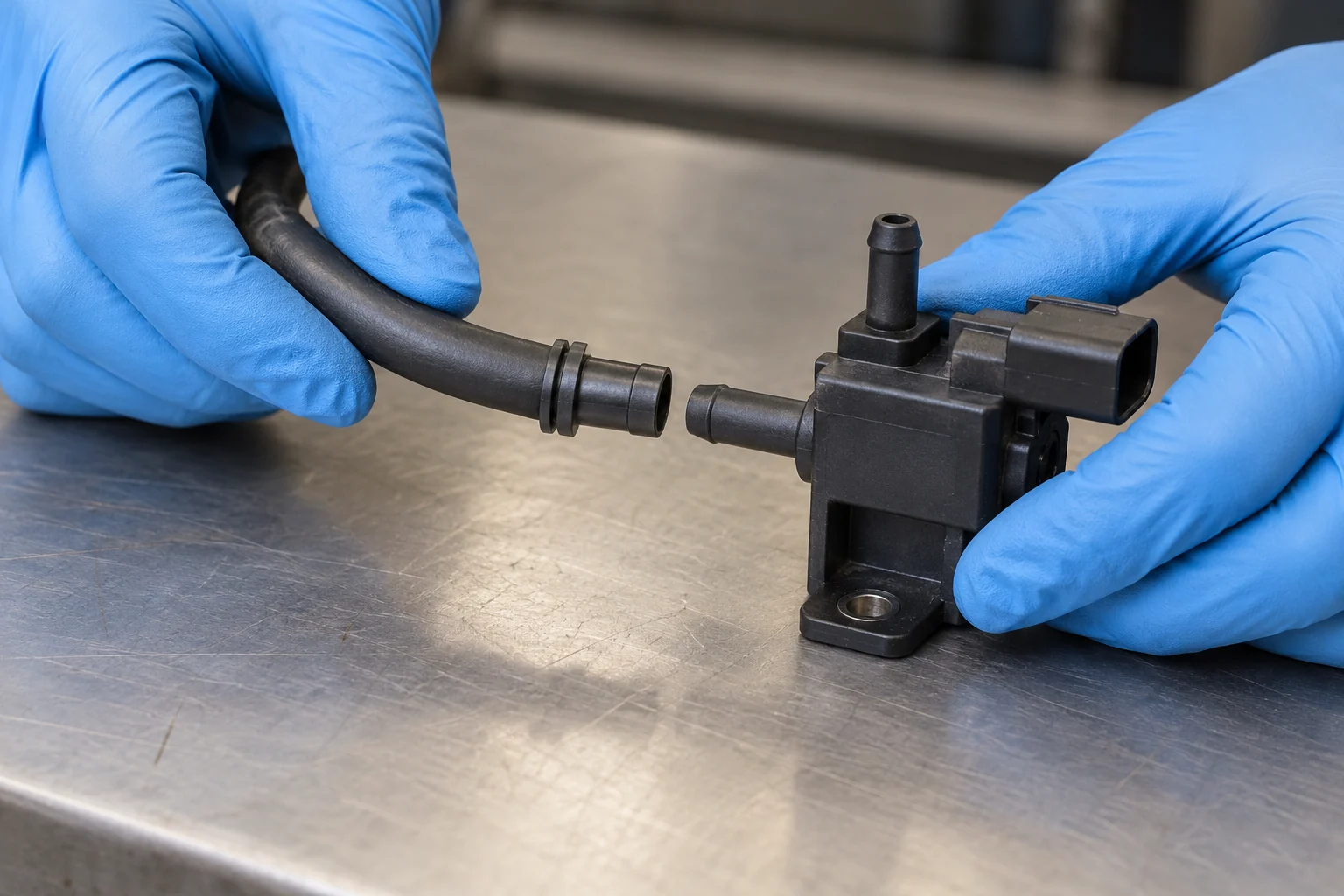
Before you approve work
1
Which sound features the car has, confirmed from the equipment record and the hardware.
2
Engine temperature, mode, load and where the noise was heard during the test.
3
The part, connection or leak found, with a photo where access allows.
4
How the finding was confirmed, for example a vacuum check, an actuator test or a repeat road test.
5
Repair, replacement or leaving it as it is, each with its own price and what it includes.
6
How the result will be checked after the work and what to do if the noise returns.
Rubber hoses, clips and plastic ducts in a hot engine bay age over time, and summer heat plus dust make a regular look at intake parts sensible during servicing. Heat does not mean a symposer needs routine replacement or seasonal calibration. Investigate a new symptom rather than replacing parts on a schedule nobody published.
Cost and scope
Every sound complaint starts with finding the source. A description such as the car sounds quieter cannot support a reliable repair price.
Diagnostic figures include VAT and come from our Porsche diagnostics page.
Questions
No. It carries real intake sound through a membrane. Electronic sound played through speakers is a different feature, used for example on the Taycan.
No. It changes what occupants hear. Engine output is not changed by the sound path.
No. A mechanical intake path does not depend on the Bose or Burmester volume. Use the factory sound controls for your model.
Possible causes include a switching valve, a vacuum line, a control fault or a setting. Have the system confirmed and tested before parts are ordered.
On some cars it can. Porsche campaign WE11 described a 991 Turbo symposer line that could affect other vacuum actuators and bring up a cooling message.
Not by simply unplugging or blanking it. Shared vacuum and fault monitoring must be checked first. Use the factory controls where they exist.
Only with a parts list and a supported method for that exact car. Coding alone does not add the hardware.
No. The Taycan has no combustion intake. Porsche Electric Sport Sound is its optional electronic sound.
Not because it looks the same. The part number must suit your VIN and installed equipment, and the need for the part should be proven first.
It helps describe the noise, but phone microphones and different conditions make recordings poor loudness references. The source still needs an inspection.
There is no published routine interval. Look at intake hoses and clips during servicing and investigate any new noise.
Porsche Repair Dubai is an independent workshop in Al Quoz, Dubai. We are not affiliated with or authorised by Porsche AG. Campaign and recall work is carried out by authorised Porsche Centres.
Send us
Model and year, the mode you were in, where the sound comes from and any warning message.