Skip to content

What a Porsche diagnostic scan can and cannot tell you

A scan reads what the control units have recorded. A diagnosis proves why it happened. This guide explains the difference, what each tool can reach on a Porsche, and the tests that turn a fault code into a repair you can trust.

Engine control unit, DME
Code

P0301

Meaning

Cylinder 1 misfire detected

Status

Stored, intermittent

Freeze frame

Warm engine, light load

Verdict

Evidence, not yet a diagnosis

1

The short answer

A Porsche diagnostic scan shows stored and current fault codes, the conditions when they were set, and live data from each control unit the tool can reach. It does not name the failed part.

2

Diagnosis adds proof

The technician forms possible causes from the scan, then confirms one with measurements such as voltage, pressure, compression or a smoke test.

3

Repair comes last

Parts are replaced only when a test supports them, and the original complaint is checked again afterwards.

Before any scan

Which Porsche warnings mean stop, not scan?

Some faults are about safety first. Getting the codes can wait until the car is somewhere safe and, if needed, recovered on a flatbed.

  • Oil pressure warning

    Stop the engine as soon as it is safe. Running without oil pressure can destroy bearings within moments.

  • Coolant temperature in the red

    Pull over and switch off. Never open a hot expansion tank, and wait for the engine to cool.

  • Flashing engine warning

    A flashing light usually signals a misfire heavy enough to damage the catalytic converters. Reduce load and stop when you can.

  • Brake, steering or stability faults

    Reduced braking or steering assistance changes how the car behaves. Do not test it on the road.

Electric and hybrid models add high voltage warnings. Follow the message on the dashboard and the owner manual, and do not touch orange cables or battery parts.

Reading a fault code

What does a Porsche fault code actually mean?

Every diagnostic trouble code describes what a control unit detected, not what broke. On combustion Porsches sold under OBD2 rules, the engine codes follow the structure set out in SAE J1979 and related standards, so any compliant reader can retrieve them.

Porsche control units also store their own manufacturer codes and text. These cover systems the emissions standard never touches, such as PSM stability control, PASM damping, airbags, the PDK control unit and the infotainment network. A generic reader usually cannot see them.

P0301
  • PSystem group. P is powertrain, B body, C chassis and U network communication.
  • 0Code type. 0 is a standard generic code, 1 is a manufacturer specific code.
  • 3Subsystem. 3 relates to ignition and misfire monitoring.
  • 01Detail. Here it points to cylinder 1.

P0301 tells you where the engine detected a misfire. Coil, plug, injector, air leak and low compression can all set it.

Tool coverage

Generic OBD2 readers versus Porsche specific diagnostics

Owners often ask whether an inexpensive reader gives wrong answers. In most cases it gives correct answers to a narrow question. The real limit is reach. The question is not cheap versus expensive. It is which control units and functions a tool can reach on your exact model year and powertrain. A basic reader can be accurate within its scope and still blind to most of the car.

Capability Generic OBD2 reader Enhanced multibrand tool Porsche diagnostic system, PIWIS
Emissions codes and readiness Yes, on covered combustion models Yes Yes
Manufacturer codes in other units Rarely Many units, depends on model and software Full range for supported vehicles
Live data Selected emissions values Wider set where supported Porsche defined values per unit
Actuator tests No Some Yes, within guided procedures
Guided fault finding No Limited Yes
Coding, adaptation, programming No Selected functions Yes, with online access where required

Porsche publishes how independent workshops can access its workshop information and diagnostic software through its technical information portal and the PIWIS programme for independent repairers. Access, subscriptions and functions differ by market, and none of these tools replaces interpretation.

Gateway

Diagnostic port

DMEEngine
PDKGearbox
PSMStability
PASMDamping
AirbagRestraints
PCMInfotainment

Networks and modules

Why a full scan reads every control unit, not just the engine

Modern Porsches link dozens of control units over CAN bus, with older infotainment systems on a MOST fibre optic ring. The gateway passes diagnostic requests from the port to each network.

Each unit watches its own sensors and keeps its own fault memory, so a full scan is really a conversation with every unit in turn. That matters because one fault can echo across several units. A weak battery or a damaged connector can set communication codes in the PDK, PSM and PCM at the same time. Reading only the engine would hide the pattern.

  • A unit that answers with no faults is a result.
  • A unit that does not answer is a separate finding that needs its own check.
  • A unit the tool cannot reach is a coverage gap, not a clean bill of health.

From record to proof

The evidence ladder, and what each step proves

Each step adds certainty. A good diagnostic report tells you which step a conclusion rests on.

  1. 1

    Fault code and status

    Shows what was detected and whether it is current, stored or intermittent.

    Does not show which part failed.

  2. 2

    Freeze frame

    Shows selected conditions at the moment the fault was set, such as engine temperature, speed and load.

    Does not show a continuous history of the drive.

  3. 3

    Live data

    Shows what sensors and control units report right now.

    Does not show whether a reading is plausible without units, conditions and a reference.

  4. 4

    Actuator and guided tests

    Shows how a component responds to a defined command.

    Does not show why a missing response happened.

  5. 5

    Physical measurement

    Shows the condition of a specific circuit, seal or mechanical part.

    Does not show the health of systems that were not tested.

  6. 6

    Verification

    Shows that the original complaint is gone under the same conditions.

    Does not show that an unrelated intermittent fault will never appear.

Live data

How do you read Porsche live data correctly?

Live data is a mix of very different kinds of numbers. Before a value is treated as a measurement, the technician needs to know which kind it is, its unit and the conditions it was read under.

A good habit is to compare a commanded value with the matching actual value. If the throttle is asked to open to a position and reports a different one, that gap is worth investigating, but it still does not say whether the cause is the motor, the wiring or the signal. One online voltage range or camshaft angle should never become a universal Porsche limit. Values depend on engine, temperature and load, so they are compared with the reference for that engine.

Measured

Read from a sensor

Coolant temperature, intake air temperature, battery voltage.

Calculated

Worked out by the unit

Engine load or estimated torque, built from several inputs.

Commanded

What the unit asked for

Target throttle position or requested camshaft angle.

Learned

Stored adaptations

Fuel trims and clutch adaptation values that change over time.

Confirmation tests

The physical tests that turn a code into a diagnosis

The right test depends on the question being asked. These are the common ones and what each answers.

Multimeter

Is there supply, ground and continuity in this circuit, and is the voltage drop acceptable under load?

Oscilloscope

Does a sensor or injector signal have the right shape, or does it drop out intermittently?

Smoke test

Is there an intake, vacuum or evaporative leak that would explain lean running?

Compression test

Is each cylinder building comparable pressure?

Leak down test

Where is pressure escaping, past rings, valves or a head gasket?

Pressure test

Is the cooling or fuel system holding pressure where it should?

Technician measuring a sensor signal with an oscilloscope probe on a Porsche engine wiring connector

A real sequence

How a Porsche diagnosis should run, step by step

This is the order a careful investigation follows. It keeps the work aimed at the cause rather than at a list of parts.

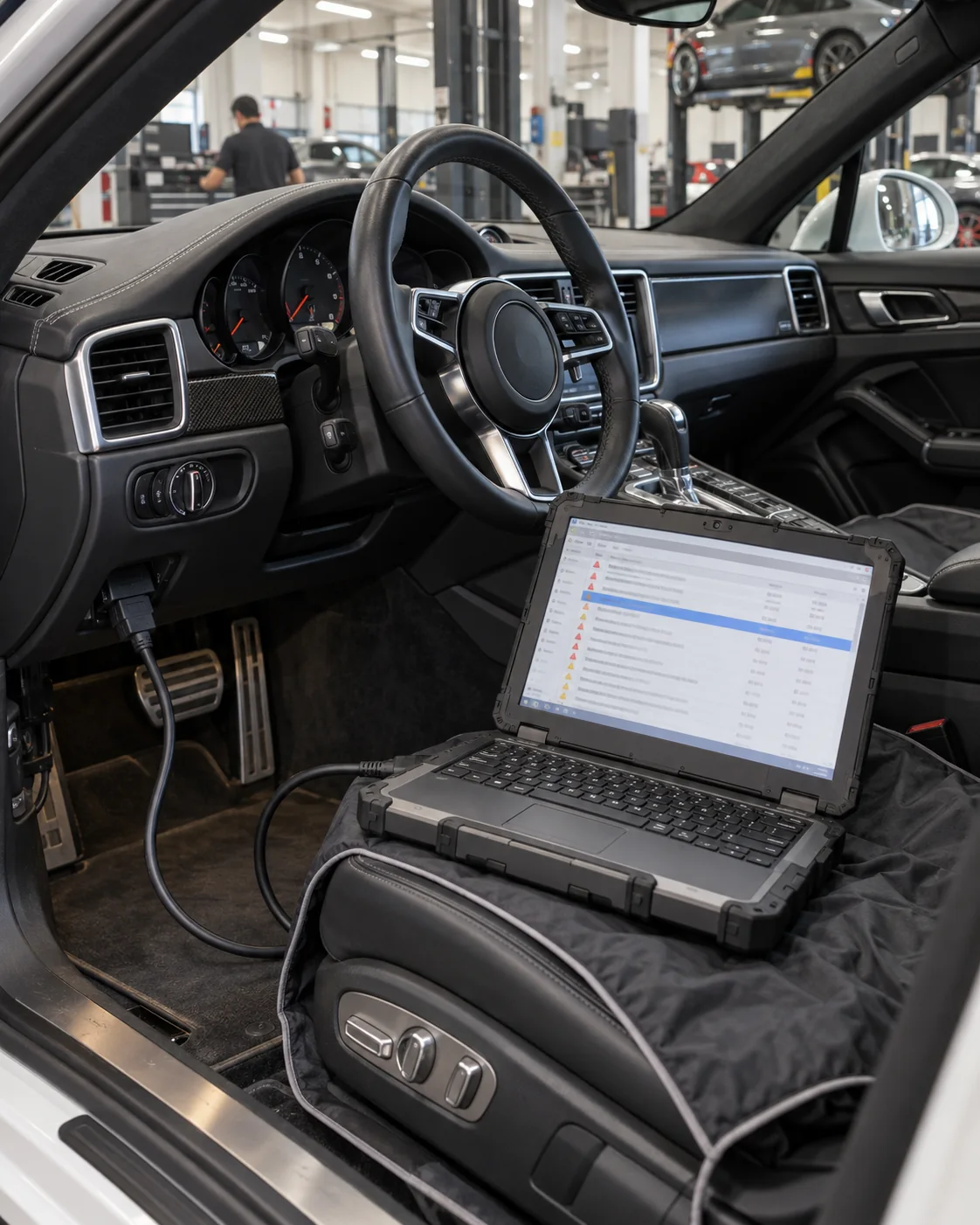
Diagnostic laptop connected to a Porsche under the dashboard with fault memory on screen
  1. Hear the complaint. When it happens, hot or cold, at idle or under load, and what changed recently.
  2. Check it is safe to run. Warnings that say stop, overheating, oil pressure or brake faults come before any test drive.
  3. Scan every reachable unit. Record codes, status and freeze frame, and note units that did not respond.
  4. Save before clearing. Clearing first destroys evidence and can reset readiness monitors.
  5. Form possible causes. List what could set the pattern, then pick the test that separates them.
  6. Confirm with a measurement. Electrical, pressure or mechanical tests decide between the options.
  7. Repair what the evidence supports. With your approval before any extra work or parts.
  8. Verify under the same conditions. Rescan and recheck the original complaint.

Explanatory examples

Two examples of why the code is only the starting point

These are illustrative cases to show the reasoning, not records of customer jobs.

Example A

Cylinder misfire on a flat six

The scan shows P0301 with a warm engine at light load. Swapping the cylinder 1 coil with cylinder 2 and rereading shows whether the misfire moves. If it stays, plug condition, injector response and compression are checked next. Replacing all six coils because an app suggested it is not a diagnosis.

Example B

Wheel speed warning on a Cayenne

A wheel speed code points to one corner. Live data compares that wheel signal with the others while the car rolls. A multimeter or oscilloscope checks the sensor circuit, and the tone ring and bearing are inspected. The sensor named in the code is replaced only if the tests point to it.

Ignition coils being swapped between two cylinders on a Porsche flat six during a misfire test

Common misunderstandings

Does a clean scan mean nothing is wrong?

No codes means the car is healthy.

No codes means no faults were stored in the units checked. Mechanical wear, leaks and intermittent faults outside monitoring conditions can still be present.

The scan will improve performance.

Reading data changes nothing. Performance returns only when a confirmed fault is repaired.

Clearing the light fixed it.

Clearing removes the record, not the cause. Readiness monitors also reset, which matters for emissions testing on cars that use them.

The code names the part to buy.

The code names what was detected. Wiring, supply, connectors and other parts can set the same code.

Changing the car

Coding, adaptation and programming are not part of a scan

These functions change how the car behaves, so they belong in a repair procedure with a reason, not in a routine check.

Coding

Tells a control unit which equipment the car has, for example after a replacement unit is fitted.

Adaptation

Resets or relearns stored values, such as PDK clutch adaptation or throttle learning, after a repair that requires it.

Programming

Loads new software into a unit. It needs the correct software, stable battery support and a recovery plan.

Running a reset because it appears on a menu can erase evidence and change how the car drives without fixing anything.

Technical service bulletins

How Porsche bulletins fit into diagnosis

Porsche issues technical information and service bulletins that describe a known pattern and a guided test route for specific models, engines and build ranges. Copies of many are filed publicly with the US NHTSA.

Some bulletins also show the guided test plan Porsche expects a technician to follow, which is a useful reminder that even the factory treats a code as the start of a test route rather than a verdict. They are useful, but only when they apply. Before acting on one, the VIN, model year, engine and software level are checked against it. A bulletin for one Panamera range does not prove the same cause on a Macan or 911.

  • ApplicabilityCheck VIN, build range and engine first.
  • Bulletin versus recallA bulletin is a repair guide. A recall is a safety campaign handled by the official dealer.
  • WarrantyEligibility for any free repair is confirmed by the dealer, not by an online match.
  • SoftwareA bulletin calling for an update needs the matching software and access.

What you are paying for

A code scan versus a full diagnostic investigation

Code scan

  • Reads codes from reachable units
  • Records status and freeze frame
  • Lists units that did not respond
  • Explains what the codes mean

Diagnostic investigation

  • Everything in a scan
  • Live data reviewed against the complaint
  • Confirmation tests on circuits or mechanical parts
  • Written findings with the likely cause and next step

On our Porsche computer diagnostics page the initial diagnostic assessment is listed at AED 200 to 500 and an extended investigation at AED 450 to 900, both including VAT. Booking and current scope are on that page.

If you own a reader

Buying an OBD reader for your own Porsche

A simple reader is useful for saving the first engine warning before a visit, and for showing a workshop exactly what the car recorded. It is less useful as a repair guide, because the code it shows still needs testing. Check these points before you buy.

  1. Confirms your exact model year and powertrain, not just the brand.
  2. Lists which control units it reaches beyond the engine.
  3. Exports reports with units, time and the vehicle identity.
  4. Separates read only functions from resets and coding.
  5. States what happens when its update subscription ends.
  6. Electric and hybrid models need system coverage that an emissions reader does not provide.
Owner holding a small OBD reader beside the diagnostic port of a Porsche
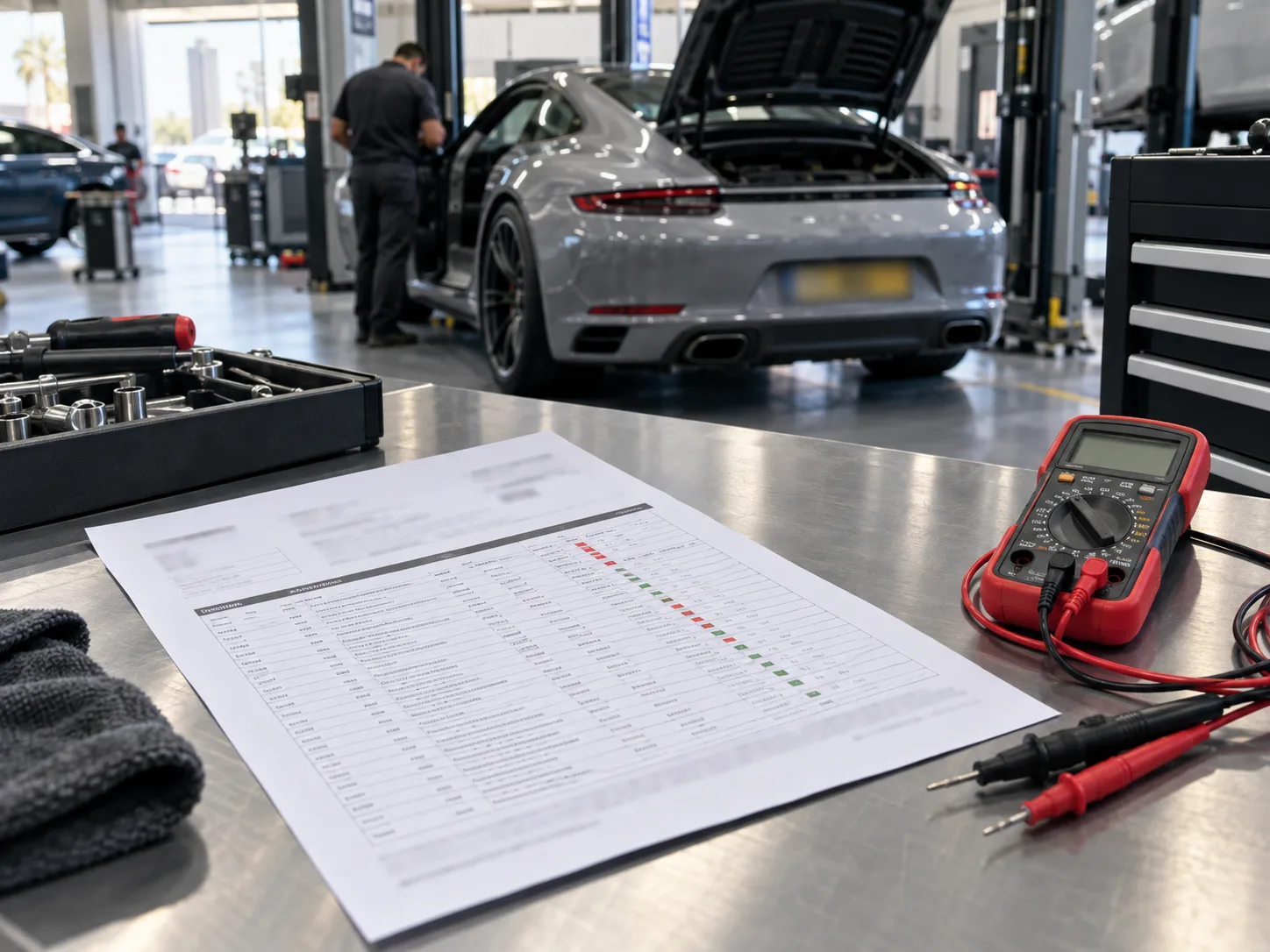
Printed Porsche diagnostic report with fault codes and test readings on a workshop bench
AI-generated example of a diagnostic report layout

Your report

What a good diagnostic report should include

Vehicle
Model, year, engine and mileage.
Complaint
In your words, with when it happens.
Units checked
Including any that did not respond or were not covered.
Findings
Codes, freeze frame and the live data that mattered.
Tests
What was measured and the result.
Next step
Confirmed repair, further testing, or optional work, kept separate.

Questions

Porsche diagnostics questions

Still unsure what your warning means? Send a photo of the dashboard and the model year.

WhatsApp the warning

Does a diagnostic scan find the exact faulty part?

No. It shows what a control unit detected and the conditions at the time. Tests on circuits or mechanical parts are needed to confirm which part has failed.

Can a cheap OBD2 reader read a Porsche?

It can usually read generic engine and emissions codes on combustion models. It normally cannot read the gearbox, stability, damping, airbag or infotainment units, which use Porsche specific codes.

What is PIWIS?

PIWIS is the diagnostic and information system Porsche dealers use. Porsche also offers access routes for independent repairers in some markets, with subscriptions and requirements that vary.

What is freeze frame data?

A snapshot of selected values, such as temperature, speed and load, saved when a fault was set. It helps recreate the conditions but is not a full record of the drive.

Should I clear the codes before bringing the car in?

No. Save a photo or export of the codes and leave them stored. Clearing removes evidence and resets readiness monitors.

Why do several warnings appear at once?

Control units share supply and network wiring. A weak battery, poor ground or damaged connector can trigger faults in several units together, so the common cause is checked first.

Does a clean scan mean the car is fine?

It means no faults were stored in the units checked. Mechanical wear, leaks and intermittent faults still need a physical inspection.

Will a diagnosis improve performance or fuel use?

Only if it leads to repairing a confirmed fault that was affecting the car. Reading data alone changes nothing.

Can you diagnose electric and hybrid Porsches?

We read and explain warnings within the low voltage systems. High voltage battery and traction system work is referred to an authorised Porsche Centre.

How long does a Porsche diagnosis take?

It depends on the fault. A clear stored code may be confirmed quickly, while an intermittent fault can need staged testing. We agree the first stage and the next approval point before starting.
Bring the warning, and get the evidence behind the fix

  • Every reachable unit read and saved
  • Possible causes tested, not guessed
  • Written findings before any repair

Porsche Repair Dubai is an independent workshop in Al Quoz. We are not affiliated with or authorised by Porsche AG.

Send us

Model year, engine, a photo of the warning and when it appears.

Call 056 464 6081WhatsApp the workshop

Call WhatsApp
Scroll to Top