A
All the time on a flat road
Start with tyre pressures, tyre fitment and condition, then four wheel alignment and brake drag.
Owner guide, steering and tyres
A Porsche that drifts left or right usually has a tyre, alignment, brake or steering cause. The quickest way to the right repair is to notice when it happens. A steady drift, a pull only while braking and a crooked steering wheel each point to different checks.
By Porsche Repair Dubai. Last reviewed 30 October 2026.
Pick the description closest to what you feel. Each one leads to a different first check.
A
Start with tyre pressures, tyre fitment and condition, then four wheel alignment and brake drag.
B
Usually a brake fault such as a sticking caliper, contaminated pads or uneven discs. Alignment rarely fixes it.
C
Check what changed. New tyres, a pothole or recent suspension work are the strongest clues.
D
This is a steering centre or alignment setting issue, not a true pull. It still needs a proper alignment.
Keep both hands on the wheel. Do not let go to test the car, and do not touch a wheel or disc to judge heat.
Symptom table
| What you notice | Checks that separate the causes | What it does not prove |
|---|---|---|
| Steady pull on a flat road | Cold tyre pressures, tyre make and type on each axle, tyre condition, tyre forces, four wheel alignment, brake drag | That the steering rack needs replacing |
| Pull mainly when braking | Caliper release, pad and disc condition, contamination, brake hoses, suspension movement under load | That an alignment will fix it |
| Pull started after new tyres | Sizes and positions, N mark and type match, pressures, direction arrows, bead seating, tyre force test | That a balanced wheel cannot be the cause |
| Pull started after a pothole or kerb | Tyre, wheel runout, steering joints, arms, mounting points, then geometry | That an undamaged looking wheel means nothing else moved |
| Steering wheel off centre only | Steering centre position, front and rear toe, thrust angle, steering angle setup | That the car has a true pull |
| Direction changes with the road | Road camber and grooves, tyre type, a controlled road assessment by a technician | That every pull is normal road behaviour |
Road camber and grooves
Most roads slope slightly from the centre towards the edge so water drains away. This slope is called camber, and it can make any car drift gently towards the kerb. Worn lanes and grooves can also steer wide tyres, which is called tramlining.
Road effects change from road to road and lane to lane. A pull that stays the same on different roads, appears suddenly, or started after tyre work or an impact is a car problem, not the road. A technician can account for camber during a road assessment. Do not test it yourself by driving hands off or by moving into another lane to compare.
Tyres first
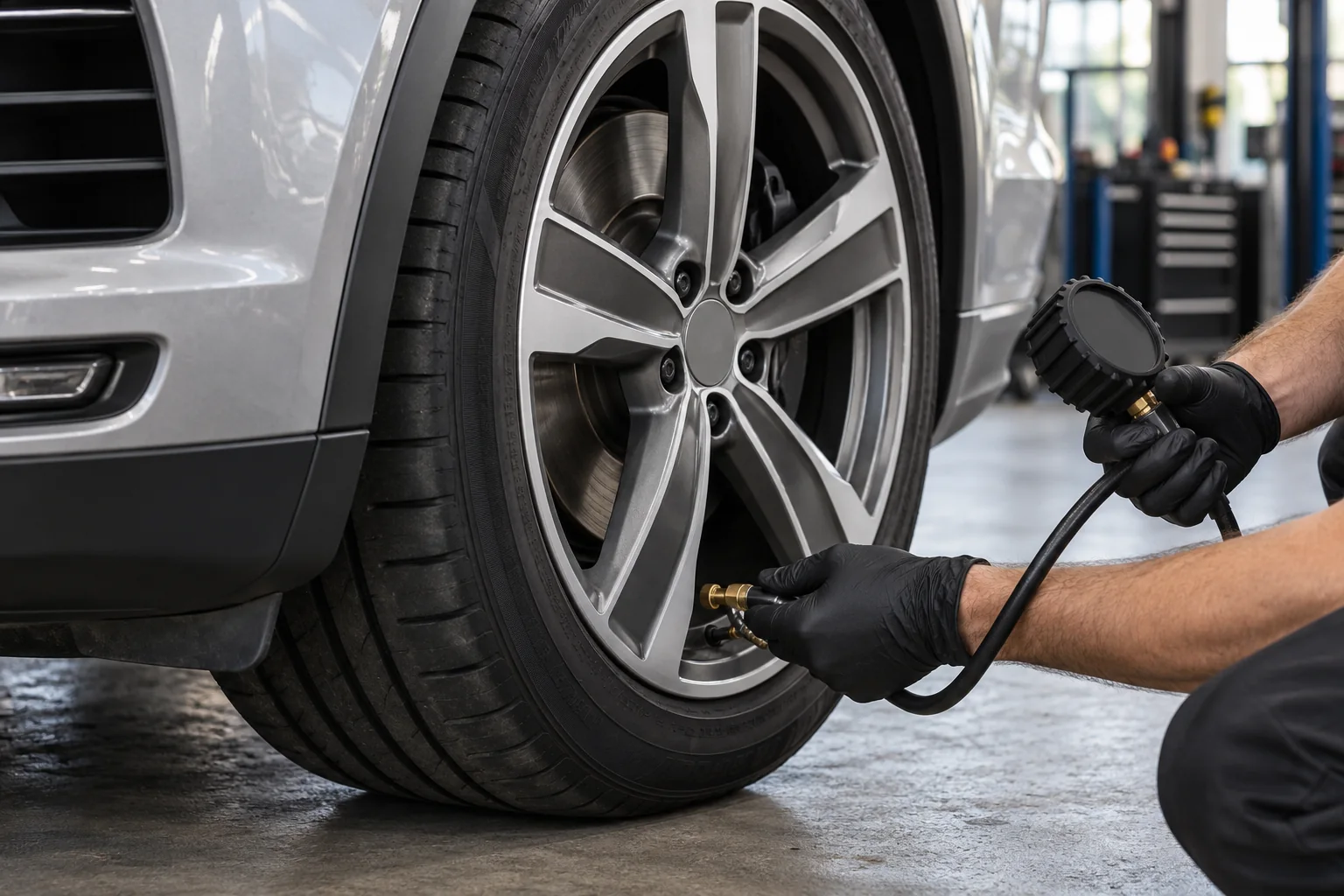
Use the cold pressures on the label for your car, wheel size and load. Front and rear figures are often different on a Porsche. Do not set all four to one number, and do not use the maximum printed on the sidewall.
A low tyre needs a reason. Look for a nail, a damaged valve or a bent rim. A tyre pressure warning that is off does not prove every tyre is right. In Dubai summer, check early in the morning before the car has been driven, because heat raises the reading.
Porsche approves tyres for each model and marks them with an N code on the sidewall, such as N0 or N1. Porsche says only N marked tyres are tested and approved for its cars. Tyre guidance based on Porsche advice says to use the same make, type and N code on an axle, and to replace tyres at least in pairs on one axle.
If one tyre on an axle is replaced alone and the other is well worn, the difference in grip and diameter can cause a pull. Ask for the wear of the remaining tyre before you agree to a single replacement.
Tyre rotation
Many Porsche models, including the 911 and 718, use wider tyres at the rear than at the front. That is called a staggered setup, and front and rear tyres cannot swap. Rotation rules depend on the tyre markings and the sizes on your car, not on a mileage figure.
Asymmetric means the tread differs from inside to outside and must be mounted with the outside marking facing out. Directional means the tread must roll one way, shown by an arrow. Some tyres are both. Our tyre rotation and alignment guide explains this in more detail.
Balance versus tyre pull
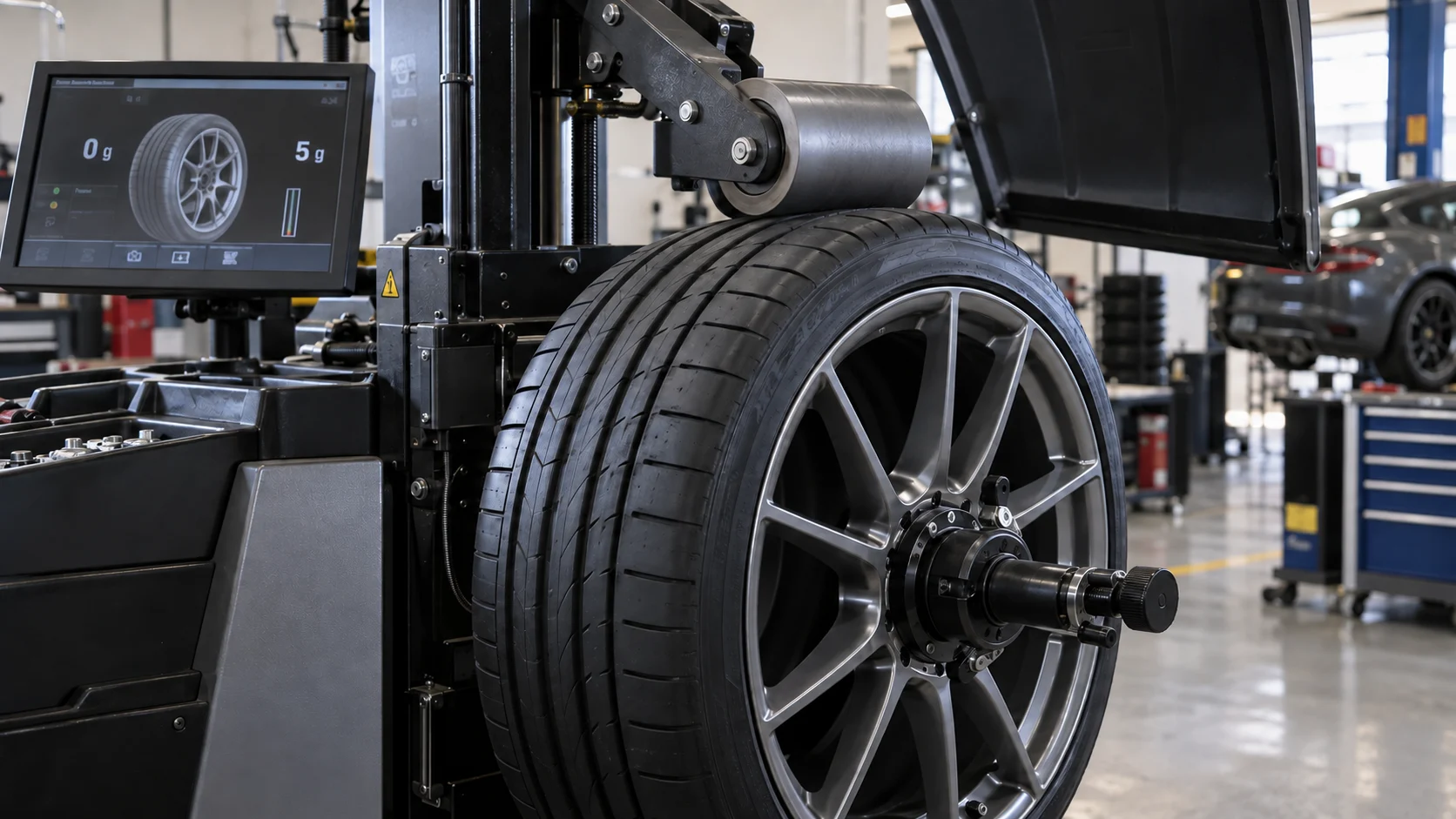
Wheel balancing corrects uneven weight in the wheel and tyre. Imbalance normally causes vibration, not a pull. A tyre can still push the car sideways because of how it was built. This is called conicity, where the tyre rolls as if it were slightly cone shaped.
A road force balancer presses a roller against the tyre to measure how it behaves under load. Some machines also measure the sideways force that causes pull. These results help a technician decide which tyre goes where, as long as the move respects direction, size and Porsche fitment. They do not show inside the tyre or prove a belt has shifted.
Wheel alignment
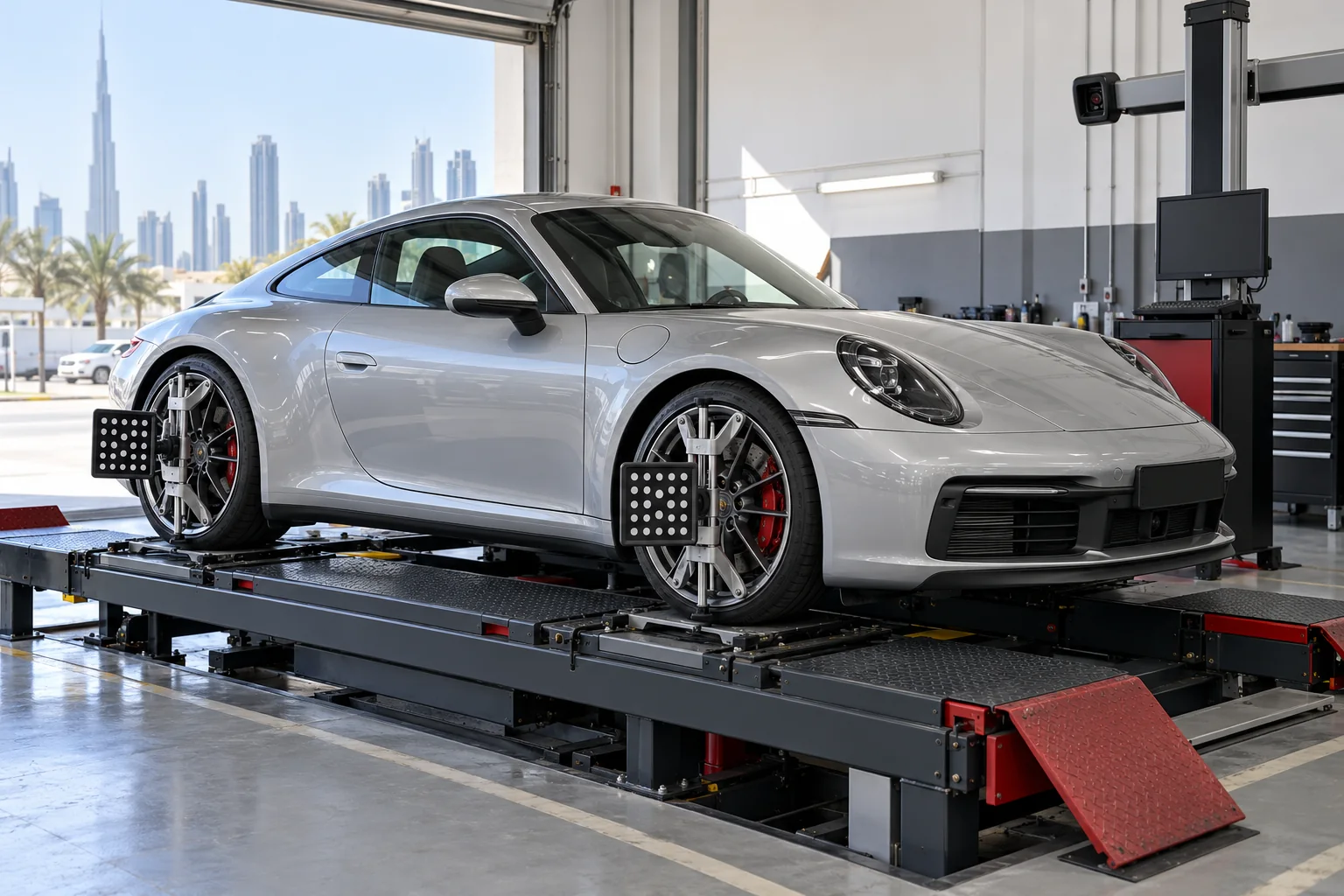
How much the wheel leans in or out at the top. A side to side difference can cause a pull.
The tilt of the steering axis seen from the side. Unequal caster can pull towards one side.
Whether the wheels point slightly in or out from above. It affects tyre wear and steering centre.
The direction the rear wheels push the car. If it is off, the car crabs and the wheel sits crooked.
Ask for the before and after readings against the correct Porsche specification. All green values do not explain a pull that remains. Pressures, load, ride height and worn parts must be right before the car is set up. Porsche models with air suspension or rear axle steering need their own setup conditions, and not every angle can be adjusted on every model.
For alignment and balancing, see our Porsche wheel alignment and balancing page. Michelin advises an alignment check after an impact, unusual wear or a change in handling, rather than on a fixed schedule for every car.
If a joint or bush is worn, the wheel moves under load and the settings will not hold. Repair proven wear first, then align.
See our Porsche suspension repair page for worn component repairs.
Model notes
Rear engined and mid engined cars with wider rear tyres on most versions. Front and rear tyres cannot swap, so uneven wear has to be judged per axle. Rear toe and thrust angle matter because they decide where the car points.
A heavy SUV with all wheel drive and, on many versions, air suspension. Ride height must be set to the specified level before alignment. Mixed tyres can also upset the all wheel drive system, so keep the same make, type and wear on each axle.
Often fitted with different front and rear widths. Air suspension is an option on some versions. A pull after kerb contact should start with a check of the wheel, tyre and front arms, since the car is often used in city parking.
Large, heavy and available with rear axle steering. Cars with rear steering need the correct setup procedure after alignment work. A pull that changes with speed can involve the rear steering as well as the front.
Heavy battery car with instant torque, so tyre wear can be quick and uneven. Use the approved tyre list for the exact wheel size. Strong regenerative braking means a braking pull may need checks of the friction brakes and the brake control system together.
Hot tarmac raises tyre pressures during the day, so check cold. Kerbs in car parks, speed humps and potholes after roadworks are common causes of a sudden pull. Tyres also age in strong sun, so check the date code on older sets even when tread looks fine.
Braking pull
When one side brakes harder than the other, the car pulls towards the stronger side. Common reasons are a caliper that does not release, pads contaminated with oil or brake fluid, the wrong pads, a collapsed brake hose or uneven discs. Worn suspension bushes can also let a wheel move when the brakes bite.
Porsche uses fixed multi piston calipers on most models, with different service steps from the sliding calipers on many other cars. Do not assume a guide pin service applies. The inspection should cover pads, discs, caliper movement and release, hoses and any stored brake faults.
See our Porsche brake repair page, and for ceramic brakes the PCCB and steel brakes guide.
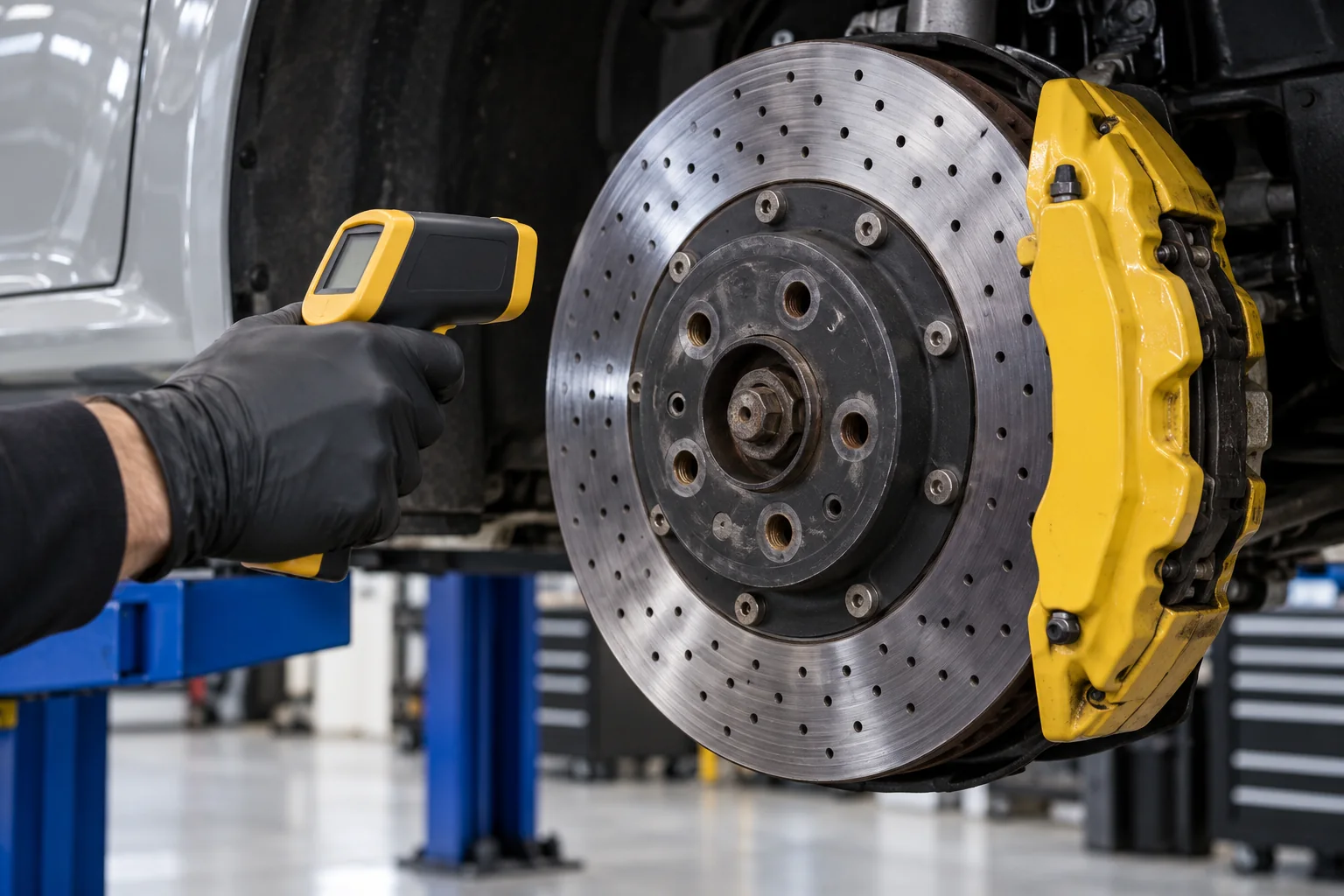
No. Temperature is a clue. There is no single left to right difference that proves a fault. A fair comparison needs the same braking history, timing, measuring spot and disc material. Infrared readings on shiny metal are also affected by emissivity, how well a surface gives off heat radiation, and by reflections. A reading supports the inspection, it does not replace it.
Depending on the model and year, a Porsche can have hydraulic power steering, electric power steering or rear axle steering. Heavy, notchy or loose steering, a knock or a steering warning needs its own assessment. A pull alone does not prove the rack, pump or angle sensor has failed.
Lane Keep Assist and similar systems can add a steering input on equipped cars. If you feel a nudge near lane lines, note when it happens. Our driver assistance guide explains these systems and their limits.
A steering angle or rear steer setup should follow the Porsche procedure when it is required. It will not fix a damaged tyre, a dragging brake or a loose joint.
Diagnosis, measurement, adjustment and parts are separate pieces of work. The symptom alone cannot set the full price. Diagnosis and alignment are quoted after we confirm the model, the wheels and any setup steps.
Before
Model, year, tyre details, direction of pull, braking effect, recent impacts or repairs
On the quote
Diagnosis, measurement, adjustment, parts, labour and calibration listed separately, with VAT shown
For each repair
The measured or shown finding that supports it
At handover
Pressures, fitment checks, before and after alignment readings, brake or steering checks and a road test
Yes. Tyre pressures, tyre forces, mixed tyres, brake drag and worn parts can all keep a pull going after alignment. Ask for the readings and for the other checks before paying for another adjustment.
Not usually. Many Porsche models list different front and rear pressures. Use the label for your wheel size and load.
Only if the tyres and wheels allow it. Directional tyres, staggered sizes and different offsets limit swaps. Leave position tests to the workshop.
There is no single interval for every car. Check after an impact, new tyres, suspension or steering work, uneven tyre wear or a change in how the car drives.
Yes. Mixed makes or N codes on an axle, wrong positions, low pressure or a tyre with high conicity can cause it. A tyre force test can help.
Most often a brake on one side is not working or releasing like the other. It needs a brake inspection, not an alignment.
No. It is a clue only. The caliper must be checked for movement and release before replacing parts.
A gentle drift towards the kerb on a cambered road can be normal. A strong, new or constant pull is not, especially after tyre work or an impact.
No. It is a setup step after the cause is fixed. It does not repair tyres, brakes or worn parts.
A mild, steady drift can be driven carefully to a workshop. A strong or sudden pull, a braking pull with a burning smell or a damaged tyre is not safe. Stop and arrange recovery.

Share your model, year, tyre details, any recent work or impact, and whether it pulls all the time or only when braking. We will suggest the right first check before you book.
If braking or control is affected, arrange recovery rather than driving in. Porsche Repair Dubai is an independent workshop in Al Quoz, not affiliated with, endorsed by or an authorised dealer of Porsche AG.